// blog
Florida Unemployment Amount: What You Will Actually Receive
Title: Florida Unemployment Amount: What You Will Actually Receive
Florida's unemployment amount is calculated as one-twenty-sixth of your highest base-period quarter wages, rounded down, with a statutory floor of $32 and a cap of $275 per week. It isn't a flat payment, so two workers laid off in the same week can receive very different checks.
The popular claim, "just look up Florida's maximum," gives an incomplete answer. The $275 ceiling matters, but it tells you nothing about whether your own benefit will be near that amount, close to the minimum, or reduced because you earned money during the claim week. Florida's system is mechanical: prior wages establish the initial weekly amount, statutory limits constrain it, and partial earnings can reduce it.
Florida's labor market also shows why a fixed mental model is risky. The state's unemployment rate moved from 10.6% in January 1976 into the 3% range in the late 2010s, then reached 13.3% during the early pandemic period before easing to 4.6% in July 2026. The latest figure was only 0.7 percentage points above the prior comparison period's 3.9% rate, according to the Bureau of Labor Statistics labor force data. Conditions can change quickly, but the benefit formula still starts with your own wage record.
Table of Contents
- How the Florida Unemployment Amount Is Actually Calculated
- Why the maximum can mislead
- Working Through the Base-Period Math
- A four-step estimate
- Why pay-stub intuition often fails
- Benefit Duration and Total Value Limits
- Why multiplying the weekly amount isn't enough
- A better way to assess the claim
- How Partial Earnings Change Your Payment
- The offset is triggered by the disregard
- Report the week as it occurred
- Filing Claims and Understanding Processing Timelines
- Build the record before submitting
- Read every determination
- Common Misconceptions About Florida Unemployment
How the Florida Unemployment Amount Is Actually Calculated
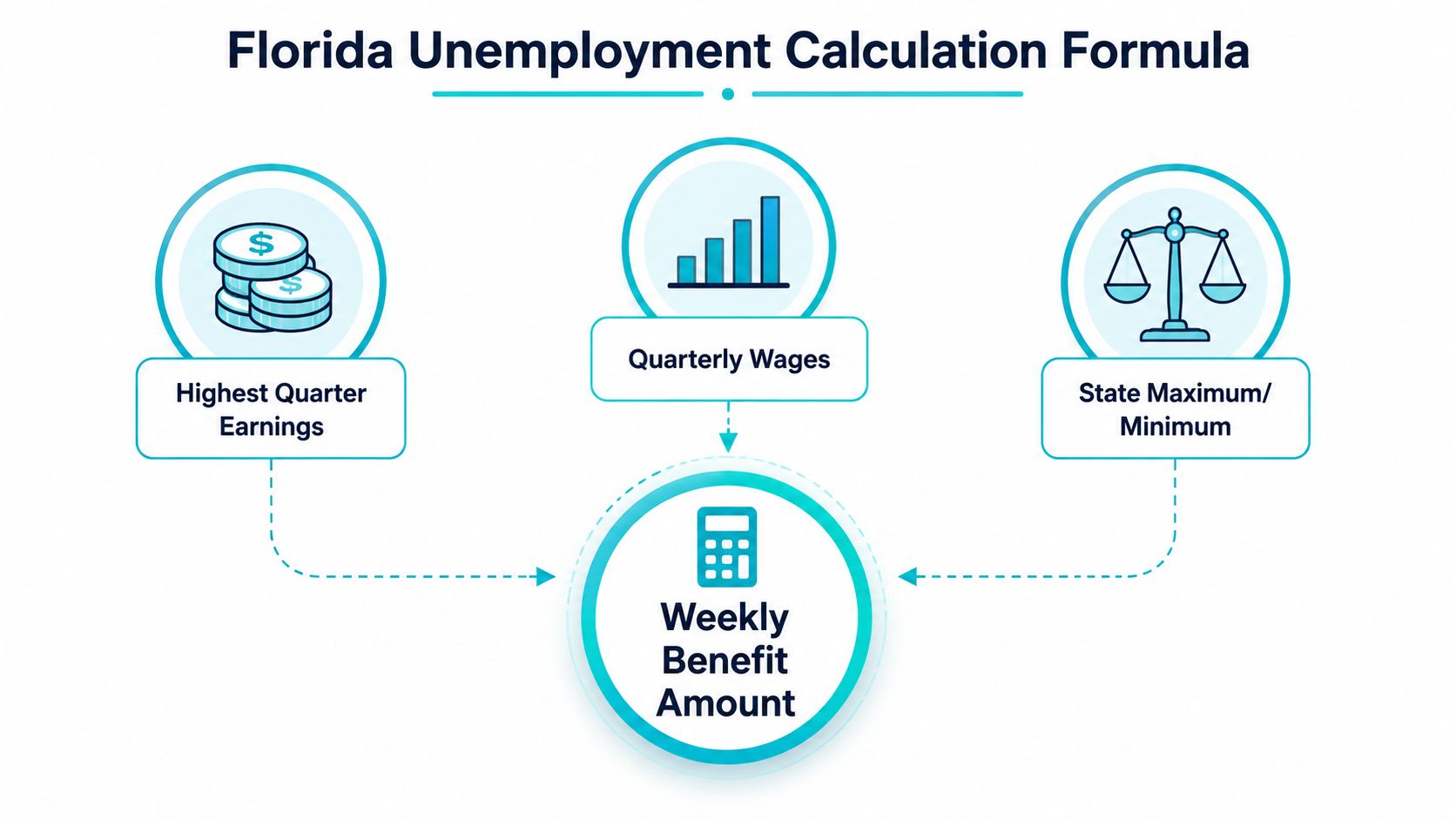
Florida doesn't pay every claimant the same weekly amount. Under the state's reemployment assistance statute, the starting calculation is one-twenty-sixth of the wages paid in the highest quarter of the base period, with the result rounded down to the nearest whole dollar. The law sets a minimum weekly benefit of $32 and a maximum of $275. The statutory formula is described in Florida Statutes Section 443.111.
That structure creates three separate questions:
1. What was your highest-earning base-period quarter? 2. What does one-twenty-sixth of that quarter's wages equal? 3. Does the result fall below $32, above $275, or within the permitted range?
The answer isn't a replacement percentage applied uniformly to your former weekly pay. It's a calculation based on quarterly wages, which means two people with different earnings histories can receive different benefits even if their jobs ended on the same day.
Why the maximum can mislead
Search results often foreground the maximum because it's easy to remember. But a cap is not a typical payment, and it doesn't tell a claimant what their wage record produces. A worker whose highest quarter produces a result below the ceiling remains tied to that lower calculation.
The reverse is also important. A worker can have earned enough for the formula to produce more than the statutory ceiling, yet the weekly payment cannot exceed $275. That makes the cap a binding limit rather than a target.
Practical rule: Treat $275 as the upper boundary of the formula, not as an estimate of your personal check.
The floor matters for the same reason. If the wage calculation produces a very small amount, the statutory minimum is $32, subject to the broader eligibility and payment rules that govern a claim. The most accurate way to understand the Florida unemployment amount is therefore to calculate from the highest quarter first, then apply the floor or ceiling.
Working Through the Base-Period Math
A useful estimate begins with your base-period wage record, not your most recent paycheck. The statute looks for the quarter in that period with the highest wages. Once you identify it, divide that quarter's wages by 26, then round the result down to a whole dollar. Finally, check whether the result falls within Florida's $32 to $275 weekly range, as set out in the state's reemployment assistance law.
A four-step estimate
Use this sequence:
1. Gather quarterly wage information. Use wage records for the quarters included in the base period used for your claim. 2. Find the highest quarter. Ignore the total across all quarters for this particular weekly calculation. The relevant input is the single quarter with the highest wages. 3. Divide by 26. This is the statutory fraction. 4. Round down and apply the limits. Drop any cents, then compare the result with the $32 floor and $275 cap.
The rounding instruction can affect the final amount. For example, if the highest quarter contained $7,150 in wages, the calculation is $7,150 divided by 26, which produces a result above $275. The statutory cap would control the weekly amount. By contrast, a highest quarter of $3,900 produces exactly $150 when divided by 26, before any other claim-specific rules.
The table below illustrates the mechanical calculation. These are arithmetic examples, not predictions of an individual claim outcome.
| Highest Quarter Wages | Divided by 26 | Rounded Weekly Benefit |
|---|---|---|
| $832 | $32 | $32 |
| $3,900 | $150 | $150 |
| $5,199 | $199.96 | $199 |
| $7,150 | $275 | $275 |
| $8,000 | $307.69 | $275 |
Why pay-stub intuition often fails
A claimant may remember earning a particular amount each week and assume the benefit should be a fixed share of that figure. Florida's formula doesn't work that way. It uses the highest quarter's reported wages, then imposes a statutory boundary.
That distinction becomes especially important for workers with irregular schedules, seasonal employment, overtime, or a recent change in hours. The quarter with the highest wages may not be the quarter immediately before the job ended, and a current pay stub may not show the wage history used in the calculation.
The fastest estimate is simple arithmetic. The difficult part is identifying the correct quarter and confirming that the wage record is complete.
Benefit Duration and Total Value Limits
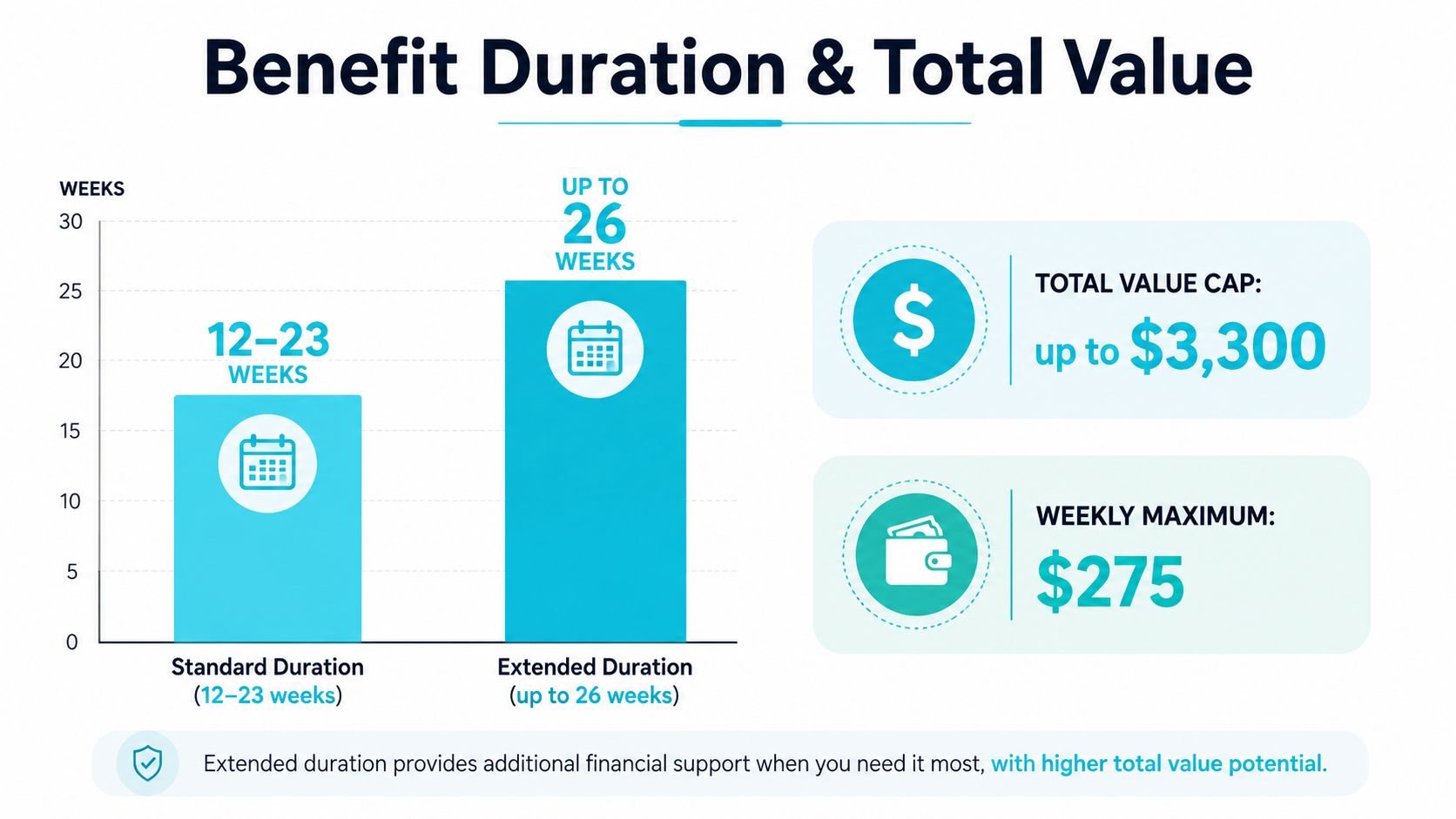
A Florida unemployment claim has two separate limits: the amount payable for one week and the number of payable weeks. The duration is not automatically identical for every claimant. Under the applicable rules, it can reflect prior employment, wages, and the state's unemployment conditions. The 2026 Florida Senate legislative analysis describes a sliding scale of 12 to 23 weeks. The commonly cited 12-week standard maximum is the floor of that scale, so it describes the shorter end of a current claim rather than contradicting the broader range.
Weekly eligibility and total claim value remain separate questions. A worker may qualify for a calculated weekly amount while facing a different limit on the total benefits payable over the claim. The governing framework appears in Florida's unemployment compensation statute.
Why multiplying the weekly amount isn't enough
Multiplying a weekly amount by an assumed duration can overstate a claim's available value. The calculation must use the payable weeks that apply to that claimant, while also accounting for aggregate limits and any week-specific adjustment.
For example, a worker with a $150 weekly amount and 12 payable weeks would have a potential total of $1,800. That figure assumes every week is payable and no offset or other claim rule reduces a payment. It shows why a moderate weekly amount does not, by itself, reveal how much support a claimant can receive during a longer job search.
The same weekly calculation can therefore produce different total claim values. One worker may remain at the shorter end of the duration scale, while another may qualify for more payable weeks based on the applicable wage and unemployment conditions.
A better way to assess the claim
Separate the estimate into two calculations:
- Weekly amount: Highest base-period quarter divided by 26, rounded down, then constrained by the statutory floor and cap.
- Total possible value: Weekly amount multiplied by payable weeks, subject to the applicable aggregate maximum and claim rules.
This two-part approach also prepares the claimant for partial earnings. A worker who earns money during a claim week may receive less than the calculated weekly amount, so the final total can fall below the initial weekly figure multiplied by the available weeks. Duration establishes the time limit. The payment formula and weekly earnings determine what is paid.
How Partial Earnings Change Your Payment
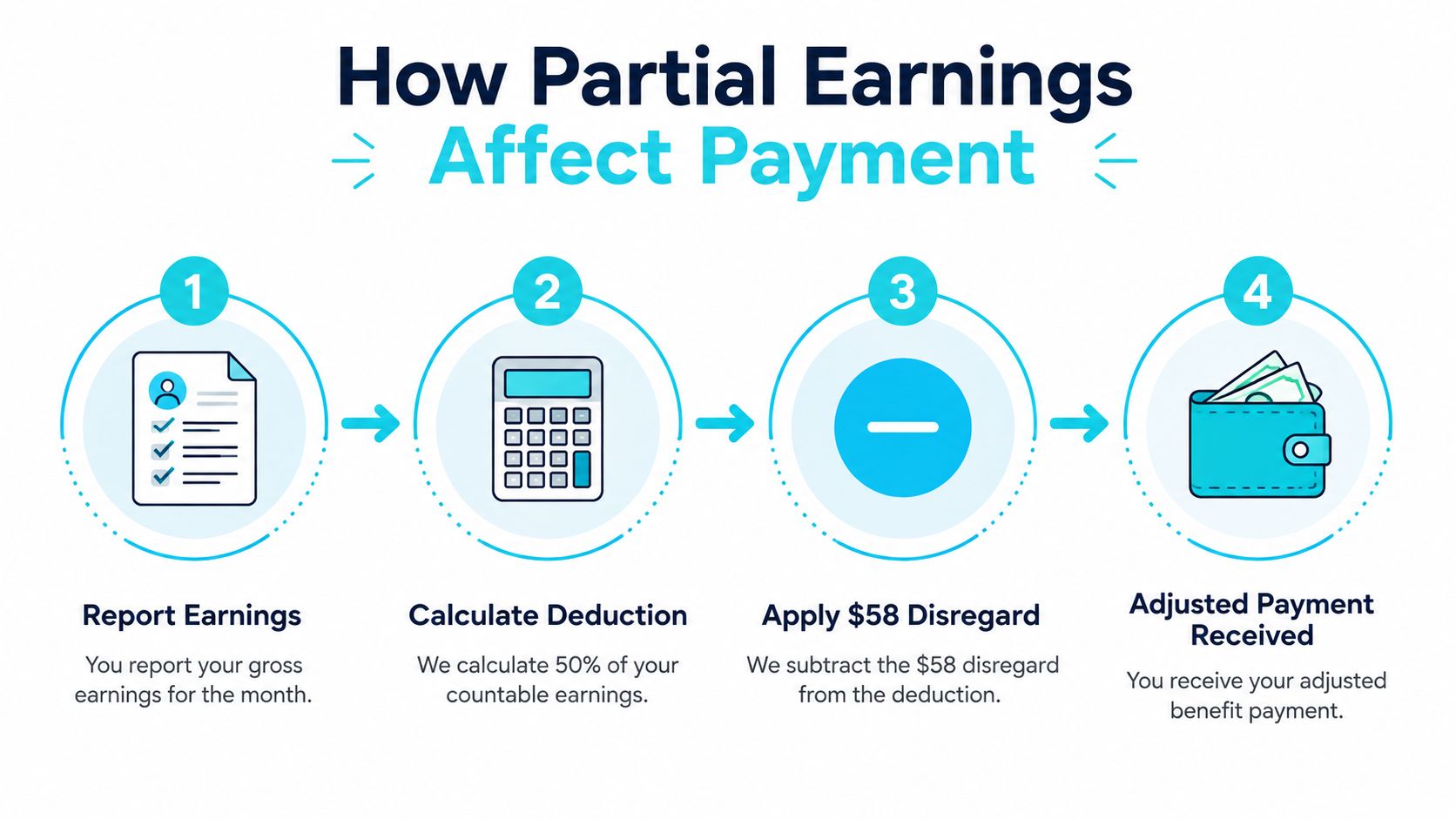
A part-time shift or gig assignment doesn't automatically answer the payment question. Florida's partial-unemployment formula adjusts benefits when earned income exceeds eight times the federal hourly minimum wage, according to Section 443.111 of the Florida Statutes. The practical consequence is that a claimant must model both sides of the week: the initial benefit amount and the income reported for that same claim period.
The offset is triggered by the disregard
The statute creates an earnings disregard tied to eight times the federal hourly minimum wage. Income up to that threshold is treated differently from income above it. Once reported earnings cross the threshold, the excess can reduce the unemployment payment for that week.
That means the relevant question isn't, "Did I work?" It's, "How much did I earn during the claim week, and how does the excess interact with my calculated benefit?"
A claimant with a $275 weekly amount and no reportable earnings starts from a different position than a claimant with the same calculated amount who accepts a short gig. If the gig produces earnings above the statutory disregard, the excess affects the payment. If the earnings are high enough, the adjusted benefit can be reduced substantially or reach zero for that week, depending on the applicable calculation.
Report the week as it occurred
Reduced hours, temporary shifts, freelance assignments, and gig work can all complicate certification. The safest calculation uses gross earned income for the relevant week, not the date a client pays an invoice or the date a platform transfers funds.
Keep a simple record containing:
- Work dates: Record when the work was performed.
- Gross earnings: Track the amount before deductions.
- Employer or platform details: Preserve names and payment records.
- Hours and status: Note whether the work was part-time, temporary, or a reduction from regular hours.
Practical rule: Don't compare a side job's payment with your unemployment check in isolation. Compare the side job's reportable earnings with the statutory disregard and then calculate the adjusted benefit.
This interaction is why generic "how much will I get?" calculators can mislead. A calculator that uses only the highest-quarter wage figure may estimate the initial amount but miss the weekly offset. The number that matters for a particular payment is the adjusted amount after the state applies the earnings rule.
Filing Claims and Understanding Processing Timelines
The claim process begins with an application for Florida reemployment assistance, followed by the required weekly or biweekly reporting steps associated with the claim. Exact processing time can vary because the agency must verify information, resolve wage or separation questions, and apply the claim's payment rules. A claimant who prepares complete records can reduce avoidable clarification requests, but no general timeline can promise a first deposit by a particular date.
Florida's weekly claims data shows why system conditions matter. Continued insured unemployment claims reached 2,151,108 in May 2020, during the COVID-era disruption. More recent figures were 34,915 for the week ending August 8, 2026, and 34,806 for the week ending August 1, 2026, according to the Federal Reserve Bank of St. Louis series for Florida continued claims. The contrast shows a large difference between the pandemic shock and later normalization, while also confirming that claims remain a live weekly indicator.

Build the record before submitting
Prepare the information the application is likely to require:
- Identity and contact details: Use consistent information across the application and supporting records.
- Employment history: Gather employer names, dates of work, and separation details.
- Wage documentation: Keep pay records that help identify the relevant base-period wages.
- Separation explanation: Describe the job ending accurately and preserve written notices.
- Earnings reports: Record any work or income that must be disclosed for claimed weeks.
Errors often arise from mismatched dates, incomplete employer information, or failure to report partial earnings. Those issues can create questions that require manual review. A precise application is more useful than an optimistic estimate because the agency ultimately applies the wage record and statutory rules to the claim.
Read every determination
After filing, monitor notices, requests for information, and payment-status messages. Don't assume that submitting the initial application completes the process. A request that goes unanswered can affect adjudication, while a determination that contains incorrect wage information may require prompt correction through the available state process.
The recent claims figures shouldn't be used to promise a processing time. They provide context, not a deadline. Your practical timeline depends on whether the wage record matches, whether the separation requires review, whether reported earnings affect a week, and whether the agency asks for additional information.
Common Misconceptions About Florida Unemployment
Myth: Everyone receives the maximum. The statutory formula starts with one-twenty-sixth of the highest base-period quarter, rounded down. The result can be as low as the $32 statutory floor or can reach the $275 weekly cap, so the maximum is only one possible outcome. The Florida statute makes the wage history decisive.
Myth: Florida benefits always last 26 weeks. Duration varies under the applicable rules. The 2026 legislative analysis describes 12 to 23 weeks depending on prior employment, wages, and the unemployment rate, while early-2026 reporting described a standard maximum of 12 weeks. A claimant needs to distinguish the weekly amount from the number of payable weeks.
Myth: Any part-time work ends the claim. Partial earnings can change a payment without automatically answering the eligibility question. Florida reduces benefits based on earned income above eight times the federal hourly minimum wage, so the weekly result depends on the amount earned and the statutory offset.
Myth: The unemployment rate is stable enough to ignore. Florida moved from 13.3% during the early pandemic period to 4.6% in July 2026, after being in the 3% range in the late 2010s, as reported in BLS labor force statistics. The rules and claim environment can shift as labor conditions change.
The useful conclusion is narrower than "Florida unemployment pays $275." Your actual amount begins with the highest quarter, gets rounded and limited, may be reduced by partial earnings, and ends when the applicable duration or total-benefit rule is exhausted.
Monsa helps operators keep a written strategy connected to the holdings they track, with deterministic scoring, visible reasoning, and nightly review of whether each position still fits its stated rules. Visit Monsa to see how a strategy-versus-portfolio terminal can turn a static investment thesis into a repeatable monitoring process.
Monsa is a portfolio-analysis tool, not a broker or investment adviser. Nothing here is investment advice.
// related reading
What Is Portfolio Turnover and Why It Matters
What is portfolio turnover? Learn the SEC formula, worked examples, costs, taxes and benchmarks to judge if trading fits your strategy.
Watchlist Management: A Step-by-Step Guide for Traders
Master watchlist management with actionable steps to create, score, and prioritize your stock list. Learn thesis alignment and alerts setup for better
XLU Ex Dividend Date 2026 and How to Read It
Find the latest XLU ex dividend date for 2026, learn how quarterly payouts work, and see how T+1 settlement changes who actually receives the distribution.
7 / 100 founding seats claimed - $100/yr locked, then $190/yr
Monsa is a portfolio-analysis tool, not a broker or investment adviser. It never recommends what to buy or sell - it checks what you hold against rules you wrote. Nothing here is investment advice.