// blog
XLU Ex Dividend Date 2026 and How to Read It
The XLU ex-dividend date for 2026 is projected around September 21, 2026, with an estimated distribution of approximately $0.2844 per share, according to Market Chameleon's XLU dividend calendar. The date is a brief settlement-driven cutoff, not a broad trading window. A purchase must meet the applicable settlement timing to qualify for the next quarterly distribution.
XLU's recurring quarterly schedule now operates alongside the U.S. T+1 settlement system, effective May 28, 2024. Investors therefore need to connect the projected ex-date with the settlement deadline and record-date process. Monsa's strategy-versus-portfolio framework fits this decision process: dividend rules become useful when investors define the holding's purpose, then check whether the position still follows those rules. Because the date is projected, portfolio planning should separate confirmed fund notices from calendar estimates.
Table of Contents
- Defining the XLU Ex-Dividend Date
- The quarterly pattern
- How Ex Date, Record Date, and Pay Date Connect
- Why T+1 Settlement Changed the XLU Cutoff
- A March 2026 illustration
- Recent and Projected XLU Ex Dividend Dates
- XLU Quarterly Distribution Pattern and Amounts
- Determining Who Receives the XLU Dividend
- Dividend Capture Mechanics for an ETF Like XLU
- Why execution dominates the idea
- Why Ex Date Alone Does Not Define XLU Income
- The inputs that matter
- Pre-Trade Checklist for the Next XLU Ex Date
- Quick Reference Summary of XLU Ex Dividend Dates
Defining the XLU Ex-Dividend Date
The ex-dividend date creates a short, settlement-driven cutoff for XLU buyers. An investor purchasing on or after that trading date generally is not entitled to the upcoming distribution. The rule follows when a trade settles, rather than the time an order was placed. For a NYSE-listed security, the ex-date is generally set one business day before the record date, according to the NYSE dividend ex-date guidance.
For XLU, the next projected cutoff is September 21, 2026, with an estimated cash distribution of about $0.2844 per share. That date remains a forecast until the fund issues its distribution notice. XLU is a quarterly payer, so each expected cutoff should be treated as a narrow entitlement boundary, not a multi-day window for qualifying purchases.
The quarterly pattern
Historical XLU records commonly place ex-dividend dates in March, June, September, and December. Examples include December 23, 2024, March 24, 2025, June 23, 2025, March 23, 2026, and June 22, 2026, with calendar shifts arising from weekends and market holidays, as shown in DivvyDiary's XLU distribution history.
This recurring quarterly pattern helps investors organize a monitoring schedule, while the T+1 framework keeps the qualification window tied closely to the relevant cutoff. XLU holds utility companies, so its distributions reflect dividend payments from the underlying portfolio. The recurring shape supports planning, but neither the precise date nor the amount should be treated as confirmed before the fund's notice.
Practical rule: Use the projected September date as a planning marker. Confirm the official notice before placing a trade or relying on the distribution in a cash-flow calendar.
How Ex Date, Record Date, and Pay Date Connect
XLU's distribution calendar has four distinct checkpoints. The declaration date sets the distribution amount and schedule. The ex-dividend date marks when the upcoming cash distribution is separated from new purchases. The record date identifies the holders listed for entitlement, and the pay date is when the cash reaches brokerage accounts.
A recent quarterly cycle shows the sequence. XLU had an ex-date of June 22, 2026, while September 21, 2026 was the next projected ex-date. The latter remains a planning estimate until the fund publishes its distribution notice. In practice, the sequence is declaration, ex-date, record date, then payment.
| Date Type | Purpose | Typical Timing | Investor Action |
|---|---|---|---|
| Declaration date | Establishes the distribution terms | Before the ex-date | Check the announced amount and dates |
| Ex-dividend date | Defines eligibility for the upcoming distribution | Generally one business day before the record date | Confirm whether a purchase settles in time |
| Record date | Captures the holder-of-record list | After the ex-date | Use it as administrative confirmation |
| Pay date | Delivers the distribution | After the record date | Reconcile the cash received |
The ex-dividend date is the trading cutoff that matters most. Buyers on or after that date generally do not receive the next distribution because eligibility depends on settlement and the record-date ledger, as explained in the XLU dividend overview. The record date confirms which holders appear in that ledger. It does not create a second qualification opportunity.
For a quarterly ETF such as XLU, each cycle creates a short settlement-driven window. Investors must align the trade date with the cutoff, rather than treating several surrounding trading days as equivalent. The pay date follows the administrative process and confirms when the distribution becomes available in the account.
Why T+1 Settlement Changed the XLU Cutoff
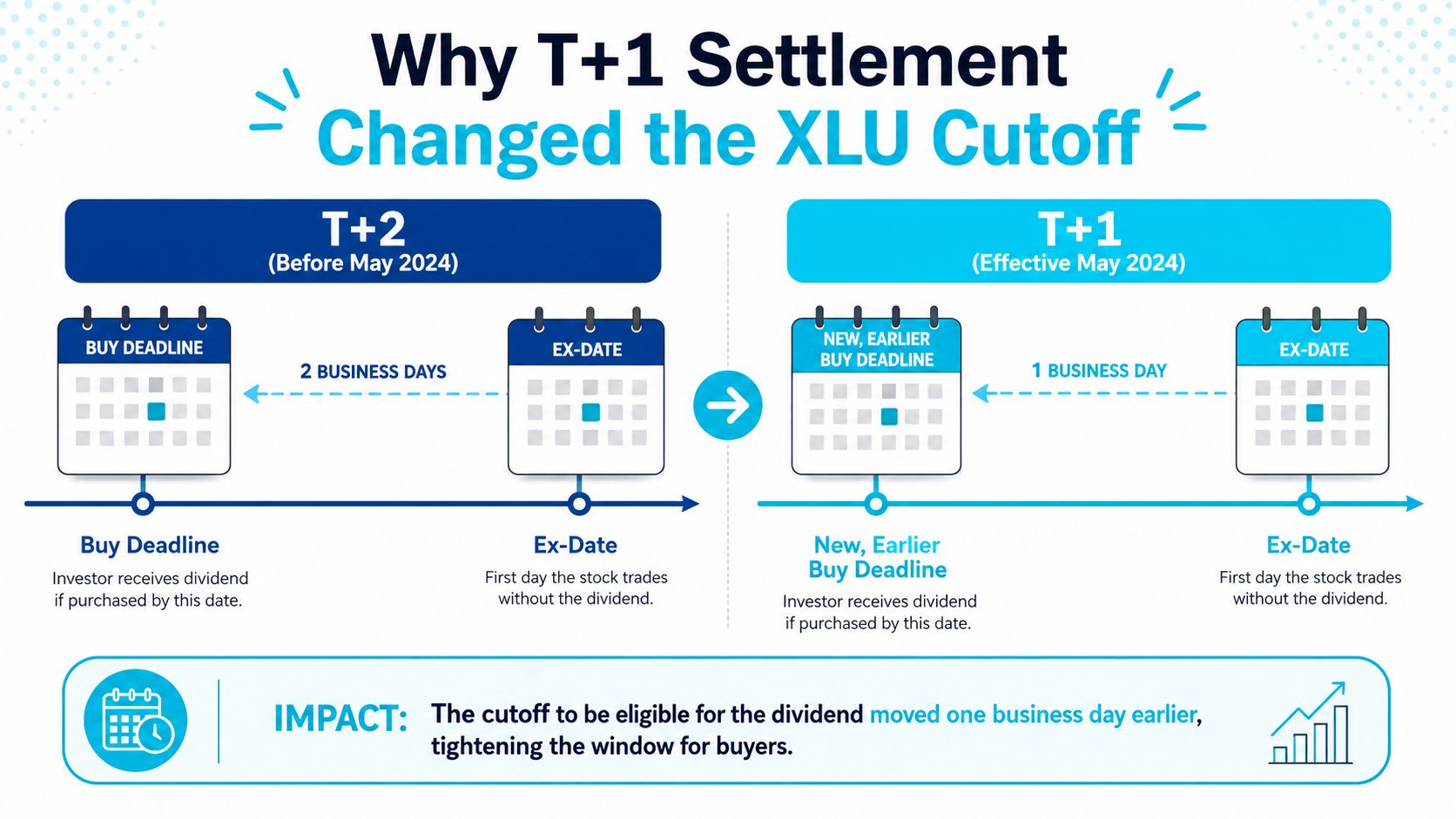
The United States moved from T+2 to T+1 settlement on May 28, 2024, reducing the time between an XLU trade and its settlement. That change altered the practical deadline for qualifying for a dividend. The rule now ties the purchase date more tightly to the ex-date and record-date process.
Under T+2, a purchase made one business day before the ex-date could settle in time under the earlier calendar. With T+1, the buyer generally must complete the purchase at least one full business day before the ex-date. The cutoff therefore sits earlier relative to the distribution date, even though the quarterly distribution schedule itself has not changed.
Weekend timing can make the window look wider on a calendar. If XLU's ex-date falls on a Monday, Friday is the relevant prior trading day. Saturday and Sunday do not provide additional settlement opportunities.
A March 2026 illustration
For a hypothetical XLU distribution with a Monday ex-date in March 2026, the T+1 calculation points to the prior Friday as the latest practical purchase date. A trade entered on the ex-date would not qualify for that distribution, even if the investor holds the shares through the payment date.
The effect is operational rather than economic. T+1 does not make the distribution larger or smaller. It compresses each quarterly cycle into a short settlement-driven window, so investors must count trading days and verify the confirmed ex-date instead of treating nearby calendar dates as interchangeable.
The following video provides additional background on dividend timing and settlement mechanics.
<iframe width="100%" style="aspect-ratio: 16 / 9;" src="https://www.youtube.com/embed/ujcSC3PD8BA" frameborder="0" allow="autoplay; encrypted-media" allowfullscreen></iframe>
Recent and Projected XLU Ex Dividend Dates
XLU's recent record shows a quarterly cadence, with ex-dates shifting by roughly one trading day around the calendar. The table combines historical entries with a projected September 2026 event. A projected date or distribution is an estimate, not an official confirmation.
Historical records list December 23, 2024, March 24, 2025, June 23, 2025, March 23, 2026, and June 22, 2026 as recent ex-dates. The next projected event is around September 21, 2026, with estimated cash of about $0.2844 per share. Investors should treat each quarterly cutoff as a short settlement-driven window under T+1, rather than as a broad span of nearby trading days.
| Ex-Dividend Date | Record Date | Pay Date | Distribution Per Share | Status |
|---|---|---|---|---|
| Dec. 23, 2024 | Fund schedule | Fund schedule | Not specified in verified data | Historical |
| Mar. 24, 2025 | Fund schedule | Fund schedule | Not specified in verified data | Historical |
| Jun. 23, 2025 | Fund schedule | Fund schedule | Not specified in verified data | Historical |
| Mar. 23, 2026 | Fund schedule | Fund schedule | Around $0.28 to $0.31 in recent records | Historical |
| Jun. 22, 2026 | Fund schedule | Fund schedule | Around $0.28 to $0.31 in recent records | Historical |
| Sep. 21, 2026 | Not yet confirmed | Not yet confirmed | About $0.2844 | Projected |
Verified information does not provide corresponding record and pay dates for every historical row, so those fields remain tied to the fund schedule rather than being filled with unsupported precision. Recent XLU records indicate that payment generally follows the ex-date by about two days.
Holiday calendars can move a quarterly ex-date by one trading day. For any future event not covered by an official fund notice, confirm the fund's announcement before trading. The recurring quarterly pattern helps identify the likely window, while the confirmed ex-date determines the actual cutoff.
XLU Quarterly Distribution Pattern and Amounts
XLU typically distributes cash four times per year, with ex-dates commonly falling in March, June, September, and December. Recent records place individual payments around $0.28 to $0.31 per share. The projected September 2026 distribution is about $0.2844 per share, according to Market Chameleon's XLU distribution listing.
That recurring quarterly schedule matters more than any single estimate. Under T+1 settlement, each cutoff is a short settlement-driven window. The calendar identifies the likely quarter, while the confirmed ex-date determines which trading session controls eligibility.
Independent dividend calendars show a trailing-twelve-month distribution total of about $1.20 per share. Annualized figures range from approximately $1.20 to $1.48, depending on the snapshot date, as shown in DivvyDiary's XLU data.
| Quarter | Ex-Dividend Date | Distribution Per Share | TTM Total |
|---|---|---|---|
| Historical quarter | Dec. 23, 2024 | Not specified in verified data | About $1.20 |
| Historical quarter | Mar. 24, 2025 | Not specified in verified data | About $1.20 |
| Historical quarter | Jun. 23, 2025 | Not specified in verified data | About $1.20 |
| Projected quarter | Sep. 21, 2026 | About $0.2844 | About $1.20 |
The evidence supports a regular, clustered payout pattern, not a reliable conclusion that distributions are rising, flat, or shrinking every quarter. Payment amounts can vary, and annualized totals change as the measurement date moves.
Cash income and ETF market value also follow different mechanics. On the ex-date, the distribution is detached from XLU's value mechanically. The cash arrives later, but entitlement is determined by the trade's position around the cutoff.
Determining Who Receives the XLU Dividend
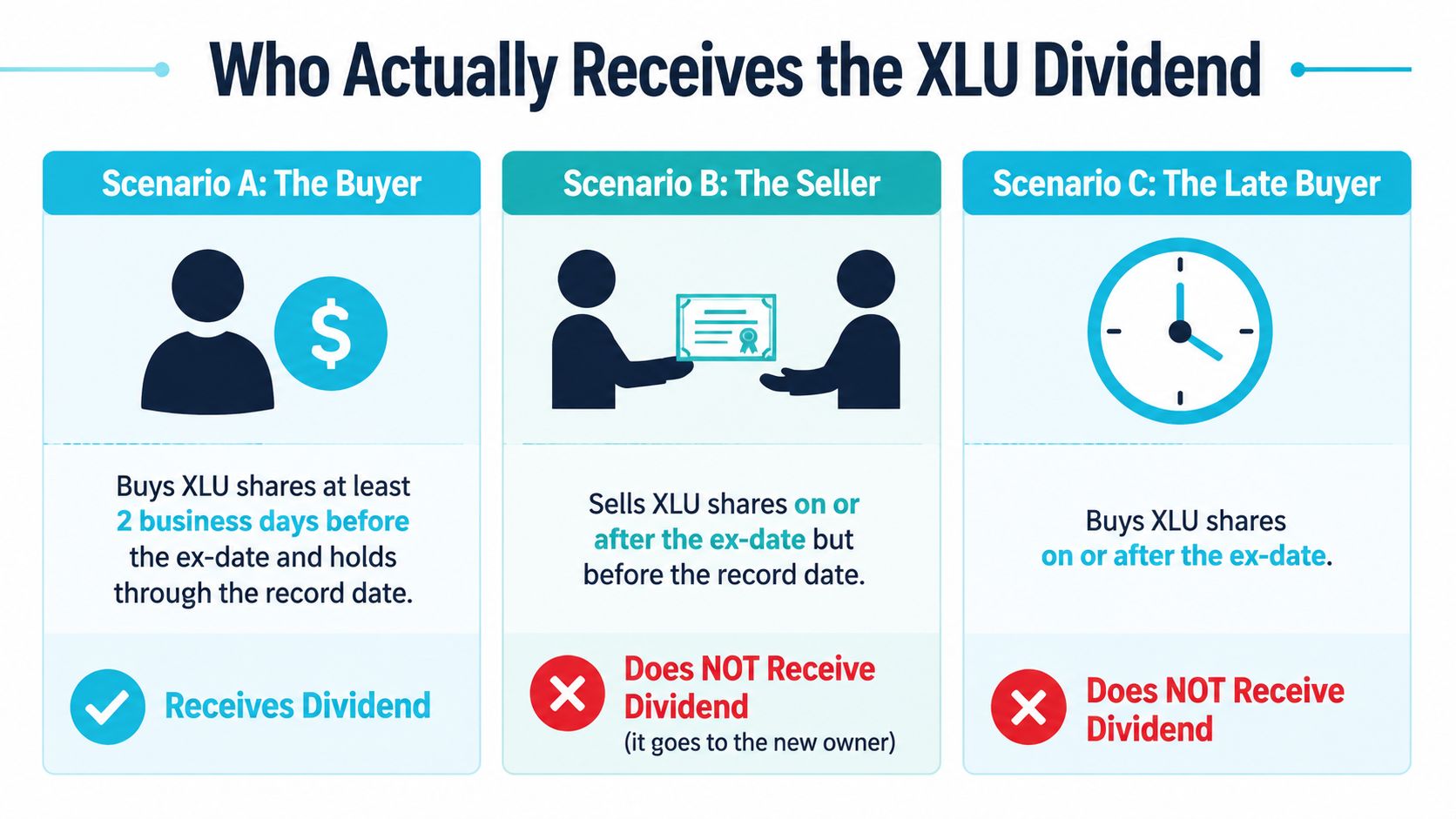
Eligibility depends on the trade's position relative to the ex-date, not on when the cash reaches the account. Buyers on or after the ex-date generally do not receive the next distribution, as explained in the SEC-based explanation of ex-dividend treatment.
For the projected September 21, 2026 XLU ex-date, a purchase completed early enough to settle before the cutoff can qualify. A purchase made on the ex-date itself does not qualify for that distribution, even if the buyer keeps the ETF through the payment date.
| Scenario | Trade Position | Distribution Result |
|---|---|---|
| Early buyer | Buys at least one full business day before the ex-date and remains eligible through the record process | Receives the upcoming distribution |
| Ex-date buyer | Buys on the ex-date | Doesn't receive the upcoming distribution |
| Later buyer | Buys after the ex-date | Doesn't receive the upcoming distribution |
Selling has a separate outcome. An investor who sells on or after the ex-date can remain entitled to the upcoming cash because the position qualified before the cutoff. The buyer becomes eligible for later distributions, not the one already detached.
The payment date tells you when cash arrives. The ex-date determines who earned it.
T+1 settlement makes the practical deadline a business-day calculation. XLU's recurring quarterly pattern creates a short settlement window around each cutoff, rather than a broad span of trading days. Confirm the broker's treatment and account records, particularly around market holidays.
Dividend Capture Mechanics for an ETF Like XLU
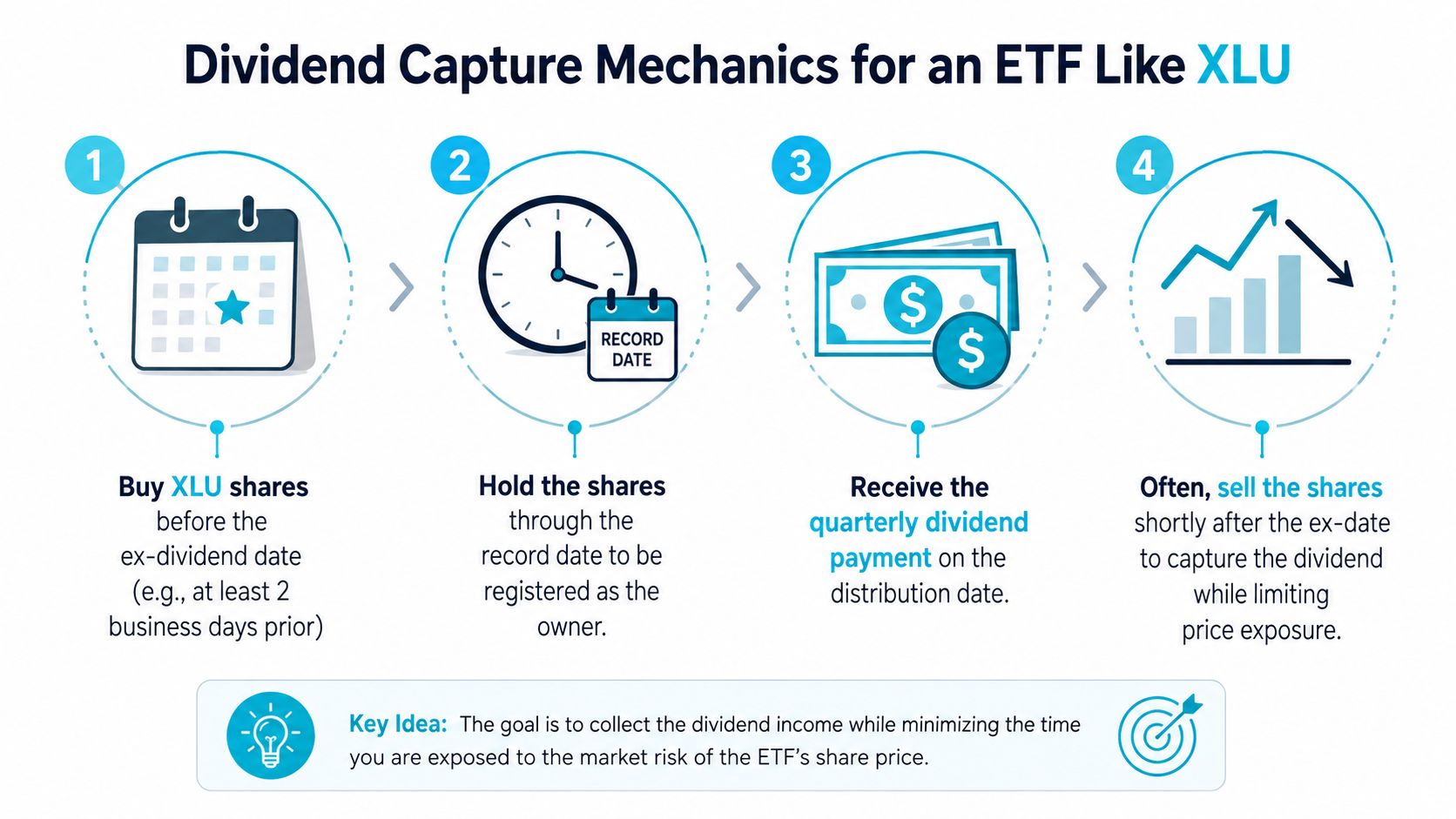
Dividend capture uses a defined sequence: buy XLU before the ex-date, qualify for the distribution, then sell after entitlement is established. The cash payment does not represent a free gain. When the distribution leaves the fund, XLU's value adjusts, so the outcome depends on the entry price, exit price, trading costs, spread, taxes, and broader market movement.
Recent XLU distributions have generally been in the $0.28 to $0.31 per share range, according to the fund's reported distribution history. That range describes the payout, not the potential profit from a capture trade.
Why execution dominates the idea
The trade has two execution points, entry and exit. Spreads can widen during volatile sessions, while XLU can move for reasons unrelated to the distribution. Even when the ex-date adjustment roughly matches the cash amount, the price may not recover in the next session.
T+1 settlement makes the opportunity a short, settlement-driven window around XLU's recurring quarterly cutoff. It is not a broad period in which any purchase can qualify. The broker's records, market holidays, and order timing can affect whether the intended position is established in time.
Dividend capture also differs from holding XLU for recurring income. A capture trade seeks a specific calendar outcome, while a longer-term position must fit sector exposure, cash-flow needs, and the planned holding period.
For a broader comparison, review Monsa's dividend growth strategy framework. The relevant test is whether the transaction follows a written strategy, not whether a single calendar cutoff appears attractive.
Why Ex Date Alone Does Not Define XLU Income
A frequent ex-dividend date doesn't, by itself, make XLU an income-friendly holding. The ex-date is a scheduling event. When the distribution is detached, the fund's value adjusts mechanically, so the cash payment shouldn't be treated as an automatic source of additional economic value on day one.
The income picture requires several inputs. The trailing-twelve-month distribution total provides a recent cash-flow reference, while the fund's expense ratio affects what remains after operating costs. XLU's stated expense ratio is 0.09 percent, but that figure isn't included in the verified source set provided here, so it shouldn't be presented as a sourced fact in this analysis.
The inputs that matter
The fund's sector concentration also matters. XLU represents a utilities-oriented portfolio, so its distributions reflect the dividend policies of the underlying holdings rather than an independent cash-generating business operated by the ETF.
| Metric | What It Tells You |
|---|---|
| Ex-dividend date | When eligibility changes |
| Distribution per share | The cash amount associated with a specific payout |
| Trailing-twelve-month total | Recent aggregate distributions |
| Yield on cost | Cash distribution measured against an investor's own cost basis |
| Sector concentration | How dependent the income profile is on one industry group |
| Fees | The portion of assets used to operate the fund |
Investors evaluating dividend income can use the framework in Monsa's guide to dividend yield. The central distinction is simple: timing determines entitlement, while the broader portfolio and fund structure determine the income profile.
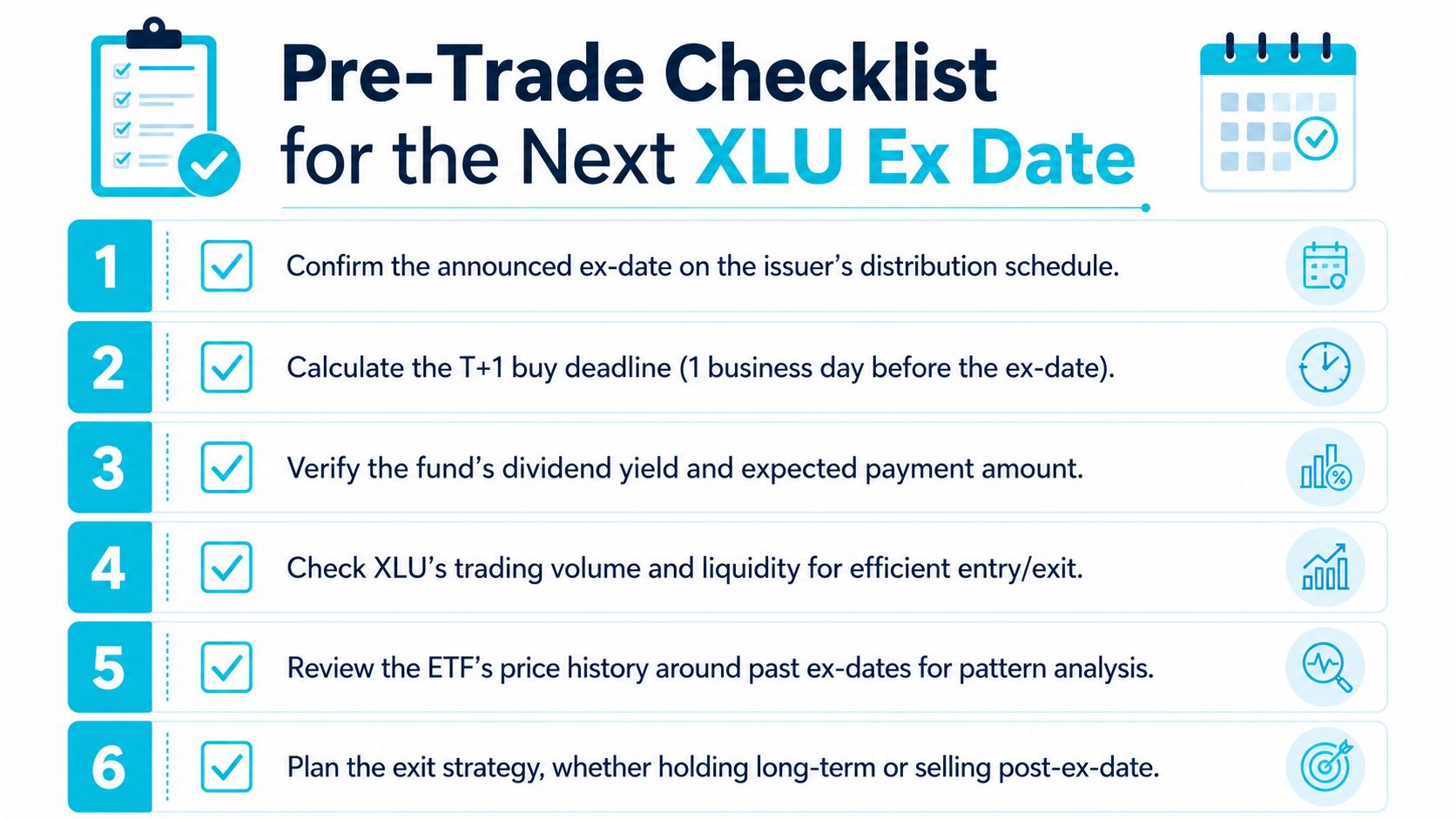
Pre-Trade Checklist for the Next XLU Ex Date
A disciplined review begins with confirmation, not a calendar guess. Use the following sequence before acting around the next projected XLU cutoff.
1. Confirm the announcement: Check the fund's current distribution notice and verify whether September 21, 2026 remains projected or has become official. 2. Calculate settlement timing: Apply T+1 and identify the last business day on which a purchase can settle before the ex-date. 3. Compare the amount: Place the expected distribution beside the recent trailing-twelve-month total. A change may indicate a different quarterly cash amount. 4. Review liquidity: Examine the bid-ask spread and trading activity for the intended position size. A narrow theoretical margin can disappear during poor execution. 5. Define the purpose: Separate dividend capture, long-term income holding, and portfolio rebalancing. Each objective requires different holding-period rules. 6. Record the event: Log the trade date, ex-date, expected cash, and eventual payment so quarterly reconciliation and tax records remain consistent.
For investors screening securities against a defined dividend approach, Monsa's dividend stock screener guide offers a way to think about rules before a position enters a portfolio. The checklist keeps the calendar event connected to the broader holding thesis.
Quick Reference Summary of XLU Ex Dividend Dates
The table below is a working reference, not a replacement for the fund's latest notice. Historical dates show XLU's recurring quarterly rhythm, while the September 2026 entry remains projected.
The T+1 cutoff is expressed as the prior business day. If a weekend or market holiday intervenes, the relevant date must be recalculated from trading days rather than counted as a fixed number of calendar days.
| Quarter | Ex-Dividend Date | Buy-Before Cutoff (T+1) | Distribution Amount | Pay Date |
|---|---|---|---|---|
| Q4 2024 | Dec. 23, 2024 | Prior business day | Not specified in verified data | Typically follows the ex-date |
| Q1 2025 | Mar. 24, 2025 | Prior business day | Not specified in verified data | Typically follows the ex-date |
| Q2 2025 | Jun. 23, 2025 | Prior business day | Not specified in verified data | Typically follows the ex-date |
| Q1 2026 | Mar. 23, 2026 | Prior business day | Around $0.28 to $0.31 | Typically about two days later |
| Q2 2026 | Jun. 22, 2026 | Prior business day | Around $0.28 to $0.31 | Typically about two days later |
| Q3 2026 | Sep. 21, 2026 | Prior business day | About $0.2844, projected | Not yet confirmed |
The main takeaway is operational: the ex-date is the entitlement boundary, and T+1 makes the prior-business-day calculation essential. Reconfirm each quarterly date and amount against the latest issuer notice before placing a trade.
Monsa scores the stocks an operator holds against the strategy they wrote down, every night, including dividend-focused rules. Visit Monsa to see how a rules-based portfolio check can keep distribution timing connected to the wider holding thesis.
Monsa is a portfolio-analysis tool, not a broker or investment adviser. Nothing here is investment advice.
// related reading
What Is Portfolio Turnover and Why It Matters
What is portfolio turnover? Learn the SEC formula, worked examples, costs, taxes and benchmarks to judge if trading fits your strategy.
Watchlist Management: A Step-by-Step Guide for Traders
Master watchlist management with actionable steps to create, score, and prioritize your stock list. Learn thesis alignment and alerts setup for better
Florida Unemployment Amount: What You Will Actually Receive
Learn how the Florida unemployment amount is calculated, the $275 weekly cap, duration rules, and how partial earnings change your payment in 2026.
7 / 100 founding seats claimed - $100/yr locked, then $190/yr
Monsa is a portfolio-analysis tool, not a broker or investment adviser. It never recommends what to buy or sell - it checks what you hold against rules you wrote. Nothing here is investment advice.