// blog
10 Best Growth Stock Screener Tools for 2026
Most growth screens fail for a simple reason. They pull back companies that look fast on one quarter of revenue or a cheap PEG ratio, then miss the harder question of whether the business is still compounding when you own it. The best growth stock screener is the one that matches the job you need done, whether that's building a filter from scratch, triaging a watchlist, or checking nightly whether a holding still deserves to stay in the portfolio.
The tools below are strongest where growth investors need precision, not noise. Some lean on multi-year revenue and EPS growth, some add margin and valuation discipline, and a few go further by combining factor grades, analyst revisions, or strategy rules that help separate genuine compounders from short-lived spikes. That distinction matters because several published screening frameworks already treat growth as a multi-factor problem, not a single metric, with filters that blend growth, quality, and valuation constraints to cut false positives and highlight businesses that have compounded over time (Stock Investor IQ growth screener).
Table of Contents
- 1. Monsa
- Why it stands out for growth discipline
- 2. Stock Rover
- Best fit for reusable growth templates
- 3. FINVIZ Elite
- Where it wins and where it stops
- 4. Seeking Alpha Premium
- Better for cross-checking than for pure screening
- 5. Zacks Premium
- Strong for revisions, lighter on nuance
- 6. MarketSurge formerly MarketSmith by IBD
- Best when momentum is part of the thesis
- 7. Morningstar Investor
- Stronger as a filter check than a discovery engine
- 8. GuruFocus All-in-One Screener
- Useful for richer composite screens
- 9. Simply Wall St
- Good for communicating the why
- 10. TradingView
- Strongest as a bridge between screen and chart
- Top 10 Growth Stock Screener Comparison
- Building Your Growth Filter Stack & Picking the Right Tool
1. Monsa
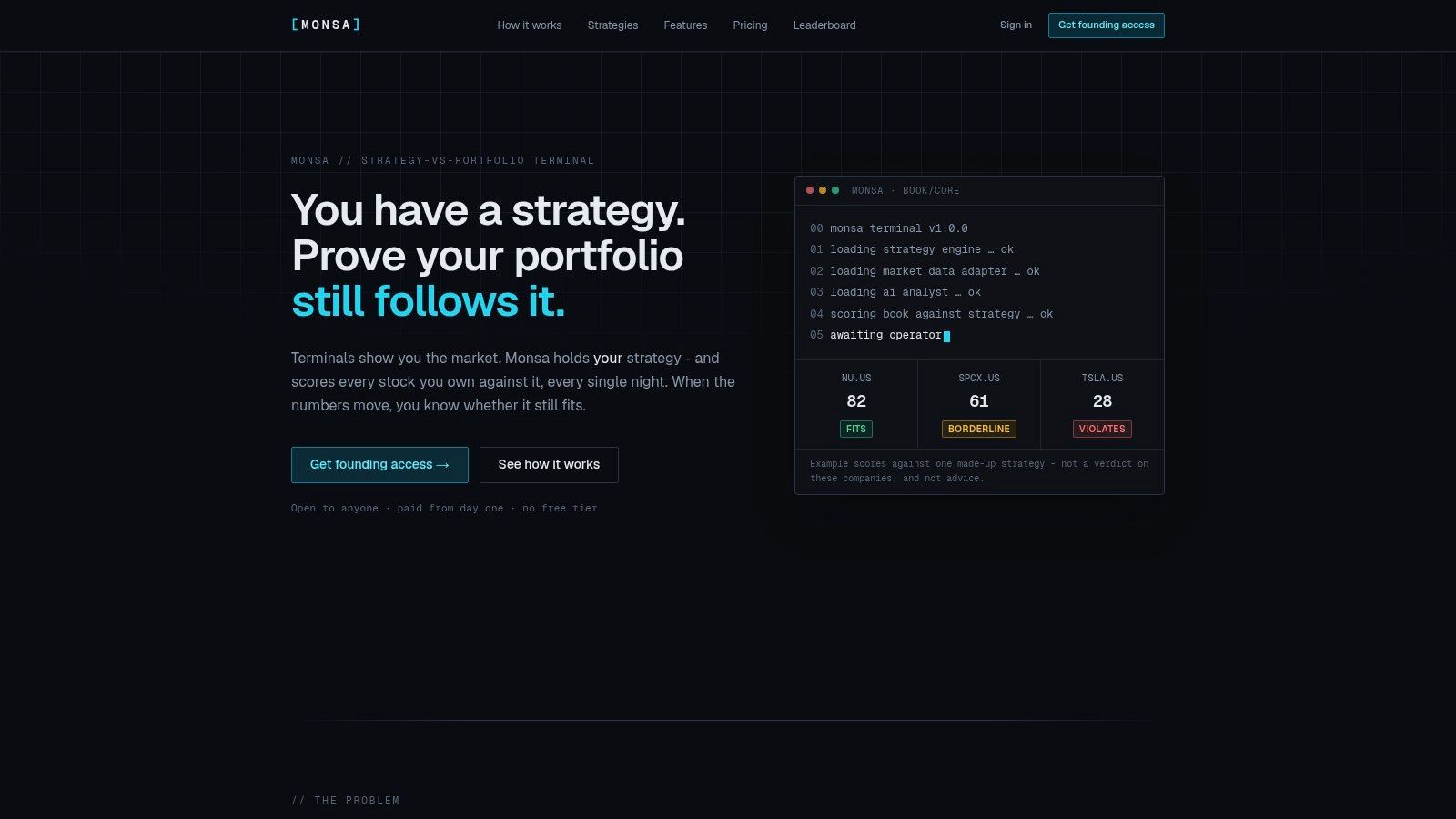
Monsa stands out because it starts with the portfolio rule, not the stock list. It asks whether a holding still fits the written strategy after prices move, fundamentals update, and FX shifts flow through the book. That makes it especially useful for ongoing growth monitoring, since a name can pass a discovery screen and still drift outside the thesis after the next earnings report.
Its core advantage is the combination of strategy templates, nightly re-scoring, and a fit verdict. The platform stores defined rules, then scores each stock against them with a clear result such as fits, borderline, or violates, plus a breakdown by criterion. It also supports watch-only scoring, so you can test a growth idea before capital goes in. That matters at the point where many screeners stop helping.
Practical rule: use Monsa when your growth definition is already written down, and you want the portfolio checked against that definition every night instead of only during a periodic review.
Why it stands out for growth discipline
For growth investors, the most useful part is the way Monsa separates deterministic checks from qualitative judgment. The system tracks reported, derived, and missing data flags, applies a 34-metric vocabulary, and uses AI only where numbers cannot settle the call. That matters because growth names often fail for soft reasons like slower guidance, margin pressure, or a thesis that no longer matches the business.
Monsa also supports US and major European exchanges, including London, Frankfurt, Amsterdam, and Copenhagen, which makes it more relevant for investors who do not stay inside a U.S.-only universe. The book-level controls, such as position and sector caps, help keep a growth sleeve from turning into an accidental concentration trade. Its public roadmap and transparent rule sets also make the product feel auditable rather than opaque, which is rare in this category.
For a side-by-side look at how it compares with a more traditional screener workflow, see the Monsa vs FINVIZ growth screening comparison.
If your process already has rules, Monsa is built to enforce them. If your process is still fuzzy, the natural-language thesis capture helps turn a written view into checkable criteria before the stock ever enters the book.
2. Stock Rover
Stock Rover is the strongest all-around pick for investors who want a fundamental-first growth stock screener with enough depth to build serious multi-factor workflows. Its published materials show why growth screeners often work better as composites than as one-metric filters, because the platform's own ranker weights Growth at 35%, Valuation at 30%, Efficiency at 20%, and Price performance and momentum at 15%, while restricting results to mid-cap and above companies with market cap over $2 billion (Stock Rover library PDF).
That structure matches how many growth investors really screen. They don't just want fast top-line expansion, they want enough quality and valuation discipline to avoid overpaying for it. Stock Rover's 650+ metrics and composite scores make it especially useful for building a repeatable GARP-style workflow, then saving it as a template instead of reinventing the filter every time.
Best fit for reusable growth templates
The main strength here is repeatability. Stock Rover is built for saved screens, custom scores, percentile-based sorting, and ranking lists, so you can run the same growth framework across a new universe without changing the logic. That matters when you're comparing new names against older holdings, because a clean screen design is the only way to tell whether the survivors are improving or just benefiting from noise.
It also works well when your definition of growth includes more than revenue and EPS. In practical use, the platform is better suited to investors who want to layer quality and valuation on top of raw growth, rather than people who only want a fast ticker dump. The tradeoff is that it asks for more setup time than simpler scanners, but that setup is what makes the output reusable.
Internal reference: Monsa's Stock Rover comparison
Website: Stock Rover
3. FINVIZ Elite
FINVIZ Elite is the fastest tool here for watchlist triage. It is built for speed, visual scanning, and alerting, which makes it useful when you want to move from a broad growth universe to a short list of candidates without getting trapped in a heavy research workflow. Its growth-screening value comes less from deep fundamental modeling and more from how quickly it lets you combine earnings, sales, margin, and price behavior into a workable shortlist.
That speed matters because growth screens often start as discovery tools. The published feature set includes real-time quotes, charts, extended-hours data, more than 20 advanced filters, 200 presets, alerts, and CSV export or API access, which gives it a practical edge for active monitoring and quick reruns (FINVIZ Elite).
Where it wins and where it stops
FINVIZ is strongest when the task is fast narrowing, not deep thesis work. It can get you to a usable list quickly, then export the names into a more rigorous research process. That makes it a useful front-end scanner, especially if you are watching for earnings acceleration, margin improvement, or a break in price behavior that deserves a closer look.
Its weakness is the same one that affects many broad terminals. It does not try to be a full valuation modeler, and its fundamentals are better for screening than for advanced portfolio supervision. The result is a tool that works well for idea generation and ongoing alerts, but less well for deciding whether a name still belongs in a growth bucket after fundamentals shift.
Internal reference: Monsa's FINVIZ comparison
Website: FINVIZ Elite
4. Seeking Alpha Premium
Seeking Alpha Premium earns a place here because its screener treats Growth as a first-class factor instead of a side filter. That sounds minor until you compare it with platforms where growth is just one line item among many. Here, the Quant Ratings framework gives you a direct way to separate growth quality from price noise, while still checking how that growth stacks up against valuation, profitability, momentum, and EPS revisions.
That mix is valuable because growth investing breaks down fast when a company's revenue acceleration is real but the earnings base keeps getting revised downward. The platform's factor-grade structure makes it easier to inspect sub-factors instead of stopping at a headline score, which is exactly what a serious growth investor should do when a name starts to wobble.
Better for cross-checking than for pure screening
The key advantage is cross-checking. Seeking Alpha lets you filter by quant signals, then compare those signals with author coverage and Wall Street ratings. That combination is useful for watchlist triage, because it helps you see when a name is attractive on paper but controversial in the market's eyes.
It's also a good fit for investors who want a growth screen that sits close to the news flow. Rating changes and price alerts can surface thesis shifts earlier than a once-a-month manual review. The tradeoff is obvious, though. If you're looking for a customizable growth engine, this is more of a ratings-led research layer than a pure build-anything screener.
Website: Seeking Alpha Premium
5. Zacks Premium
Zacks Premium is one of the clearest fits for investors who treat earnings momentum as the heartbeat of growth. The platform's screening logic is shaped by the Zacks Rank and Style Scores, so it naturally pushes users toward revisions, estimate momentum, and earnings surprise behavior. That makes it especially useful when your version of growth is less about long-duration story stocks and more about names where analyst expectations are moving in the right direction.
That emphasis lines up with a broader growth-screening truth. A name can look strong on revenue alone and still disappoint if earnings revisions turn negative. Zacks is built to catch that mismatch early, which is why it remains relevant for growth investors who don't want to ignore revisions just because the revenue line looks good.
Strong for revisions, lighter on nuance
The platform works best for investors who want a familiar, rank-driven framework and a prebuilt Growth screen they can rerun regularly. It's efficient, easy to understand, and aligned with the way many earnings-focused growth investors already think.
Its limitation is that the system's simplicity can underweight qualitative growth quality. A business with great customer retention, strong capital allocation, or an improving moat may not always get the same nuance that a broader research suite would provide. If you want a clean tool for earnings-led growth selection, it's useful. If you want a richer picture of business quality, you'll probably pair it with another platform.
Website: Zacks Premium
6. MarketSurge formerly MarketSmith by IBD
MarketSurge is the most explicit match for CAN SLIM-style growth investing. It focuses on earnings and sales growth, leadership, and breakout behavior, which makes it less of a generic screener and more of a guided growth framework. If your process starts with strong fundamentals and ends with a technical entry, this is one of the best fits in the market.
The platform's value comes from how it blends proprietary IBD ratings, curated idea lists, and pattern recognition. That matters because many growth investors don't want to sort through thousands of names, they want a pre-filtered universe where the strongest candidates are already organized around a specific discipline.
Best when momentum is part of the thesis
MarketSurge is strongest for investors who care about timing as much as quality. The curated lists help focus attention on names that already fit a growth template, and the breakout monitoring makes it easier to watch for near-pivot setups rather than chase extended moves later.
Its downside is price and, for some users, the friction that can come with a rebrand. Still, if your growth process is tied to leadership, market action, and follow-through, the platform's structure makes sense. It's not trying to be a generalist research suite, and that focus is why it works.
Website: MarketSurge
7. Morningstar Investor
Morningstar Investor is best for growth investors who won't buy a name unless the valuation story makes sense too. Its stock screener sits inside a broader research ecosystem, so you're not just filtering for growth characteristics, you're also looking at analyst ratings and fair-value views. That combination makes it especially useful when you want a second opinion on whether a fast-growing company is also priced with some discipline.
The product fits best at this stage in a workflow. It's not the fastest way to generate a giant candidate list, but it's a strong way to refine that list after you've already identified names with attractive growth traits. For many long-term investors, that's the right sequence.
Stronger as a filter check than a discovery engine
Morningstar's strength is context. A company that screens well on growth but looks stretched on fair value gets pushed into sharper focus, which is exactly what you want before capital is committed. The portfolio tools also help you see whether your holdings are unintentionally tilted toward a narrow growth style.
The screener itself is solid, but it's not built for the deepest custom quant workflows. If your process depends on highly tuned, multi-layer ranking systems, you may find it simpler than you want. If your process needs valuation discipline alongside growth, it's a sensible choice.
Website: Morningstar Investor
8. GuruFocus All-in-One Screener
GuruFocus is the deepest all-purpose research platform on this list for investors who want growth plus quality plus capital allocation signals in one place. Its screener spans more than 500 filters across growth, profitability, valuation, dividends, insiders, and guru activity, which gives you a lot of room to build a growth screen that feels closer to how professional investors think.
The platform's GF Score and GF Value composites also make it easier to interpret a result fast. Instead of reading every metric from scratch, you can use those composites as a first pass, then dig deeper into the underlying factors that explain why a name passed or failed. That is especially helpful when a growth stock looks exciting but carries hidden weaknesses elsewhere.
Useful for richer composite screens
GuruFocus is strong when you want breadth without losing signal. You can build a growth screen, then layer in quality checks and insider or guru activity to improve the shortlist. That makes it a better fit for investors who view growth as a starting point, not the final answer.
The downside is interface density. New users can spend too much time learning where everything lives before they get a smooth workflow. It's a powerful system, but not a minimalist one. If you're willing to work through the complexity, the payoff is flexibility.
Website: GuruFocus
9. Simply Wall St
Simply Wall St is the most visual growth screen in this group, and that's exactly why it works for quick triage. The platform's Snowflake profile breaks a stock into multiple dimensions, including a Future category that covers growth, which makes it easier to see whether a candidate is attractive because of fundamentals, not just price action. For teams, clients, or less technical stakeholders, that visual clarity is a real advantage.
It's also one of the better tools for global coverage when you want a simple first pass across a wider universe. The interface is approachable enough that you can move from screen to explanation without turning the process into a spreadsheet project.
Good for communicating the why
The major strength here is presentation. A growth thesis is much easier to explain when the output is visual, especially if you're sharing an idea with a client, partner, or investment club. The Portfolio Snowflake also helps you see whether your holdings are tilted toward growth quality or whether the book is more mixed than it looks.
Its limit is depth. The platform is lighter on advanced export and backtesting than a dedicated research suite, so it's better for framing and communication than for highly technical build-outs. For a clear, visual growth screen, though, it does the job well.
Website: Simply Wall St
10. TradingView
TradingView belongs on a growth screener list because it blends fundamental growth filters with the charting workflow that many investors use to confirm a setup. Revenue growth, EPS growth, margins, and ROIC can all sit next to technical analysis in the same research flow, which is useful when you want to know not just whether a company is growing, but whether the stock is timing well enough to act on.
That matters for growth investing because fundamentals alone rarely tell you when to buy. TradingView's ability to connect screening, alerts, watchlists, and charts gives it a strong place in the middle of a workflow, especially for investors who use technical confirmation as a final gate.
Strongest as a bridge between screen and chart
The platform's biggest advantage is convenience across asset classes and workflows. You can screen a large universe, move the survivors into charts, and keep monitoring them without breaking context. That makes it valuable for investors who want one environment for both discovery and timing.
Its weakness is that not every data point is scriptable, and deeper fundamental modeling is not its main purpose. So, while it's excellent for the screening-to-chart handoff, it's not the right place to build the most intricate growth thesis model from scratch.
Internal reference: Monsa's TradingView comparison
Website: TradingView
Top 10 Growth Stock Screener Comparison
A growth stock screener works best when it matches the job you need done. If the goal is filter design, you want strong revenue growth, EPS growth, margin, and valuation controls. If the goal is watchlist triage, you want fast comparisons and clean saved screens. If the goal is ongoing thesis monitoring, you need a tool that shows when a stock still fits the original growth case after the purchase date.
| Product | Core features | UX / Quality (★) | Value & Price (💰) | Target audience & USP (👥 ✨) |
|---|---|---|---|---|
| 🏆 Monsa | 10 editable strategy templates, NL thesis to rules, nightly 0-100 fit scores, matrix view, Claude AI qualitative analyses (100/mo), book constraints | ★★★★, transparent, auditable scoring; nightly refresh | 💰 $19/mo; founding annual $100/yr (first 100); no free tier | 👥 DIY equity investors, indie PMs, small RIAs; ✨ thesis vs book enforcement, numeric+AI judgment, matrix exposes drift |
| Stock Rover | 650+ metrics, composite scores, custom multi-factor scoring, saved screens | ★★★★, deep fundamental scoring, reusable workflows | 💰 Paid tiers (varies), strong fundamentals value | 👥 Fundamental growth/value investors; ✨ multi-factor templates & deep metric coverage |
| FINVIZ Elite | Real-time quotes, 200+ presets, 20+ advanced filters, alerts & CSV/API export | ★★★★, extremely fast scanning & visualization | 💰 Premium subscription (paid) | 👥 Active screeners/traders; ✨ real-time speed, alerts & export/API |
| Seeking Alpha Premium | Quant Ratings + 5 Factor Grades, ratings-tied screener, alerts | ★★★, quant-driven with broad coverage | 💰 Premium subscription required | 👥 Quant/ratings-focused investors; ✨ integrated author/Wall St views with quant grades |
| Zacks Premium | Zacks Rank, Growth Style Scores, predefined Growth/Momentum screens | ★★★, earnings-momentum heritage | 💰 Paid subscription | 👥 Earnings/revisions investors; ✨ rank + revision-driven growth discovery |
| MarketSurge (MarketSmith) | CAN SLIM filters, IBD proprietary ratings, pattern recognition, curated lists | ★★★, focused growth UX (rebrand noted) | 💰 Premium price point | 👥 CAN SLIM/momentum growth traders; ✨ IBD ratings, pivot/breakout monitoring |
| Morningstar Investor | Screener + Morningstar analyst ratings & fair-value, long history | ★★★★, trusted methodology, portfolio lens | 💰 Subscription (no free Investor tier) | 👥 Long-term investors/advisors; ✨ fair-value context & analyst coverage |
| GuruFocus (All-in-One) | 500+ filters, GF Score composites, insider/guru signals | ★★★, very deep data, denser UX | 💰 Premium pricing (higher tier) | 👥 Deep fundamental researchers; ✨ guru/insider integration with GF Score |
| Simply Wall St | Snowflake visual profile (Future/growth), global screener, portfolio snowflakes | ★★★★, approachable, visual thesis comms | 💰 Free tier with limits; paid for fuller access | 👥 Retail investors & advisors; ✨ visual "Snowflake" for quick thesis & client communication |
| TradingView | Stock screener (revenue/EPS growth, ROIC), alerts, Pine Screener + charts | ★★★★, huge coverage, direct chart integration | 💰 Free tier + Pro plans | 👥 Traders combining technical + fundamental analysis; ✨ Pine scripting & chart handoff |
The list separates growth screening from growth monitoring because the best names do not always stay attractive after you buy them. A screen can find a company with fast revenue growth, but it may miss whether margins are holding up, valuation is still disciplined, or the business is drifting away from the original thesis. That is why the strongest tools here fall into different roles. Some are better for raw discovery, some for sorting candidates by quality, and some for checking whether a position still belongs in the portfolio.
Monsa sits at the monitoring end of that workflow. Its thesis-to-rules structure, nightly fit scores, and matrix view make it useful after the initial screen has already narrowed the field. Stock Rover is stronger for building and reusing factor-based screens, especially when you want multiple growth inputs in one place. FINVIZ Elite is the fastest option for broad candidate generation, while TradingView is more useful once technical confirmation matters. Seeking Alpha Premium, Zacks Premium, and GuruFocus add a layer of quality judgment that helps separate durable growth from names that only look strong on the headline numbers.
The tools also differ in how they treat qualitative growth signals. Simply Wall St translates future growth into a visual profile that is easy to review quickly, while Morningstar Investor adds analyst context and fair-value discipline for investors who want growth to clear a valuation hurdle. MarketSurge fits investors who screen for growth through a CAN SLIM lens, where breakout behavior and curated lists matter as much as fundamental acceleration. The practical takeaway is straightforward, the best screener is the one that matches your workflow, whether that workflow is filter design, watchlist triage, or ongoing thesis checks.
Building Your Growth Filter Stack & Picking the Right Tool
A growth stock screener is only as good as the filter design behind it. Start with a baseline that separates compounding growth from cyclical noise, then keep the rules simple enough that you can repeat them quarter after quarter. For many investors, that means a screen built around multi-year revenue growth, multi-year EPS growth, gross margin strength, ROIC, and a valuation cap rather than a single bright headline number.
The right workflow is layered, not monolithic. Use a broad scanner like FINVIZ, TradingView, or Stock Rover to generate a candidate universe, then add a factor-grade layer like Seeking Alpha, Zacks, or GuruFocus to separate quality growth from fragile growth. After that, use a discipline tool like Monsa if you want the portfolio checked against the written thesis every night instead of relying on memory and quarterly reviews.
Practical rule: screening finds candidates, monitoring protects the thesis. If you use the same tool for both jobs, you'll usually get one of them wrong.
The best choice also depends on the type of growth you buy. For GARP, Stock Rover plus Morningstar gives you a clean mix of growth and fair value discipline. For CAN SLIM-style momentum growth, MarketSurge is more aligned with the process than a generic scanner. For investors who own names across the U.S. and major European exchanges and want a nightly audit of whether each holding still fits, Monsa is the most workflow-specific option in the list.
The honest constraint is that no single screen catches every great growth name. Coverage gaps, data freshness, and methodology differences mean the survivor list will change from tool to tool. The edge comes from using the same screen repeatedly, comparing what survives, and writing down why each stock passed so the process stays auditable.
If you want a growth screen that doesn't stop at candidate generation, try Monsa. It's built to turn a written strategy into nightly fit scores, so you can see whether a holding still belongs in your growth book after the numbers change. That's a cleaner way to manage growth investing when the problem isn't finding names, it's keeping the right ones.
Related reading: What Is a Stock Screener and How It Actually Works and The 10 Best Stock Research Tools for 2026, Ranked.
Monsa is a portfolio-analysis tool, not a broker or investment adviser. Nothing here is investment advice.
// related reading
What Is a Stock Screener and How It Actually Works
Learn what a stock screener is, how it filters thousands of stocks by fundamentals and technicals, and the limits to know before relying on one.
The 10 Best Stock Research Tools for 2026, Ranked
Find the best stock research tools for your workflow. We review 10 top platforms for screening, analysis, and portfolio discipline to help you invest smarter.
Monsa vs Simply Wall St: Two Scores, Two Different Questions
Simply Wall St scores a stock against the market. Monsa scores it against the strategy you wrote down. A factual comparison of what each tool does, and who should run both.
7 / 100 founding seats claimed - $100/yr locked, then $190/yr
Monsa is a portfolio-analysis tool, not a broker or investment adviser. It never recommends what to buy or sell - it checks what you hold against rules you wrote. Nothing here is investment advice.