// blog
7 Strategy Evaluation Examples to Study in 2026

You're staring at a portfolio that still has a few names you bought for a thesis that doesn't quite exist anymore. The price moved, the story changed, and now the question isn't whether the holding can bounce, it's whether it still fits the rules you wrote down in the first place. That's where a strategy evaluation example becomes useful, because good evaluation is less about prediction and more about deciding, in a repeatable way, whether to keep, exit, or re-score.
A formal strategy process has historically mattered because organizations that manage strategy deliberately tend to do better than peers more often than those that don't, and many still fail at basic resource alignment. One benchmark found 70% of organizations using a formal process to manage strategy did better than their peers, while only 11% said they had a fully fledged strategic control system, 77% of successful companies had an established mechanism to translate strategy into operating terms and evaluate it day to day, and 60% of organizations did not link strategic priorities to budget (strategy benchmark summary). In investing, the same logic applies. If you can't compare actual results with expected results, examine the assumptions, and take corrective action, you're not evaluating strategy, you're just watching prices (strategy evaluation definition).
Table of Contents
- 1. Berkshire Hathaway's Thesis-Drift Detection and Portfolio Discipline
- How the evaluation rule actually works
- 2. The Investment Club Model Threadneedle Value Fund's Rule-Based Evaluation
- Where the written rules do the heavy lifting
- 4. Fundsmith Equity Fund's Quality Thesis Enforcement with Disciplined Selling
- How quality rules stay enforceable
- 5. The Dividend Aristocrats Portfolio Strategy Systematic Rule Application and Constraint Monitoring
- How income rules stay from drifting
- 5. The Dividend Aristocrats Portfolio Strategy Systematic Rule Application and Constraint Monitoring
- How income rules stay from drifting
- 6. Systematic Value Investing Evaluation The Magic Formula Framework and Rule Refinement
- Why the formula is only half the work
- 7. Morningstar's Portfolio Health Check Systematic Diversification and Constraint Monitoring
- How drift turns into action
- 7-Point Strategy Evaluation Comparison
- From Example to Execution Your Strategy Evaluation System
1. Berkshire Hathaway's Thesis-Drift Detection and Portfolio Discipline
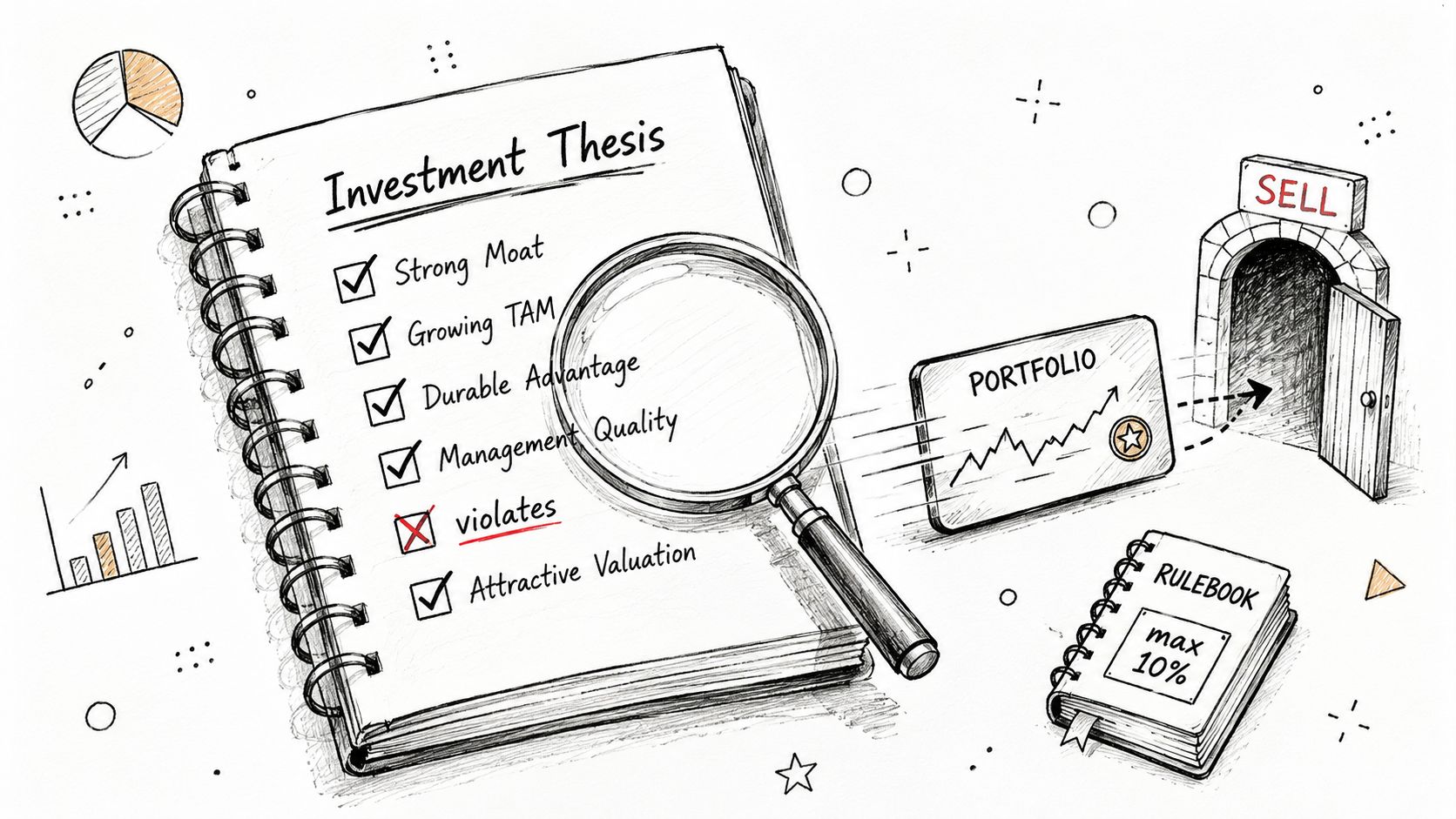
A Berkshire review starts with a simple question, whether the original reason for owning the stock still holds. That matters because a business can stay strong while the holding becomes weak, if the moat shifts, the position gets too large, or the capital allocation case no longer matches the notes written before purchase. The evaluation therefore focuses less on price movement and more on whether the holding still satisfies the conditions that justified ownership.
How the evaluation rule actually works
The cleanest process is to write the sell conditions before you buy. A Berkshire-style review usually sets the moat condition, the balance sheet condition, and the position-size condition side by side, then checks them on a fixed cadence. If Apple grows too large relative to portfolio constraints, the evaluation can still land on exit or trim even when the operating business remains excellent. That separates business quality from portfolio fit and prevents size drift from hiding in plain sight.
A useful internal rule set looks like this:
- Thesis trigger: What evidence would make you exit?
- Sizing trigger: What concentration level becomes unacceptable?
- Moat trigger: What would show the original edge is weakening?
- Review cadence: When do you reassess, monthly or quarterly?
Practical rule: Strong performance does not cancel a broken thesis. It can hide it.
The virtue of this model lies in repeatability, and that matters in a real portfolio review. Berkshire's long-term hold in See's Candies worked because the moat stayed intact, while businesses like IBM faced weakening thesis support over time. A portfolio process should state the verdict clearly, keep, exit, or watch, and the follow-up question should be direct, what fact would change that verdict. For a strategy evaluation example, a dividend-growth framework can help turn those checks into a routine review process, especially when you want the rules to stay visible and easy to apply.
2. The Investment Club Model Threadneedle Value Fund's Rule-Based Evaluation
A club or committee can drift faster than a solo investor because people can rationalize almost anything once a discussion gets going. Rule-based evaluation reduces that risk by forcing everyone to score holdings against the same written philosophy, not against the loudest voice in the room. The outcome is usually less debate over personalities and more consistency in judgment, which is what matters when several people touch the same book.
The strength of this model is repeatability. If the strategy says a stock must sit inside a certain valuation band, carry a defined dividend profile, and meet balance sheet quality standards, the discussion shifts from opinion to evidence. That makes the review process easier to defend and easier to repeat.
Where the written rules do the heavy lifting
A Threadneedle-style process works best when every holding is screened against the same thresholds on a fixed schedule. If a healthcare name moves above a pre-set valuation limit, the verdict can shift from keep to exit even if the story still sounds persuasive in the meeting. That discipline keeps the portfolio aligned with the original philosophy instead of letting exceptions build up one by one.
The simplest way to copy the model is to make the rules explicit:
- Hard rules: Must meet these, no debate.
- Soft rules: Usually apply, but you can document exceptions.
- Exception log: If you keep a rule-breaker, explain why.
- Quarterly review: Don't wait for a crisis to revisit the thesis.
For a strategy evaluation example, Monsa can help because it lets you hold a strategy constant while the portfolio changes. The relevant template for this style is the Quality Compounders strategy, which fits the idea of checking businesses against written quality rules instead of reacting after the fact.
Document exceptions explicitly. If you're going to violate your own rule, the burden of proof should be on the holding, not on the analyst.
A good club process also asks the right “what if” question. What if valuation stays stretched for another year while the fundamentals stall? What if the sector cap gets breached because three names move together? The verdict should come from the rules, not from group memory.
4. Fundsmith Equity Fund's Quality Thesis Enforcement with Disciplined Selling
A quality portfolio can look comfortable right up until one holding becomes hard to justify at the current price. That is the point where evaluation has to do real work. A Fundsmith-style process checks whether the business still fits the quality thesis, then applies the exit rules without softening them because the company is admired or the holding has already done well.
Better evaluators go further, asking whether the business remains good enough at the current price and whether it still satisfies the published ownership rules. That matters because a thesis can fail in two different ways, the economics can weaken, or the valuation can drift beyond what the process allows.
How quality rules stay enforceable
The sell side has to be as explicit as the buy side. If a holding no longer matches the quality and valuation framework, the decision should follow the rule set, not familiarity with the brand or confidence that the market will eventually agree. If a company still clears the return, moat, and durability tests, the review can support continued ownership even after the share price has moved sharply.
That is where the Quality Compounders strategy becomes a practical evaluation template. It focuses attention on the published quality rules and forces the portfolio review to answer the same questions every time, even when a position feels emotionally difficult to sell.
A useful checklist keeps the review concrete:
- Quality still intact? Confirm the business still shows the traits the process requires.
- Price still acceptable? Compare the current valuation with the framework, not the purchase price.
- Ownership rule still met? Check whether the holding remains within the published limits.
- Decision documented? Record why the name stays or goes.
The trade-off is easy to miss. A strict process can cause an investor to exit a great company too early if the valuation rule is tight. A loose process can leave a portfolio holding onto a weak thesis long after the original case has faded. The evaluation step exists to keep those two errors in view at the same time.
If a holding breaks the rule, the review needs a clean verdict. If it stays, the file should explain why the thesis still holds under the written process.
What if the business quality is intact but the multiple keeps expanding? What if the company looks excellent, yet the portfolio already has too much exposure to the same type of earnings stream? The answer should come from the rules on paper, not from the comfort of owning a familiar winner.
5. The Dividend Aristocrats Portfolio Strategy Systematic Rule Application and Constraint Monitoring
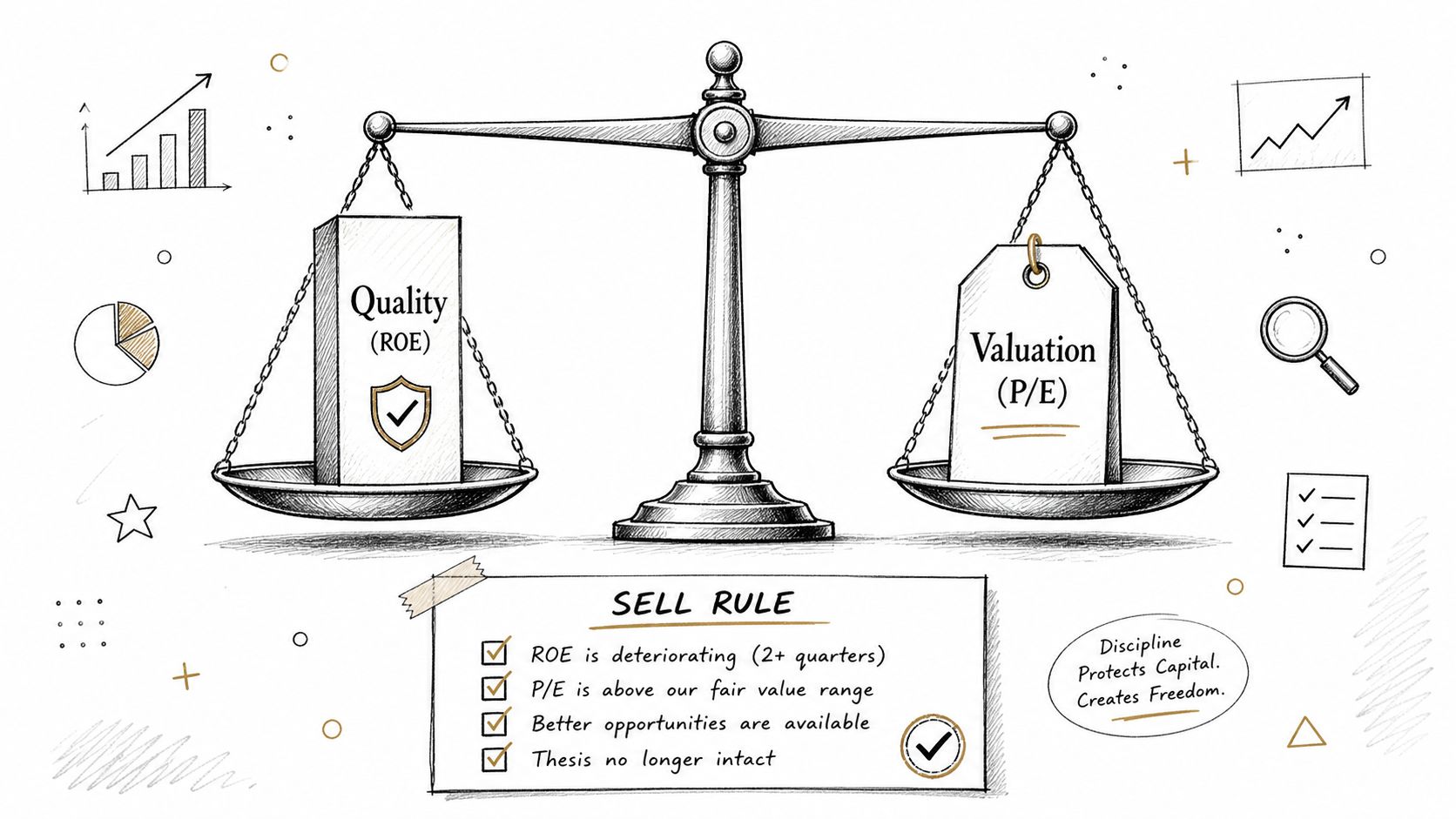
Income portfolios often fail for a boring reason, they get attached to yield and stop checking the rule set. The Dividend Aristocrats framework is useful because it turns income selection into a set of explicit, repeatable tests. You are not just asking whether a company pays dividends, you are asking whether it still deserves to stay inside a rules-based income portfolio.
Evaluation has to go beyond a yearly glance at the payout. Dividend growth can weaken, payout ratios can creep higher, and sector concentration can become easy to miss if the review stops at headline yield.
How income rules stay from drifting
A proper evaluation starts with quality, not with the distribution check. If a company's dividend coverage weakens, or if a holding no longer matches the streak requirement, the verdict should change. The portfolio then needs a second layer of review at the constraint level, because even good names can create poor concentration.
Income investors gravitate toward stable names, but stability can hide concentration risk. Fixed review cycles and watch-only scores catch weak coverage before it turns into a cut. That is the discipline that keeps the framework honest.
A practical monitoring routine includes:
- Coverage check: Is the dividend still supported by earnings or cash flow?
- Streak check: Does the company still meet the dividend-growth rule?
- Sector check: Are utilities or staples becoming too dominant?
- Position check: Is one holding too large to ignore if it cuts the dividend?
The Dividend Growth strategy helps keep that review anchored in the same rule set. It forces quality and discipline into one screen, which matters more when the portfolio is concentrated and a single mistake can matter disproportionately.
The real test comes when sentiment and rules point in different directions. A company can still look dependable while its valuation gets stretched, or it can keep paying while the coverage trend slips. In either case, the review should end with a clean verdict, keep, trim, or exit, based on the written process rather than comfort with a familiar holding.
5. The Dividend Aristocrats Portfolio Strategy Systematic Rule Application and Constraint Monitoring
Income portfolios often fail for a familiar reason, they let yield become the headline and stop checking the rule set underneath. The Dividend Aristocrats framework helps because it turns income selection into a sequence of explicit, repeatable tests. You are not only asking whether a company pays dividends, you are asking whether it still belongs inside a rules-based income portfolio.
The evaluation should happen well before the annual review. Dividend growth can slow, payout ratios can drift higher, and sector concentration can stay hidden if the only focus is total yield.
How income rules stay from drifting
Start with the quality rule, then move to the distribution rule. If a company's dividend coverage weakens, or if a holding no longer matches the streak requirement, the verdict should change. Then review the portfolio at the constraint level, because even good names can create poor concentration.
A practical monitoring routine includes:
- Coverage check: Is the dividend still supported by earnings or cash flow?
- Streak check: Does the company still meet the dividend-growth rule?
- Sector check: Are utilities or staples becoming too dominant?
- Position check: Is one holding too large to ignore if it cuts the dividend?
Reliability and diversification pull in different directions. Income investors gravitate toward stable names, but stability can hide concentration risk. Fixed review cycles and watch-only scores for borderline holdings help catch weak coverage before it turns into a cut, and that keeps the framework honest.
A good strategy evaluation example in this category ends with a clear verdict, keep, trim, or replace. For investors using Monsa, the Classic Value strategy provides a useful reference point for keeping the rules visible as holdings change. If the rules no longer fit the business, the portfolio should not pretend otherwise.
6. Systematic Value Investing Evaluation The Magic Formula Framework and Rule Refinement
The Magic Formula keeps the thesis plain. Find quality, find cheapness, rank the universe, and rebalance on schedule. That sounds mechanical because it is. Mechanical discipline helps when the risk is letting a story override the screen.
The evaluation problem is not whether the formula looks elegant. It is whether the formula is still being applied in the same way, and whether the inputs are being calculated consistently. Once the math shifts, the strategy shifts with it.
Why the formula is only half the work
A value strategy rises or falls on definitions. If return on invested capital is calculated one way in one screen and another way elsewhere, the ranking is contaminated before the portfolio even starts. Evaluation should include a source check for every metric, especially when the process is meant to stay systematic.
A disciplined review process looks like this:
- Define the formula clearly: No hidden adjustments.
- Standardize the data source: Same inputs, same logic.
- Rebalance on schedule: No discretionary delays.
- Review regime fit: Ask when the formula tends to struggle.
For investors using Monsa, the Classic Value strategy is a natural reference because the platform keeps the rules visible while the portfolio changes. The fit is obvious with Monsa, which scores each holding against written thesis rules and refreshes verdicts nightly. That matters when the verdict needs to come from the strategy, not from the last polished idea someone heard on a podcast.
The trade-off is easy to miss. Simpler formulas are easier to audit, but they can be less adaptable. More complex formulas may seem smarter, but they are harder to explain and harder to test. A good evaluator keeps enough detail to separate strong holdings from weak ones, without adding so many moving parts that no one can say why a name was bought or sold.
7. Morningstar's Portfolio Health Check Systematic Diversification and Constraint Monitoring
Diversified portfolios still drift, they just drift more subtly. A portfolio can look balanced on paper and still end up overexposed to one sector, one style box, or one crowded fund pair. That's why a health-check style evaluation is so valuable. It doesn't just ask whether each holding is good, it asks whether the book is still built the way you intended.
Morningstar-style monitoring is useful because it breaks portfolio evaluation into three separate questions. Does the allocation still match the target, do the holdings overlap too much, and are any constraints close to breaking?
How drift turns into action
A clean review process starts with target ranges, then watches for deviations that need action. If a stock grows too large after a strong run, the verdict might be trim even if nothing is wrong with the business. If two funds overlap too much, the issue isn't quality, it's redundancy. If a sector becomes too large, the evaluation should move from observation to rebalancing.
Use a simple control loop:
- Target allocation: What you want the portfolio to look like.
- Constraint limits: Hard boundaries you won't cross.
- Warning zone: A place to monitor before action is required.
- Violation: A state that demands a decision.
For this style of evaluation, the fit is obvious with the strategy-versus-portfolio terminal. It's built around checking whether holdings still match the written thesis, which is exactly the problem portfolio drift creates.
The practical benefit is speed. You don't need to re-decide the whole portfolio every time markets move. You only need to know which names are at risk, which constraints are broken, and which holdings deserve a fresh thesis review. That makes portfolio management less reactive and more governable.
7-Point Strategy Evaluation Comparison
| Approach | Implementation Complexity (🔄) | Resource Requirements (⚡) | Expected Outcomes (📊) | Ideal Use Cases (💡) | Key Advantages (⭐) |
|---|---|---|---|---|---|
| Berkshire Hathaway's Thesis-Drift Detection and Portfolio Discipline | Medium 🔄, manual thesis writing & periodic reviews | Medium ⚡, experienced analysts, time-intensive documentation | Clear exit rationale, reduced emotional holding, consistent portfolio rules 📊 | Long-term concentrated investors wanting disciplined exits 💡 | Institutionalized decision-making and stakeholder transparency ⭐ |
| The Investment Club Model: Threadneedle Value Fund's Rule-Based Evaluation | Medium 🔄, formal numeric rules + committee checks | Medium ⚡, multi-person coordination, spreadsheets, compliance logs | Consistent decisioning across team; defensible audit trail 📊 | Investment clubs and small teams needing alignment and onboarding 💡 | Scalability across people; simplified analyst onboarding ⭐ |
| Renaissance Technologies' Quantitative Rule Refinement and Strategy Evolution | Very High 🔄, codification, backtesting, continuous tuning | Very High ⚡, quant researchers, heavy compute, long clean datasets | Rapid iteration and measurable signal tracking; higher overfitting risk 📊 | Quant shops pursuing systematic process research with infrastructure to match 💡 | Empirical optimization and regime-aware adaptation ⭐ |
| Fundsmith Equity Fund's Quality Thesis Enforcement with Disciplined Selling | Low-Medium 🔄, published rules with strict exit triggers | Medium ⚡, deep research on concentrated positions, investor comms | Clear evaluation discipline; transparent rationale; concentrated exposure 📊 | Concentrated quality investors who demand public rules and discipline 💡 | Publicly known criteria that build trust and prevent anchor positions ⭐ |
| The Dividend Aristocrats Portfolio Strategy: Systematic Rule Application and Constraint Monitoring | Low 🔄, mechanical eligibility rules and annual re-qualification | Low-Medium ⚡, dividend metrics, periodic rebalancing tools | Stable income profile, diversified dividend exposure, lower single-stock risk 📊 | Income-focused, buy-and-hold investors seeking dividend stability 💡 | Simplicity, mechanical rebalancing, easy replication ⭐ |
| Systematic Value Investing Evaluation: The 'Magic Formula' Framework | Low 🔄, two-metric formula and mechanical rebalance | Low-Medium ⚡, screening tools, historical data for validation | Deterministic value exposure; replicable process but limited nuance 📊 | Rule-based value investors and DIY quantitative practitioners 💡 | Transparency, easy replication, mechanical discipline ⭐ |
| Morningstar's Portfolio Health Check: Systematic Diversification and Constraint Monitoring | Medium 🔄, multi-asset analytics and drift detection workflows | Medium-High ⚡, data integrations, visualization and reporting tools | Better diversification visibility, overlap detection, and proactive rebalancing alerts 📊 | Advisors and retail portfolios needing allocation, overlap, and drift monitoring 💡 | Holistic portfolio view with automated drift and overlap alerts ⭐ |
From Example to Execution Your Strategy Evaluation System
These examples point to the same conclusion. Good strategy evaluation isn't about being right once, it's about building a process that tells you when your original idea still holds and when it doesn't. The strongest investors don't rely on memory or vibes. They write the rules, check the rules, and act when the rules say the holding has drifted.
The common thread across these portfolios is a written strategy with checkable criteria. Berkshire-style discipline, committee-based rule enforcement, systematic quant refinement, quality exit rules, dividend constraint monitoring, formula-based value ranking, and portfolio health checks all work for the same reason, they create a repeatable verdict. That verdict may be keep, exit, trim, or watch, but it should never be vague.
The best habit is to separate three things every time you review a holding. First, what the original thesis said. Second, what the current data says. Third, what would have to change to reverse the verdict. If you can't answer those three questions, the portfolio is running on inertia.
A tool like Monsa fits this workflow because it stores investor rules, scores holdings against them, and refreshes the verdict nightly using fundamentals, prices, and FX. That doesn't replace judgment, but it does make the discipline visible, which is the part most portfolios lack.
If you want to turn this framework into a live process, visit Monsa and test your written rules against the holdings you already own. Build the verdicts before the drift gets worse, then let nightly scoring tell you which names still fit and which ones need a new decision.
Related reading: How to Evaluate Stocks with a Rules-Based Workflow, Deep Value Investing Strategy: A 2026 Guide, and Monsa's founding annual pricing for the first 100 annual subscriptions.
Monsa is a portfolio-analysis tool, not a broker or investment adviser. Nothing here is investment advice.
// related reading
How to Evaluate Stocks with a Rules-Based Workflow
Learn how to evaluate stocks using a stepwise rules-based workflow. Covers fundamentals, valuation, qualitative checks, and practical templates.
Deep Value Investing Strategy: A 2026 Guide
Master the deep value investing strategy with metrics, screening rules, and risk controls. A practical 2026 guide for serious long-term equity investors.
Momentum Investing Strategy: Rules to Check Nightly
A momentum investing strategy holds stocks the market is already rewarding. Learn the entry rules, drawdown limits, and portfolio caps that make it checkable.
7 / 100 founding seats claimed - $100/yr locked, then $190/yr
Monsa is a portfolio-analysis tool, not a broker or investment adviser. It never recommends what to buy or sell - it checks what you hold against rules you wrote. Nothing here is investment advice.