// blog
Deep Value Investing Strategy: A 2026 Guide

From 1926 to 2013, low price-to-book stocks posted 12.6% annually versus 8.6% for glamour stocks, and from 1951 to 2013 the spread was even clearer, 15.0% for value versus 9.6% for glamour. That historical gap is the starting point for any serious deep value investing strategy. The point is not to buy whatever screen looks cheap on paper. The point is to study deep discounts without getting trapped in names that cannot survive long enough for mean reversion to matter.
That distinction still matters in 2026 because deep value is often reduced to a multiple screen. Many guides stop at price-to-book or price-to-earnings and ignore liquidity, refinancing risk, and position sizing, even though those are the controls that shape whether cheapness can close or quietly bleed. A real deep value process ties valuation to balance-sheet survivability and patience, then keeps reassessing both as conditions change.
Table of Contents
- What Deep Value Investing Strategy Means in 2026
- Three commitments the strategy requires
- The Core Principles Behind Deep Value Investing
- What the philosophy rejects
- Mean reversion is a thesis, not a hope
- Key Metrics and Distressed Signals to Track
- What each metric is really doing
- Distressed signals that change the meaning of cheap
- Deep Value Metric Toolkit with Typical Thresholds
- Risk Management and Balance-Sheet Filters
- Hard filters that keep the book alive
- Reading debt and liquidity as a pair
- What to check before you call something deep value
- A Sample Deep Value Screening Rule Set
- An Auditable Rule Stack
- How to score without turning the process into a black box
- Position Sizing and Portfolio Construction
- Why breadth matters more here than in most styles
- The sizing discipline that keeps behavior sane
- Common Deep Value Mistakes and How to Avoid Them
- The second mistake is ignoring debt risk
- The third mistake is emotional attachment to losers
What Deep Value Investing Strategy Means in 2026
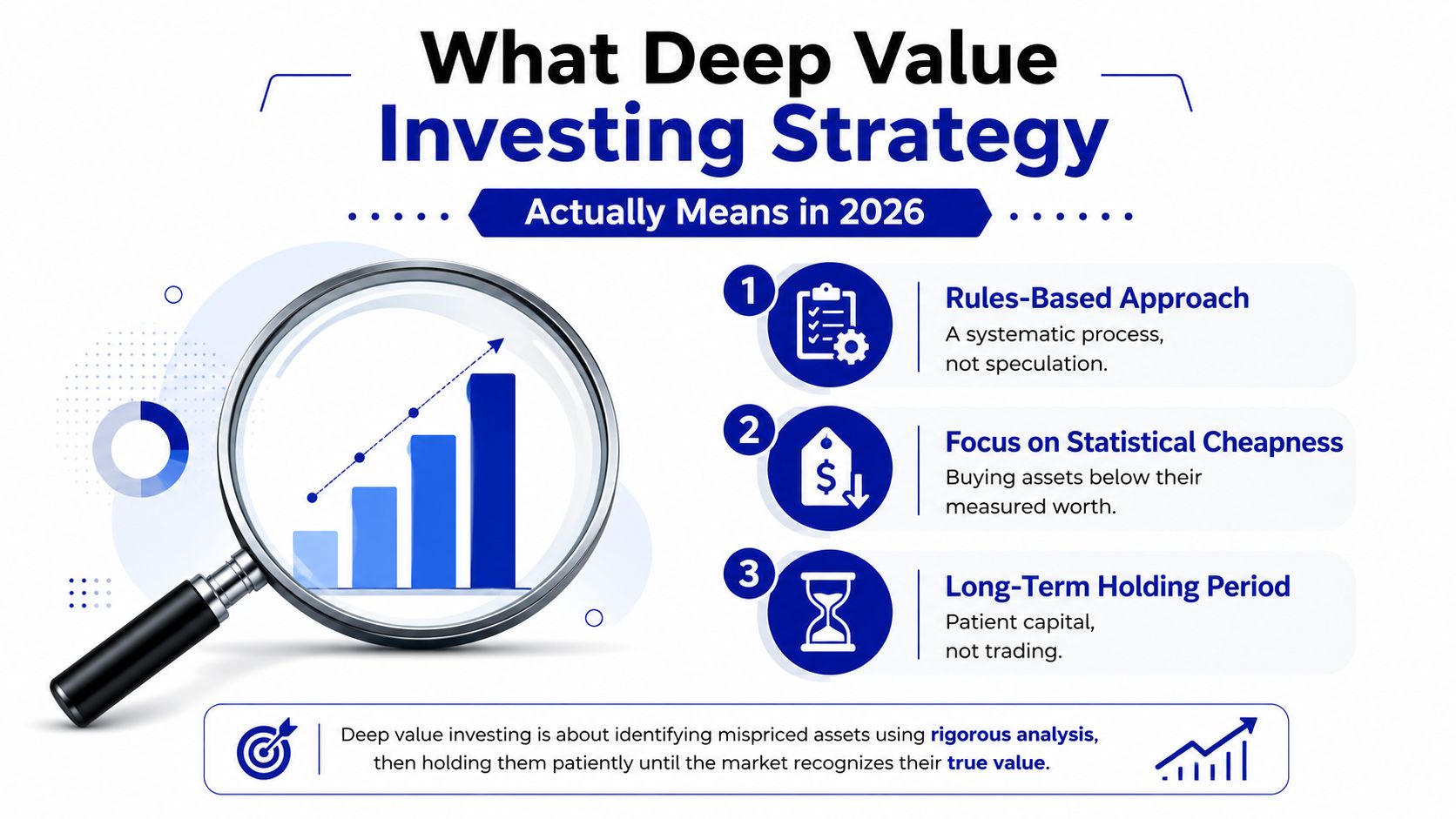
A deep value investing strategy is a process for studying businesses or assets at a steep discount to conservative estimates of worth, usually when the market has moved on because the headlines are bad, momentum has broken, or the stock has been ignored for too long. The point is not to own the cheapest-looking ticker in a screen. The point is to identify a margin of safety that still survives a closer look at earnings power, asset coverage, and refinancing risk.
That distinction matters because cheapness can be real or fake. A stock can screen low on price-to-book or enterprise value and still be a poor candidate if the balance sheet is stretched, the assets are hard to monetize, or the business needs perfect execution to avoid dilution. A solid deep value investing strategy starts with valuation, then immediately asks whether the company can stay alive long enough for that valuation gap to close.
The practical version in 2026 is more disciplined than the old “buy what is hated” rule of thumb. Analysts who run deep value screens through multiple cycles usually treat three controls as first-class problems, not afterthoughts. They check the gap to intrinsic value, they pressure-test balance-sheet survivability, and they set a re-scoring cadence so a cheap stock can be removed when the thesis stops working. A useful starting point for building that workflow is a structured stock research process, such as the one outlined in Monsa's stock research tools guide.
Three commitments the strategy requires
First, valuation has to be measurable. Cheap needs a reference point, whether that comes from book value, normalized earnings, liquidation-style asset support, or a conservative sum-of-the-parts view. If the discount cannot be tied to something concrete, it is just a story about price.
Second, survivability comes before upside. A large discount on a weak balance sheet can disappear for the wrong reason, through covenant pressure, asset sales, or dilution. Deep value investors are assessing time as much as they are assessing price, because a business that runs out of liquidity rarely gives the market a clean path back to fair value.
Third, patience has to be paired with discipline. Deep value positions can look wrong for long stretches, and that is part of the setup. The right response is not to average down mechanically. It is to keep tracking whether the original discount still exists and whether the company's capital structure still supports a recovery.
Practical rule: if the discount is large but the balance sheet cannot absorb a weak operating period, the setup is not deep value. It is unresolved distress.
The modern version of the strategy also needs a written process for when to hold, when to trim, and when to exit. Cheap stocks fail for different reasons, and a screen that ignores that fact will accumulate traps alongside opportunities. The edge comes from evaluating cases where valuation, survivability, and review discipline line up at the same time.
The Core Principles Behind Deep Value Investing

The philosophy behind deep value starts with a blunt assumption, prices can diverge from worth for a long time, but they do not get to ignore reality forever. Benjamin Graham's margin-of-safety logic still sits underneath the approach, and the value framework summarized by VanEck emphasizes buying at a significant discount to intrinsic value and staying focused on long-term outcomes rather than daily noise source. Deep value takes that logic further by leaning into uglier, more neglected setups where the discount is larger and the recovery path is less popular.
What the philosophy rejects
Deep value does not trust narrative first. It distrusts stories that justify high multiples, especially when the story depends on fast growth, clean sentiment, or investor enthusiasm staying intact. That is why the approach can tolerate companies that look awful in the present, but only when the underlying asset base, earnings power, or liquidation math gives real support.
It also differs from softer value or GARP-style thinking. A quality-oriented value investor may accept a fair price for a strong business. A deep value investor usually wants a much bigger gap between price and conservative worth, even if the business quality is lower. That gap is the compensation for uncertainty.
Mean reversion is a thesis, not a hope
Mean reversion is often treated like a slogan. In deep value, it is a testable belief that a business can move from mispriced to fairly priced only if the facts stop getting worse. That is why the strategy accepts volatility as a cost of entry. The investor is studying cases ahead of recognition, not after recognition is obvious.
Cheapness without a recovery mechanism is just a lower price on the same problem.
That is the part many investors do not internalize. The market can be right about weak businesses for years. Deep value only makes sense when the market is over-penalizing something that can still stabilize, normalize, or liquidate into more value than the current quote reflects.
The cleanest mindset is simple. Focus on statistically cheap businesses, demand a margin of safety, and accept that patience is part of the underwriting. If that trade-off does not fit your style, a softer value or quality approach is probably a better fit.
Key Metrics and Distressed Signals to Track
A deep value screen starts with a ratio, but the ratio alone does not decide the case. Price-to-book remains a common anchor because the long-horizon evidence behind deep value is built around low book multiples. Price-to-tangible-book helps when intangibles make equity look better than it is, while earnings-based ratios help separate cheap companies from balance-sheet mirages. The point is to test whether cheapness is supported by assets, cash generation, and survivability.
What each metric is really doing
Price-to-book tells you what the market is paying for accounting equity. It works best when the asset base is real and the balance sheet is not overloaded with accounting noise. Price-to-earnings and EV/EBIT answer a different question, namely whether operating earnings can support a recovery even when book value is messy or temporarily distorted.
Free cash flow yield matters because reported earnings can flatter the picture, but cash still has to arrive. If a company looks cheap on P/E and still produces cash, the base case is sturdier than if the reported profit is carrying all the weight. That matters in deep value, where distress often sits in the gap between accounting income and actual liquidity.
Distressed signals that change the meaning of cheap
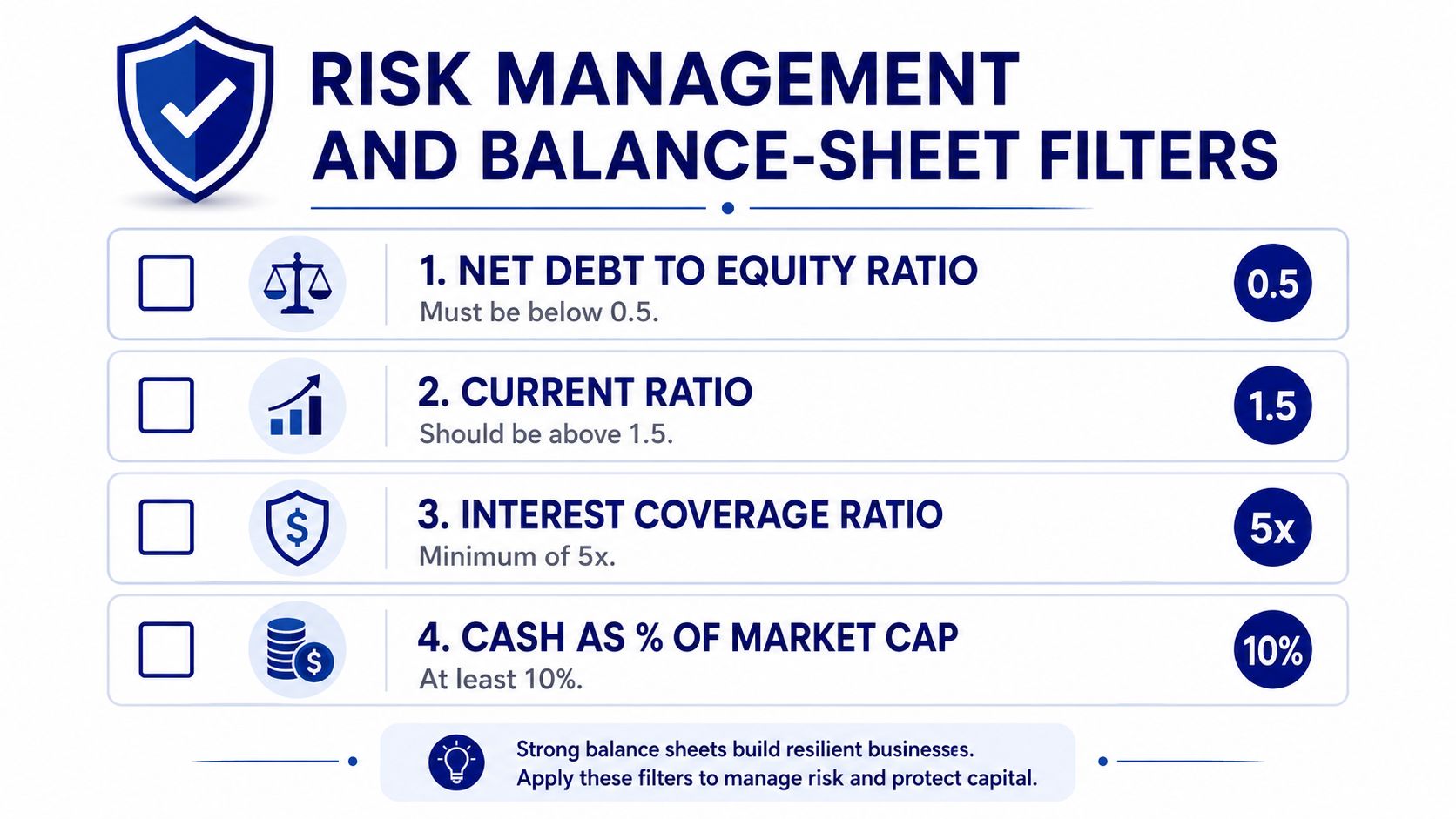
A low multiple on a business with weakening working capital means something very different from the same multiple on a stable cyclical. The cited deep value guidance recommends avoiding excessive debt, watching net debt-to-equity above 50%, and preferring a current ratio above 1.5 as a buffer against default and working-capital strain Stockopedia's deep value guidance.
A company can look optically cheap and still be uninvestable if current assets are shrinking, liabilities are climbing, or debt service is crowding out operational flexibility. In those cases, the multiple is a symptom, not an opportunity.
Deep Value Metric Toolkit with Typical Thresholds
| Metric | What It Captures | Typical Threshold | Caveat |
|---|---|---|---|
| Price-to-book | Asset-backed cheapness | Low enough to show a clear discount | Can mislead when assets are intangible-heavy |
| Price-to-tangible-book | Harder asset support | Preferably below tangible value | Tangible book can still overstate recoverable value |
| P/E | Earnings cheapness | Low relative to peers and history | Earnings can be cyclical or temporarily inflated |
| EV/EBIT | Whole-firm operating value | Low enough to imply cheap enterprise value | Must be read with debt and cash levels |
| Free cash flow yield | Cash generation relative to price | Strong enough to support holding through noise | One period of cash flow can be noisy |
| Net debt-to-equity | Debt burden | Keep below 50% where possible Stockopedia's deep value guidance | Equity can be distorted by accounting write-downs |
| Current ratio | Short-term liquidity | Prefer above 1.5 Stockopedia's deep value guidance | Inventory quality matters too |
| Share count drift | Dilution risk | Watch for persistent increases | New shares can erode the thesis |
If you want to compare candidate names against tools and workflows that support screening, the best stock research tools discussion is a useful reference point for how investors organize data before they ever place capital.
The key habit is to read metrics together. Cheapness plus stress is a red flag. Cheapness plus stable cash generation plus liquidity is the kind of setup that belongs on a real watchlist.
Risk Management and Balance-Sheet Filters
A deep value screen that ignores the balance sheet is usually screening for trouble, not opportunity. Cheapness only matters if the company can survive long enough for the market to reprice it. In practice, that means debt, liquidity, and refinancing risk deserve the same attention as valuation, because a stock can remain optically cheap while the underlying business keeps weakening.
Hard filters that keep the book alive
The cleanest way to handle this part of the process is to set the balance-sheet rules before you look at upside. That keeps distressed situations from slipping into the portfolio just because they screen as statistically cheap. The sharpest investors treat survival as a gate, not a side note, because the wrong capital structure can turn a valid valuation case into a value trap.
A cheap stock with no balance-sheet buffer is a timing bet, not an investment thesis.
That rule becomes more important when the market is already questioning access to capital. If a company is relying on fresh funding to bridge a weak operating period, the quoted discount may be compensation for real fragility rather than an error in pricing. The right question is whether the business can keep operating without a forced reset.
Reading debt and liquidity as a pair
Debt by itself does not tell the full story. A cyclical company can carry borrowings and still be workable if cash generation is stable and maturities are manageable. The problem is structural borrowing, where weak earnings quality, stressed working capital, or declining asset values make the balance sheet less of a buffer and more of an accelerant.
Liquidity deserves a separate check because it tells you how much room the business has before it has to make a bad choice. Current assets only matter if they can be turned into cash without heavy haircuts, and near-term obligations only become manageable if the company has time to meet them from operations. A screen that combines solvency and liquidity catches the situations where cheapness is just the first layer of stress.
What to check before you call something deep value
- Debt maturity pressure: near-term refinancing needs can expose you to terms the market has not fully priced.
- Working-capital trend: deteriorating receivables, inventory, or payables can drain cash even when the income statement looks stable.
- Dilution risk: repeated equity issuance can reduce per-share value long before the headline business turns.
- Asset quality: book value only helps if the assets have real recovery value or support ongoing earnings.
The aim is not to avoid every stressed company. It is to separate temporary stress from balance-sheet decay that makes recovery unlikely. A practical way to keep that distinction visible is to compare survivors in a portfolio visualizer for deep value screens, then ask which names still look cheap after you stress the financing side.
The result is a more honest watchlist. Cheap plus balance-sheet strain is usually a warning. Cheap plus cash support, manageable obligations, and tolerable dilution risk is the kind of setup that can survive long enough for the thesis to be tested.
A Sample Deep Value Screening Rule Set
A usable deep value screen has to be blunt. It should cut weak candidates fast, rank the survivors clearly, and leave a paper trail for every decision. The value literature in the source set favors explicit thresholds, not vague cheapness, and the same logic shows up in practitioner guidance on deep value portfolio construction source.
An Auditable Rule Stack
Start with eliminations. Remove names with broken data, non-standard listings, or fundamentals that make the comparison meaningless. Then require cheapness on a primary metric, usually price-to-book or a whole-firm equivalent, and only after that apply the solvency screen. That order matters because some investors screen for quality first and end up drifting away from deep value altogether.
A practical build might look like this:
1. Hard elimination filters. Exclude companies with negative earnings where the accounting story is too distorted to compare cleanly, and exclude businesses that fail your balance-sheet floor. 2. Valuation screen. Keep only names that look materially cheap on book-based or earnings-based measures. 3. Financial health check. Apply liquidity and debt constraints from the prior section. 4. Ranked shortlist. Sort survivors by a composite view of cheapness, cash support, and balance-sheet resilience.
How to score without turning the process into a black box
A weighted composite can help, but it has to stay transparent. Give more weight to the metric that matters most for your universe, then keep the rules visible enough that you can explain why one stock made the list and another did not. That discipline is why tools that preserve rule logic matter more than dashboards that only look polished. One workflow option is the rules-based structure at Monsa, which maps written criteria into checkable outputs.
Analyst rule: If you cannot explain the screen in one page, it is too complicated to manage through a cycle.
Keep the result narrow in practice. A shortlist should be short enough that you can read filings, compare balance sheets, and revisit the thesis without rushing. The goal is not to own the most names, it is to study only the names that still fit the rules after the market moves.
A screen that produces too many names usually means the thresholds are too soft. A screen that produces none usually means the rules are closer to a fantasy than an investable standard.
Position Sizing and Portfolio Construction
Deep value breaks down when one bad position can sink the result. Portfolio construction is part of the strategy, not an afterthought. The deep value guidance in the source set points toward a broad, diversified book, and AQR's paper stresses careful risk management plus keeping dry powder for dislocations source.
Why breadth matters more here than in most styles
Deep value names are often cheap for different reasons. Some are cyclical recoveries, some are balance-sheet repairs, and some are true traps. Because the failure modes are not the same, a narrow portfolio can be damaged by one permanent loser, one sector shock, or one financing event that hits several holdings at once.
Cash belongs in the framework for the same reason. It is not dead weight in a deep value book, it is optionality. When the screen turns up a better dislocation later, capital should still be available instead of fully committed to marginal ideas that only looked acceptable at entry.
The sizing discipline that keeps behavior sane
Per-name caps matter because conviction is not the same thing as certainty. Sector caps matter because cheap stocks often cluster in stressed industries, and correlation rises when the market stops separating one name from another. If the portfolio is full of companies that all need the same macro break, it does not have diversification, it has one crowded trade in multiple wrappers.
A workable structure is simple:
- Size by thesis quality. Stronger balance sheets and cleaner catalysts can justify more capital than fragile or unclear cases.
- Cap sector exposure. Cheapness clusters, and so does disappointment.
- Keep cash for dislocations. Dry powder is part of the strategy, not a sign the screen failed.
- Re-score names routinely. A stock that was cheap and survivable last quarter may no longer fit after new filings or price moves.
If you want a portfolio-level view of names, weights, and drift, the portfolio visualizer comparison is a useful workflow reference for thinking in books rather than isolated ideas.
The best deep value portfolios usually feel boring on purpose. They are broad enough to absorb failure, concentrated enough to matter, and liquid enough to act when the market offers better discounts. That balance is what turns a style into a repeatable process.
Common Deep Value Mistakes and How to Avoid Them
The fastest way to turn a cheap stock into a bad outcome is to confuse statistical cheapness with a thesis that can survive stress. A low multiple can coexist with weakening assets, poor capital allocation, or a business model that keeps losing ground. In those cases, the stock may look cheap for a long time because the market is pricing in slow erosion rather than a quick re-rating.
The cleaner approach is to treat balance-sheet condition and business quality as part of the entry decision, not as afterthoughts. If the discount exists because creditors have more claim on the enterprise than equity holders do, or because dilution is likely, the low price is not a margin of safety. It is the market warning you that the capital structure matters more than the headline valuation.
The second mistake is ignoring debt risk
Cheap stocks with too much debt can stay impaired long after the screen says they are attractive. The deep value guidance cited earlier recommends avoiding excessive debt, keeping net debt-to-equity below 50% where possible, and preferring a current ratio above 1.5 source. Those are not decorative filters. They are survivability checks that help separate temporary weakness from a balance sheet that can absorb pressure.
Ignoring debt risk usually shows up as valuation-only thinking. The investor sees low price-to-book or low P/E and assumes the market has already priced in the downside. In practice, the equity can keep getting repriced lower if suppliers tighten terms, lenders become cautious, or working capital starts to consume cash faster than expected.
The third mistake is emotional attachment to losers
A deep value position needs patience, but patience is not the same thing as refusing to admit that the thesis has changed. Re-scoring matters because filings, prices, and operating trends move the name in or out of range. The guidance on periodic review and portfolio discipline supports that point, as noted earlier source.
Rule of thumb: If the stock no longer passes a fresh screen, the original purchase price does not matter.
The habit to build is simple. Write the exit condition before entry, then enforce it without drama. If the stock stops being cheap, if the financial profile worsens, or if the survivability test no longer holds, the position deserves an immediate review. That keeps deep value disciplined instead of turning it into a way to defend old mistakes.
Monsa gives self-directed investors a way to hold a written strategy, score each stock against it, and refresh those scores nightly as fundamentals and prices change. If you are building a deep value process, that kind of rules-based oversight helps keep the book aligned with the thesis instead of the other way around. Visit Monsa to see how strategy-defined screening and ongoing fit checks can support a more disciplined portfolio.
Monsa is a portfolio-analysis tool, not a broker or investment adviser. Nothing here is investment advice.
// related reading
Value Investing Screener: What to Filter For and How to Build One
The metrics a value investing screener actually filters by, how to set thresholds that catch cheap stocks without catching value traps, and what changes once you own the name.
Momentum Investing Strategy: Rules to Check Nightly
A momentum investing strategy holds stocks the market is already rewarding. Learn the entry rules, drawdown limits, and portfolio caps that make it checkable.
7 Strategy Evaluation Examples to Study in 2026
See 7 real-world strategy evaluation examples from Buffett to quant funds. Learn to apply disciplined, rule-based analysis to your own stock portfolio today.
7 / 100 founding seats claimed - $100/yr locked, then $190/yr
Monsa is a portfolio-analysis tool, not a broker or investment adviser. It never recommends what to buy or sell - it checks what you hold against rules you wrote. Nothing here is investment advice.