// blog
Strategy Writing Template: A Practical Guide
You can write a sharp thesis in an afternoon, then come back six months later and realize the book no longer matches what you wrote. A position looked like a fit when you framed it, then prices moved, fundamentals changed, or a rule got softened in a chat thread, and now nobody can say which holdings still belong in the strategy. That gap is why a strategy writing template matters, not as a document polish exercise, but as the control layer between conviction and capital.
Why a strategy writing template matters for investors
A lot of investors can describe their thesis in one clean paragraph. Fewer can reopen that paragraph months later and prove the current book still matches it. That is the practical problem the template solves, because it turns a loose idea into a written decision system with visible rules, ownership, and review points.
From thesis memory to thesis maintenance
The strongest use case is after purchase, when the investor needs a consistent way to answer, "Does this still fit?" A generic planning worksheet won't help much there, because it treats strategy as a finished artifact. An investor-grade template treats strategy as a living set of rules that can be re-checked against new data, and that is where Monsa's strategy workflow becomes a useful reference point for turning a thesis into something that can be monitored instead of filed away.
The distinction matters for self-directed investors and small RIAs managing rules-based books. A strategy writing template typically formalizes the same core pieces found in modern strategic plans, mission or purpose, measurable goals, action plans, KPIs, timelines, and it translates broad intent into checkable parts like responsibility, timing, and evaluation (BDC's guide to writing a strategic plan). In planning workflows, structured templates have become standard for a reason.
The useful question isn't "What does this strategy sound like?" It's "What would have to be true for this strategy to still be valid next month?"
What investor-grade actually means
Investor-grade means the template can survive contact with live data. It should make it obvious what counts as a fit, what counts as a violation, and what triggers a review. That is where most template guidance falls short, because it stops at clarity of language instead of operational consistency.
A serious template also needs to be small enough to use. Many guides suggest keeping the plan to five to ten pages so it stays active instead of becoming shelf-ware (Prosper Strategies). That is a useful benchmark for investors too, because a rule set that is too long won't get checked, and a rule set that isn't checked won't govern behavior.
The rest of this article maps the core fields of a usable investor template, then shows how prose becomes thresholds, how qualitative calls stay auditable, and how a written thesis turns into something that can be reviewed again and again without guessing.
The core fields of an investor strategy template
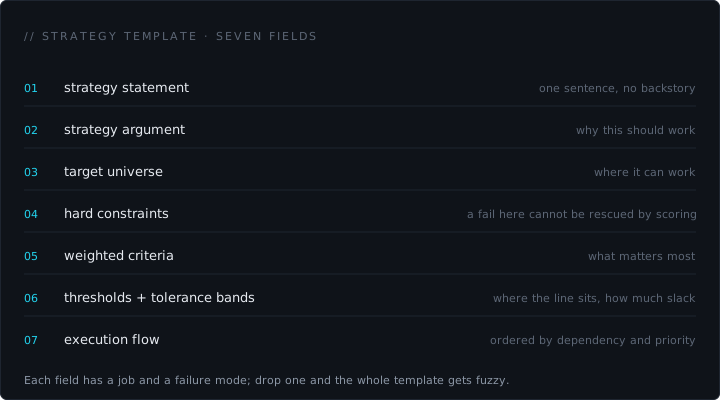
A workable template needs seven labeled slots. If one of them is missing, the whole thing gets fuzzy fast. In practice, the template behaves less like a memo and more like a configuration file, because each field has a job and a failure mode.
Start with a one-sentence strategy statement
The first field should be a single sentence that names the strategy itself. Not the backstory, not the market commentary, just the idea in one line. Alex M. H. Smith's strategy-document guidance suggests writing the strategy statement as a single-sentence summary, then building the argument, implications, and execution flow around it (Smith PDF).
For a GARP-style thesis, that line might say, "Own profitable compounders at reasonable valuations with durable business quality." That sounds simple, which is exactly the point. If the strategy statement needs a paragraph, it probably isn't a statement yet.
Add the strategy argument and target universe
The strategy argument explains why this approach should work. The target universe defines where it can work. That second part is easy to skip, then expensive to discover later, because a rule set without a universe tends to score things it was never intended to own.
The template should also include hard constraints. These are the mandatory rules, such as sector exclusions, market-cap floors, or geography limits. On an investor template page, treat those as the lock on the front door. If a name fails a hard constraint, no amount of scoring should rescue it.
Make criteria and thresholds explicit
The remaining fields are where the template becomes operational. Weighted criteria tell you what matters most. Thresholds tell you where the line sits. Tolerance bands tell you how much wiggle room exists before a rule should be treated as broken. An execution flow orders the whole thing by dependency and priority.
A useful template for investors often asks for four to seven metrics for current performance, a specified future state, and the urgency drivers and beliefs behind the strategy (Monday.com template guidance PDF). That's the right direction for portfolio work too, because a strategy that can't be measured at the rule level won't survive contact with a live watchlist.
Explore a live strategy template structure
Turning thesis prose into checkable rules and thresholds
A thesis like "I want profitable compounders trading below fair value" sounds useful until you try to act on it. Then the phrase starts asking for definitions. What counts as profitable, what counts as fair value, and how much slack is allowed before the rule stops being the same rule? That translation step is where most investors lose rigor.
Translate each phrase into an operator and threshold
The simplest move is to break the prose into measurable clauses. "Profitable compounders" becomes one or more profitability rules. "Below fair value" becomes a valuation rule. Each rule needs an operator, a threshold, and a tolerance band if the process allows judgment at the edges.
For example, a thesis could map to rules like these:
| Thesis phrase | Rule | Threshold | Tolerance | Weight |
|---|---|---|---|---|
| Profitable | ROIC | Above 15% | ±5% | High |
| Balance sheet should be conservative | Debt to equity | Below 0.5 | ±5% | Medium |
| Price should not stretch too far above history | P/E to five-year average | Below 0.9 | ±5% | Medium |
| Business quality should be durable | Margin stability | Above chosen floor | ±5% | High |
Those numbers only make sense if the investor chose them for a reason, but the structure matters more than the exact threshold. A rule that has no operator is a slogan. A rule with no threshold is a preference.
Separate constraints from scoring rules
Hard constraints should sit outside the weighted scoring logic. If a strategy excludes a sector, that doesn't get "partially" violated, it gets violated. If the book needs a minimum liquidity standard or a size floor, those belong in the same hard-stop category.
The rest can be scored. That's where weighting helps. A valuation threshold might matter less than a profitability threshold in one strategy, while the reverse may be true in another. The template should make that trade-off visible instead of burying it in memory.
If a rule changes whenever someone feels nervous, it wasn't a rule. It was a mood.
See a strategy setup example for momentum rules
Separating numeric criteria from qualitative judgments
Numeric rules are clean. Qualitative judgments are messier, but pretending they don't exist usually makes the template worse. Management quality, moat durability, or brand strength often matter in real portfolio work, yet they can't always be reduced to a single balance-sheet line.
Keep the two layers distinct
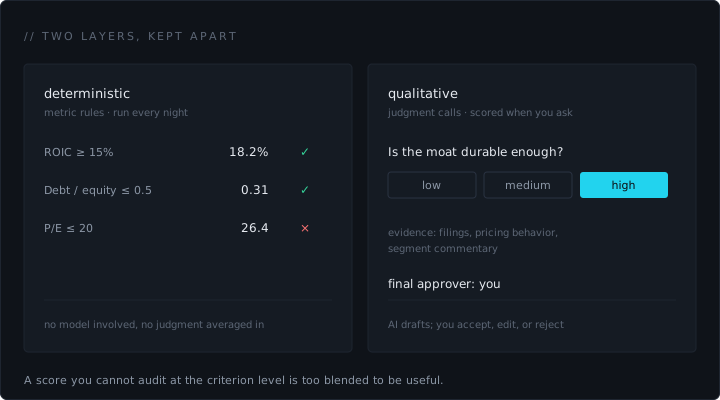
The mistake is mixing a ratio and a judgment in the same field. When that happens, the template becomes hard to audit, because nobody knows whether a score came from evidence, instinct, or last week's market move. A better design keeps deterministic metrics in one layer and qualitative calls in another.
A numeric rule can say whether ROIC passes the threshold. A qualitative rule can say whether the company's moat looks durable enough to support the thesis, but it should be scored on a fixed scale and tied to explicit evidence. That evidence can come from filings, segment commentary, pricing behavior, or product signals, but the investor should still be the final approver.
Use a fixed scale for judgment calls
A fixed scale makes the judgment legible. If a management-quality assessment is high, medium, or low, the meaning still needs to be stable across time. Otherwise, the scoring system drifts with whoever happens to be on duty.
That same split is why AI can help without taking over. A tool can draft a qualitative verdict, summarize the evidence it sees, and highlight what would need to change for the call to flip. The investor then accepts, edits, or rejects it. That workflow is much safer than asking a model to replace judgment altogether.
This separation also keeps the rule set auditable. When a holding slips from "fit" to "borderline," the question should be answerable at the criterion level. Was it the valuation band, the profitability floor, or the qualitative score on business durability? If the template can't answer that, it's too blended to be useful.
Capture, confirm, and tune your rule set
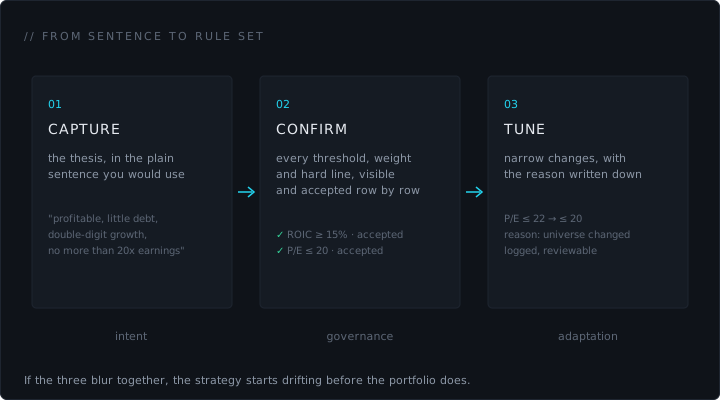
Natural-language capture works best when it doesn't ask the investor to do all the structuring manually at the start. The practical workflow is simple: write the thesis, let the system propose the rules, then inspect every line before anything becomes active. The person making the decision still owns the decision.
Capture the thesis in plain language
Start with the words the investor would use. That might be a sentence, a short paragraph, or a rough note with a few criteria embedded in it. The point is to preserve intent before the template hardens into fields.
At this stage, the system should propose a draft rule set from the language. The investor shouldn't have to build the whole structure from scratch unless the thesis is highly unusual. Many investors know what they want to express, but not how to encode every part cleanly on the first pass.
Confirm each rule before it goes live
Confirmation is where the draft gets tested. Every threshold, weight, tolerance band, and constraint should be visible before use. If the system inferred something too aggressively, the investor should be able to delete it or rewrite it.
That manual confirmation step is what keeps the template from becoming a black box. It also prevents a familiar failure mode in rules-based portfolios, where a nice-looking framework gets launched with assumptions nobody remembers authorizing. A live rule set needs explicit acceptance, not just implied consent.
Tune without losing the original intent
Once the rules are confirmed, tuning should be narrow and documented. If a threshold changes, the reason should be recorded. If a weight changes, the rationale should be visible. That doesn't mean every tweak needs ceremony, but it does mean the template has to remember its own history.
A useful mental model is that capture defines intent, confirm establishes governance, and tune handles adaptation. The best templates make the three steps distinct. If they blur together, the strategy starts drifting before the portfolio ever does.
Scoring holdings and watching the matrix
A rule set that never gets checked against live holdings turns into decoration. The useful version is the one that can score a tracked name, explain the score, and show where the holding sits relative to every other strategy in the book. That's the difference between a plan and oversight.
Score each holding against the confirmed rules
Each tracked stock should receive a fit score, plus a verdict that makes the outcome easy to read. In a live portfolio workflow, that can be something like fits, borderline, or violates, with per-criterion breakdowns showing the exact source of the result.
The matrix view is the part many people underestimate. Once every stock is lined up against every strategy, patterns jump out that are hard to see in a flat list. A name may fit one strategy cleanly, sit on the edge of another, and clearly violate a third. That's useful because it turns a vague "Do we still like this?" into a concrete comparison of rule sets.
Re-score on a fixed cadence
If the scoring only happens when someone remembers to check, the process loses discipline. Nightly re-scoring is far more useful for live books, because refreshed fundamentals, prices, and FX can move the verdict even when no one is looking. That makes drift visible early, before the gap between thesis and holding gets wide.
This is also where watch-only names matter. A watchlist should not be a second-class spreadsheet. It should be scored against the same logic as owned positions so the investor can see when a candidate moves into, or out of, range.
The best portfolio screen is the one that tells you exactly which rule broke, not just that something feels off.
Compare a strategy-first portfolio view
Adding portfolio-level constraints and drift checks
Stock-level fit is only half the job. A book can hold individually acceptable names and still violate the spirit of the strategy because the portfolio drifted into one sector, one currency, or one oversized position. That's why portfolio-level constraints need to live in the template too.
Check the book, not just the stock
A good template should specify maximum position size, sector caps, and minimum or maximum number of positions at the portfolio level. It may also need rules for currency concentration if the strategy is sensitive to exposure in one denomination. Those checks belong above the ticker layer, because they describe the health of the whole book.
Drift tracking is the other piece. A portfolio can slowly wander away from the written thesis even when no single holding looks alarming. That's why the template should compare current book composition against the original intent, not just score names in isolation.
Build an update trigger into the process
A strategy writing template without an update trigger becomes stale fast. Quarterly review is a sensible default cadence, because it forces the investor to re-open the thesis, re-read the rules, and decide whether the thresholds still match the market reality. If a holding violates a hard constraint, the review should happen immediately, not at the next scheduled check.
A simple version log helps a lot here. Record what changed, why it changed, and who approved it. That trail keeps the template auditable and makes it easier to separate deliberate strategy evolution from accidental rule drift.
The same logic applies to weights. If a weight changed because one criterion became less informative, write that down. If a threshold changed because the universe changed, write that down too. The point isn't bureaucracy. The point is making sure the strategy can survive the next review without anyone reconstructing history from memory.
If you're turning investor theses into a live rule set, Monsa is built for that workflow. It stores your rules, scores each tracked stock against them, and refreshes verdicts nightly so you can see whether a holding still fits the written thesis. Visit Monsa if you want a strategy writing template that acts like an operating system, not a document that gets forgotten after launch.
Related reading: How to Evaluate Stocks with a Rules-Based Workflow, Build an Investment Checklist for Smarter Decisions, and Monsa's founding annual pricing.
Monsa is a portfolio-analysis tool, not a broker or investment adviser. Nothing here is investment advice.
// related reading
How to Evaluate Stocks with a Rules-Based Workflow
Learn how to evaluate stocks using a stepwise rules-based workflow. Covers fundamentals, valuation, qualitative checks, and practical templates.
7 Strategy Evaluation Examples to Study in 2026
See 7 real-world strategy evaluation examples from Buffett to quant funds. Learn to apply disciplined, rule-based analysis to your own stock portfolio today.
Deep Value Investing Strategy: A 2026 Guide
Master the deep value investing strategy with metrics, screening rules, and risk controls. A practical 2026 guide for serious long-term equity investors.
7 / 100 founding seats claimed - $100/yr locked, then $190/yr
Monsa is a portfolio-analysis tool, not a broker or investment adviser. It never recommends what to buy or sell - it checks what you hold against rules you wrote. Nothing here is investment advice.