// blog
Build an Investment Checklist for Smarter Decisions

An investment checklist is often treated like a polite reminder list. That's too weak for real portfolio work. A useful checklist is closer to a rule engine, one that forces you to say what would make a stock fit, what would make it fail, and what would make you change your mind after you already own it.
That distinction matters because the biggest investing mistakes rarely come from missing information, they come from inconsistent judgment. A checklist that only lives at the moment of purchase misses the more dangerous problem, thesis drift, where the original reason for owning a stock stops being true. The checklists that hold up in practice are the ones that turn conviction into a repeatable process, then keep checking whether the facts still support the position.
Table of Contents
- An Investment Checklist Is Not a To-Do List
- The point is discipline, not decoration
- The Foundational Pillars of a Checklist That Holds
- Financial health is the floor, not the finish line
- Business moat tells you whether the edge lasts
- Management quality is about allocation, not charisma
- Valuation is where discipline becomes visible
- Risk assessment is where most checklists stay too shallow
- Constructing Your Custom Investment Checklist
- Start with hard gates before you assign scores
- Write questions that force evidence
- Keep the scoring model separate from the narrative
- A checklist only works if it matches your temperament
- Turning Your Checklist into a Repeatable System
- Manual review is where discipline leaks
- The value is consistency, not automation for its own sake
- Use the system for both screening and review
- Using Your Checklist for Ongoing Portfolio Management
- Thesis drift is the failure mode most investors under-monitor
- Review the thesis, not just the ticker
- Build the review loop around triggers
- Common Checklist Pitfalls and How to Avoid Them
An Investment Checklist Is Not a To-Do List
A bad checklist asks whether you remembered to do the work. A good investment checklist asks whether the investment still deserves capital. That difference sounds subtle until you're under pressure, staring at a stock that's cheap for reasons you don't fully trust, or expensive because the story has become more persuasive than the numbers.
The point is discipline, not decoration
Structured checklists became more important after the 2008 financial crisis, when documented process and risk control moved to the center of fiduciary oversight. That shift pushed investors away from ad hoc judgment and toward rules they could defend, repeat, and review. Public stock-selection checklists now commonly compare 3-5 competitors and screen valuation and balance-sheet ratios like P/E, P/B, P/S, EV/EBITDA, ROE, ROIC, debt-to-equity, and current ratio as part of the basic process (Stock Education checklist).
That's useful, but it's still only the starting point. If the checklist stops at first-pass screening, it becomes a box-ticking exercise with no memory. The better version acts more like a pre-commitment device, one that reduces confirmation bias by forcing the same questions every time and separating hard failures from softer judgments.
Practical rule: If a checklist can't tell you when to pass, it's not an investment checklist, it's a note-taking habit.
The strongest investing frameworks are personal. They reflect how you think, what you're willing to tolerate, and where your edge sits. A generic list copied from the internet can't do that, because it doesn't know whether you're a quality investor, a deep value buyer, a growth compounder, or someone who needs strict downside rules to stay disciplined.
A useful checklist also has to survive your own moods. When the market gets noisy, you don't need more information, you need a structure that keeps you from improvising. That's why the best checklists aren't broader. They're sharper.
The Foundational Pillars of a Checklist That Holds
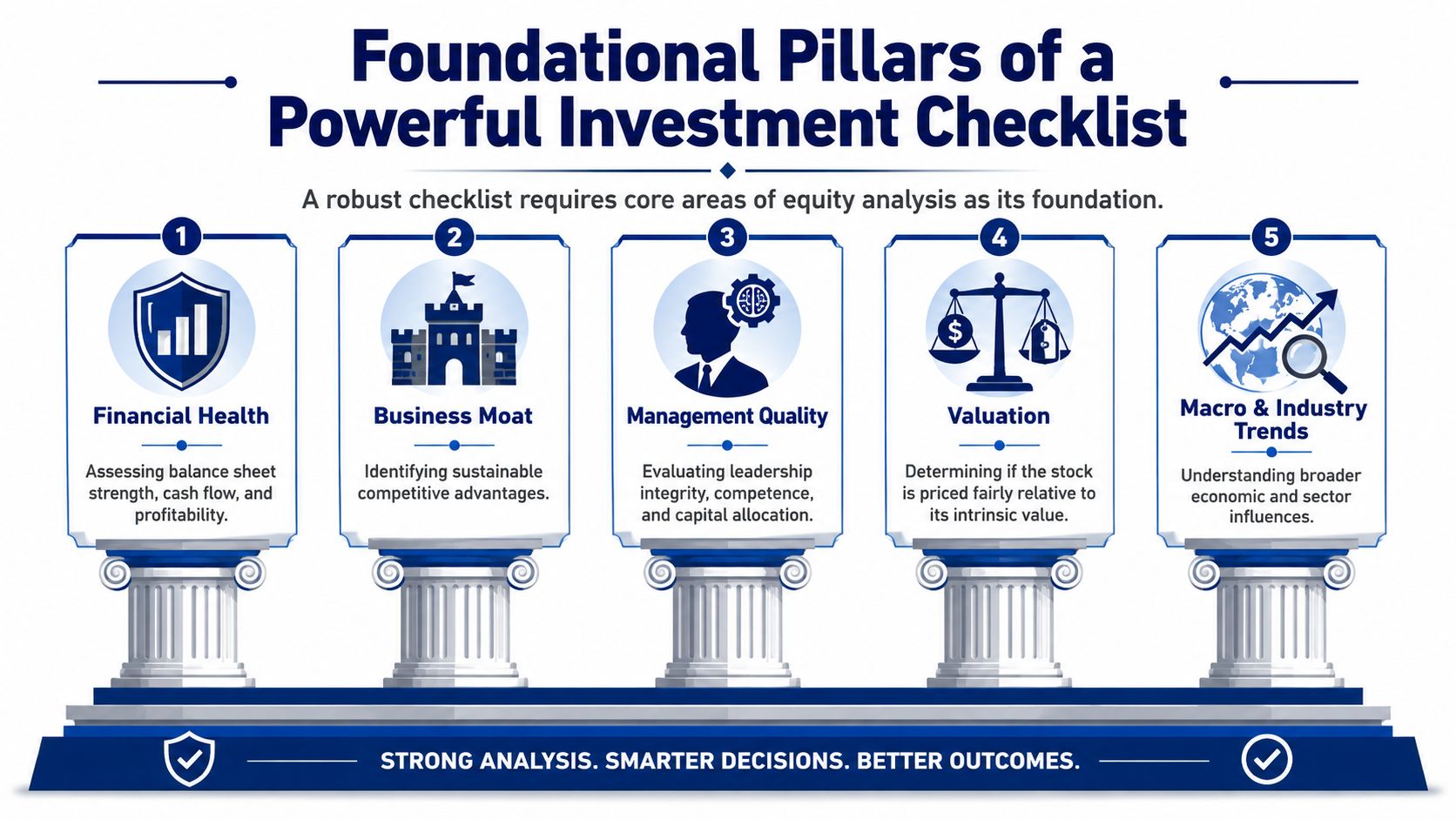
A stock analysis framework needs a base strong enough to hold facts, judgment, and the follow-up work that keeps a thesis alive after entry. If one pillar is weak, the whole decision starts to tilt. The point is not to collect interesting questions, it is to isolate the parts of the business that keep driving outcomes, or breaking them, once the market starts testing your original view.
Financial health is the floor, not the finish line
Financial health tells you whether the company can absorb stress. Balance-sheet strength, cash conversion, and profitability matter because they determine how much room management has to make mistakes, or how quickly a small problem turns into a capital loss. A practical checklist should ask whether the business produces positive free cash flow, carries debt/equity below 0.5 where that test makes sense for the industry, and can sustain profitability thresholds such as ROCE of 15-20%+ or another benchmark that fits the business model.
That floor also has to be monitored after purchase. A company that passes on entry can drift if debt increases, cash conversion weakens, or earnings quality slips while the headline numbers still look tidy. A static checklist misses that change. An automated review process, whether handled manually or through a tool such as Monsa, catches the gap between a clean thesis and a deteriorating balance sheet before the market does.
Business moat tells you whether the edge lasts
A moat is evidence that the company can protect pricing, retain customers, or stay relevant without constantly buying growth. Margins, debt, and ROE help, but they do not tell the whole story. The harder tests sit in the operating details, customer concentration, supplier concentration, distributor control, input-cost exposure, and the risk of low-cost substitutes or regulatory interference. Those pressures matter because earnings can break faster than neat historical ratios suggest.
A good checklist keeps asking whether the edge still exists after the first look. That matters even more once the portfolio is live, because thesis drift usually starts when a business keeps printing acceptable results while its competitive position subtly weakens. If the moat is eroding, the checklist should force a review, not just a softer score.
Management quality is about allocation, not charisma
Good operators can still be poor capital allocators. The checklist should ask whether management has a record of protecting shareholder capital, whether incentives make sense, and whether communication matches behavior. If the story keeps changing while the capital base keeps expanding, the market usually notices eventually.
Management also needs to be judged against the original investment thesis. A founder who starts disciplined can become complacent after a period of strong performance, especially when the business still looks healthy from the outside. That is where a repeatable checklist earns its keep. It keeps the review tied to actions, not mood, and makes it easier to spot when the team is drifting away from the plan that justified the position in the first place.
Valuation is where discipline becomes visible
Valuation answers a different question than quality. A wonderful business can still be a poor investment if the price already reflects too much good news. One published scoring model assigns 25% to valuation, alongside 35% to business quality and 20% to growth durability, then standardizes inputs before combining them into a composite score. It also recommends a minimum composite score of 70/100 and a margin of safety of at least 25% (IR Tracker checklist).
That discipline matters after the purchase as well. Valuation should not be a one-time filter that disappears once the order is filled. If a holding rerates far beyond the assumptions that justified entry, the checklist should force a fresh read on expected return potential, not a reflexive hold. Price can stay expensive for a long time, but a disciplined framework should still know when the payoff no longer matches the risk.
Risk assessment is where most checklists stay too shallow
The omission that hurts portfolios most often is concentration risk. A company can look stable on paper and still be fragile if one customer, one supplier, or one channel matters too much. In practice, that is where a checklist has to become more specific than generic stock screens.
- Customer concentration: Ask whether any single customer dominates revenue.
- Supplier dependence: Ask whether one vendor can interrupt production or margins.
- Channel control: Ask whether distributors can squeeze the business.
- Regulatory exposure: Ask whether approvals, pricing, or trading rules can change the earnings profile.
A business that looks diversified in the annual report can still be structurally concentrated in the places that matter.
Risk checks should also be written so they can be repeated without interpretation drift. If the same question is asked every quarter, the answer becomes a trend, not a one-off impression. That is the difference between a checklist that supports portfolio management and one that only helps at the point of entry.
A useful way to think about the checklist is as a hierarchy. The top layer is valuation, but the base is business resilience, financial strength, and operational fragility. Without that base, valuation can mislead you into buying a cheap problem.
Constructing Your Custom Investment Checklist
A checklist only has value once it can be used in real decisions. “Good management” is too vague to carry a position. “Can the company fund growth without stretching the balance sheet?” can be answered, tested, and revisited. The goal is to turn each pillar into a question with a clear pass, fail, or watch-list outcome.
Start with hard gates before you assign scores
A strong model works in two layers. The first layer is absolute rules, the second is weighted scoring. That split matters because some failures should end the process immediately. If a business breaks a hard rule, a high score on the rest of the checklist should not rescue it. As noted earlier, the framework uses business quality, growth durability, and valuation, then applies a composite threshold and a margin-of-safety rule.
Hard gates work best for facts that can break the thesis fast. Weighted scores fit judgment calls such as moat strength, management credibility, or long-run optionality. If those layers are blended together, the checklist becomes easy to game and harder to trust when a position starts to drift.
Write questions that force evidence
A practical template should read like an operating manual, not a philosophy essay. Each line needs a metric, a threshold, and a verdict. One equity template recommends sales growth of 10-15%+, profit growth of 15%+, ROCE of 15-20%+, debt/equity below 0.5, and positive free cash flow, while still checking moat, management, and valuation (Invest Blueprint checklist).
| Pillar | Metric / Question | Threshold / Target | Check (Pass/Fail) |
|---|---|---|---|
| Financial Health | Is free cash flow positive? | Positive | |
| Financial Health | Is debt/equity within the range you accept for this industry? | Below your limit | |
| Business Moat | Does the company have clear pricing power or switching costs? | Clear evidence | |
| Business Moat | Is customer concentration low enough to avoid one-client risk? | No hidden concentration | |
| Growth Potential | Is revenue growth durable rather than one-off? | Meets your standard | |
| Growth Potential | Does the business scale without constant capital strain? | Sustainable scaling | |
| Management Quality | Has management protected shareholder capital? | Consistent record | |
| Management Quality | Do incentives align with long-term owners? | Acceptable alignment | |
| Valuation | Is the price below your margin-of-safety level? | Yes | |
| Risk Assessment | Can regulation, suppliers, or channels break the thesis? | No material threat |
A table like this only works if the wording is tight. A vague prompt invites interpretation drift, which is how thesis drift starts. The question should force an investor to look for evidence in filings, calls, or operating data, not in a comfortable story.
Keep the scoring model separate from the narrative
The best checklist does not remove judgment. It disciplines it. A qualitative note still matters, but it should sit next to a rule, not replace one. If a question cannot be explained clearly, it probably does not belong in the core checklist.
One practical way to keep the framework tight is to build the questions from your own strategy, then test them against live holdings and watchlist names. A tool like Monsa's strategy templates can help translate a written thesis into explicit criteria, and a comparison such as Monsa vs spreadsheet makes the trade-off clear when you are deciding how formal that process needs to be. The point is the structure, not the software.
Practical rule: If a question cannot be scored or answered decisively, move it into a notes field, not the core checklist.
A checklist only works if it matches your temperament
Some investors need a detailed framework. Others stall when they see too many lines. That is not a weakness, it is a design constraint. The right checklist is the one you will use when the stock is moving, the news flow is loud, and your own memory is trying to soften a rule you set for a reason.
Turning Your Checklist into a Repeatable System
A spreadsheet checklist is better than nothing, but it still leaves room for mood, inconsistency, and selective memory. The next step is to turn the rules into a repeatable system that scores every candidate the same way, every time. That's how a checklist stops being a document and starts behaving like a process.
Manual review is where discipline leaks
When a checklist is only in your head, or buried in a file you rarely open, the final decision gets rewritten by emotion. The investor who meant to reject a weak balance sheet suddenly “makes an exception” because the story sounds compelling. The investor who planned to be patient gets pushed into a rushed buy because the chart looks exciting.
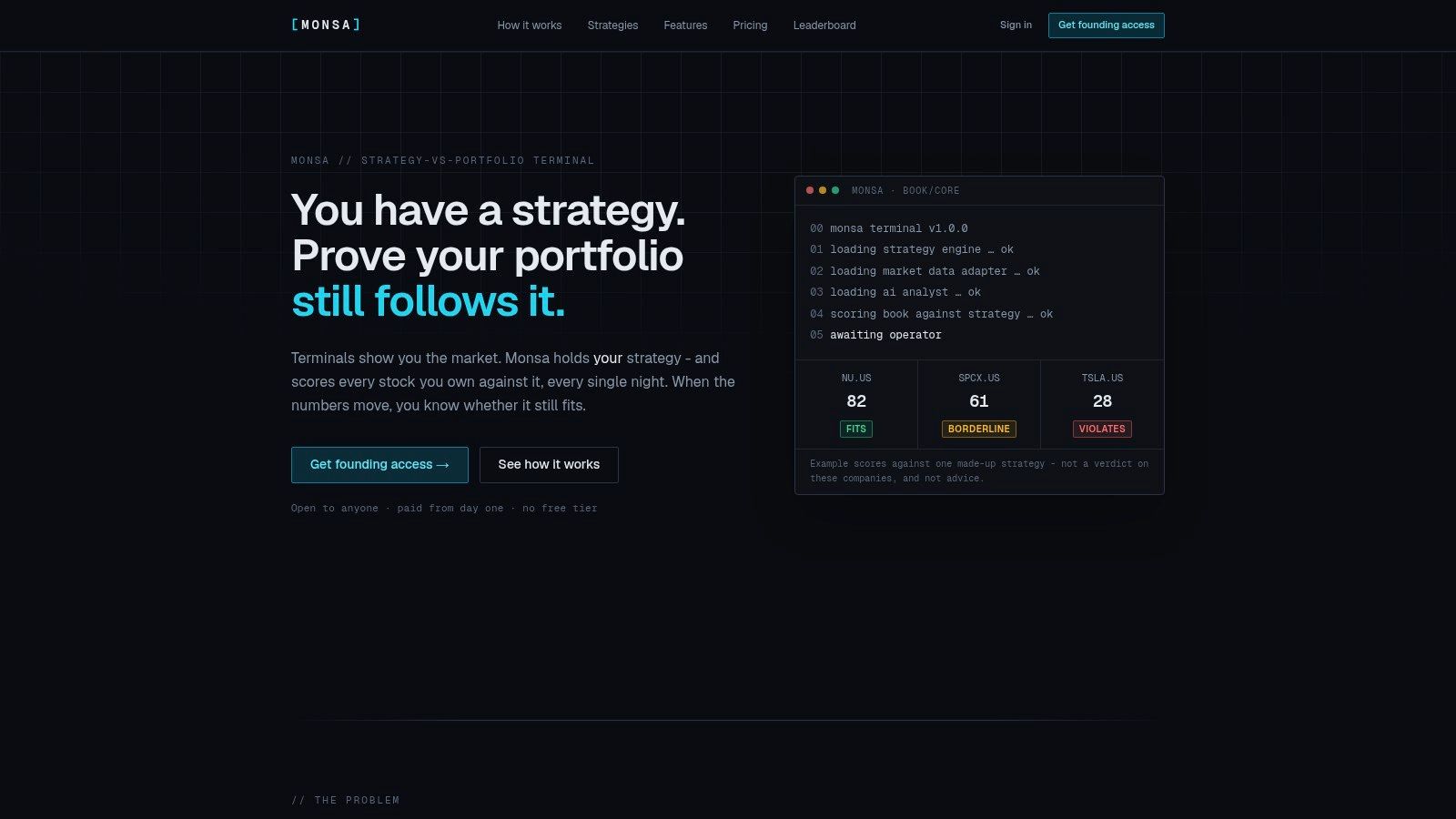
A rules-based workflow removes that drift by applying the same checklist to each name, then showing where it fits, where it's borderline, and where it violates the written thesis. That matters because the investor no longer has to remember every rule at the moment of decision. The system does the first-pass enforcement.
The value is consistency, not automation for its own sake
The point of automating a checklist is not speed alone. It's consistency under pressure. A spreadsheet can track answers, but it doesn't naturally enforce portfolio-level constraints, refresh data, or highlight when a holding drifts away from the original thesis. A strategy engine can do that across holdings, not just at the point of entry, which is where manual processes often break down. One option in that category is Monsa vs spreadsheet comparison, which frames the difference as rules-based oversight rather than static recordkeeping.
The useful outputs are simple: fits, borderline, or violates. That language is valuable because it forces action. A holding that violates the thesis doesn't become fine just because you still like the company.
Use the system for both screening and review
A repeatable process works best when it handles two moments, before purchase and after purchase. Before purchase, it screens candidates against your criteria. After purchase, it checks whether those same criteria still hold. That second function is where many investors are weakest, because they keep using the checklist like a gate instead of a monitoring tool.
<iframe width="100%" style="aspect-ratio: 16 / 9;" src="https://www.youtube.com/embed/GVAhHgDm9hc" frameborder="0" allow="autoplay; encrypted-media" allowfullscreen></iframe>
A practical system also benefits from alerts. If a key input changes, such as valuation, margins, or portfolio concentration, the system should surface it instead of waiting for a quarterly review. Price alerts are one useful layer when the portfolio needs a trigger rather than a memory test.
The strongest process doesn't make decisions for you. It removes the parts of the process where people usually fool themselves.
Using Your Checklist for Ongoing Portfolio Management
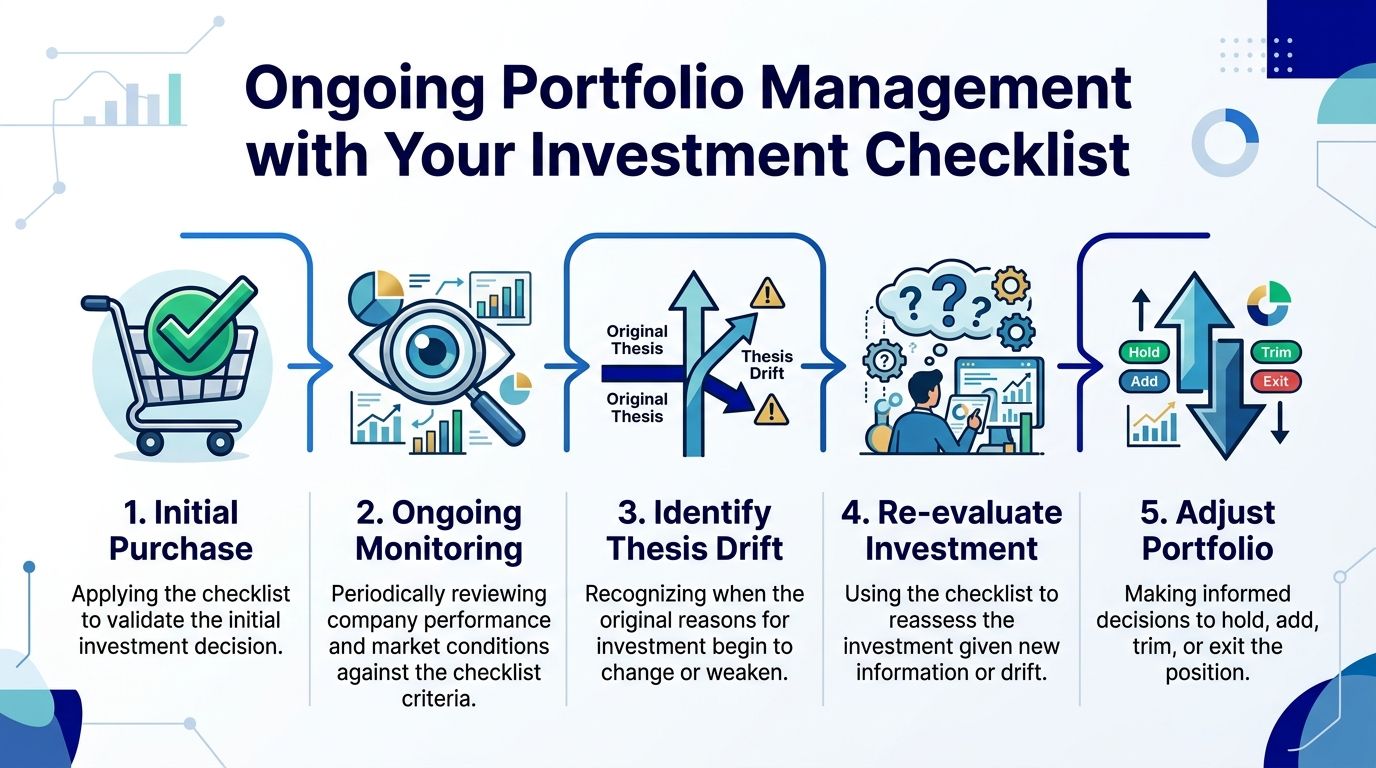
A stock rarely fails on one dramatic day. More often, it drifts. Growth slows, indebtedness grows, a key customer weakens, or management starts explaining away what the checklist used to catch early. That's why a checklist's true value shows up after the purchase, not before it.
Thesis drift is the failure mode most investors under-monitor
A frequently missed angle in checklist content is portfolio-level fit after purchase. Most checklists stop at business quality and valuation, while a complete one also asks how the idea fits into diversification and the investor's written thesis. That gap matters because investors often keep positions long after facts change (Reasonable Deviations checklist).
A good example is a company that originally qualified because it had strong growth, a sane balance sheet, and a clear moat. Over time, the balance sheet gets heavier, growth starts to fade, and the customer mix becomes more concentrated. None of those changes need to be catastrophic on their own, but together they can invalidate the original buy case.
Review the thesis, not just the ticker
The trap is thinking ownership means the thesis is still alive. Ownership can last longer than evidence. A recurring checklist review should ask whether the current facts still match the version of the business you bought, whether the position still belongs in the portfolio, and whether a different use of capital has appeared elsewhere.
That's where portfolio context matters. A stock can remain a good standalone company and still be the wrong holding if it duplicates another position, increases sector risk, or no longer matches your written objective. The checklist should force that conversation.
A position should earn its place every review cycle, not just the day you bought it.
Build the review loop around triggers
The most practical workflow is to tie review questions to events, not to calendar habit alone. If a company misses an expectation, changes capital structure, or updates guidance in a way that weakens the original case, the checklist should reopen. If the position size grows in a way that changes portfolio balance, the review should also reopen.
The checklist becomes a living record. It shows what you believed at entry, what changed, and whether the new facts still fit the original logic. That's a better way to handle conviction than holding on and hoping the market eventually agrees.
The point isn't to trade more. It's to stop confusing familiarity with validation.
Common Checklist Pitfalls and How to Avoid Them
The most common mistake is making the checklist too broad. The second is making it too vague. Investors sometimes think a longer list creates more rigor, but if the list is too cumbersome, it stops being used when it matters. Keep the core short, and push secondary notes into an appendix or side log.
Another failure is letting story override data. A compelling founder, a clever product, or a popular theme can make weak facts feel temporary. The fix is simple, though not easy. Write down the pass-fail rules before you open the pitch deck, then refuse to rewrite them after the narrative gets attractive.
A third mistake is treating qualitative checks as optional. Management quality, moat strength, concentration risk, and portfolio fit can't always be reduced to a single metric, but they still belong in the framework. If the checklist only measures what's easy, it'll miss what hurts outcomes.
The last mistake is forgetting that the checklist is a living system. If the rules never change, they'll eventually become stale. If they change every time the market gets uncomfortable, they're not rules anymore. The right balance is a stable core with occasional updates when your process reveals a recurring blind spot.
Build for use, not for admiration. A checklist that helps you say no, stay consistent, and revisit a thesis when facts change is doing real work.
If you want to turn your own checklist into a live portfolio process, visit Monsa. It stores your rules, scores holdings against them, and refreshes the verdict as fundamentals and prices move. That makes it much easier to catch thesis drift before it turns into a stubborn holding.
Related reading: How to Evaluate Stocks with a Rules-Based Workflow, Strategy Writing Template: A Practical Guide, and Monsa's founding annual pricing.
Monsa is a portfolio-analysis tool, not a broker or investment adviser. Nothing here is investment advice.
// related reading
Value Investing Screener: What to Filter For and How to Build One
The metrics a value investing screener actually filters by, how to set thresholds that catch cheap stocks without catching value traps, and what changes once you own the name.
Deep Value Investing Strategy: A 2026 Guide
Master the deep value investing strategy with metrics, screening rules, and risk controls. A practical 2026 guide for serious long-term equity investors.
Momentum Investing Strategy: Rules to Check Nightly
A momentum investing strategy holds stocks the market is already rewarding. Learn the entry rules, drawdown limits, and portfolio caps that make it checkable.
7 / 100 founding seats claimed - $100/yr locked, then $190/yr
Monsa is a portfolio-analysis tool, not a broker or investment adviser. It never recommends what to buy or sell - it checks what you hold against rules you wrote. Nothing here is investment advice.