// blog
Your Portfolio Is Drifting and Nothing Tells You
I bought a position in early 2024 on a thesis I had actually written down. Profitable business, little debt, revenue growing at a rate I had put a number on, and a ceiling on what I would pay for it. Clean reasoning. The kind you can say out loud without wincing.
Eighteen months later I still held it. Two of those conditions were no longer true, and I could not have told you which two.
That is not a story about a bad stock pick. It is a story about the distance between the rules I set and the last time anybody checked them.
The rules were fine. The checking stopped.
I have invested my own money since 2017 and run it against written rules since 2019. The rules lived in a spreadsheet, and the spreadsheet was good: columns for what I would buy, what I would refuse, at what price.
What failed was not the sheet. It was that going through a dozen positions against a list of thresholds is boring, it is never urgent, and it therefore slipped for months at a time. Nothing bad happens the week you skip it. Nothing bad happens the month after either. It surfaces much later, as a holding you kept for a reason that had stopped applying two earnings ago, and you find it by accident.
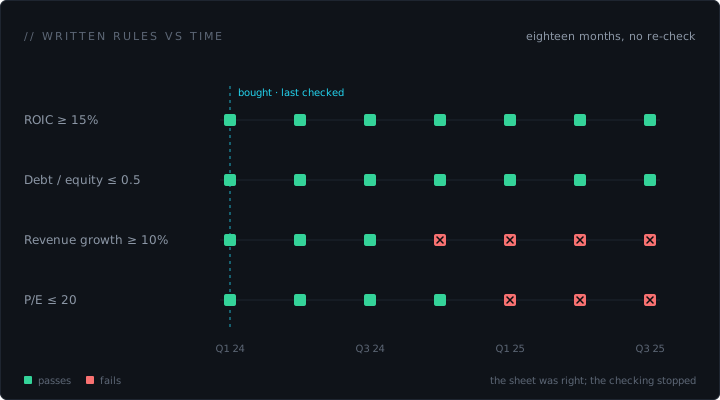
Ask anyone who invests deliberately when they last audited every position against their own criteria. My expectation, and it is only that, is that most honest answers land near "when I bought it".
Two things are supposed to catch this, and neither does
The first is your terminal. Bloomberg, TradingView, whatever charting app you have open right now. These answer the market's question: is the line going up or down, is this cheap against its sector. A thousand tools answer that question and most of them answer it well. None of them know what you promised yourself on the day you bought.
The second is you, and you are the part that gets busy.
Between the two sits a question nobody is scheduled to ask: does the stock I bought six months ago, on a thesis I actually wrote down, still deserve its seat now that earnings have landed and the price has moved?
Positions drift out of the thesis quietly and then stay there. Six months on you are holding something for a reason that expired in February, and nothing anywhere flagged it.
The spreadsheet argument, honestly
If your sheet is current, keep it. A spreadsheet holds rules perfectly well, it costs nothing, any column you can imagine goes into it, and it is already yours. I am not going to pretend otherwise, because for a while mine did the job.
There are four things it does not do.
It does not re-check itself. The sheet works the week you work it and stops the week you stop, which is the failure mode we are actually discussing.
It does not tell a missing figure from a zero. An empty cell and a genuine zero look identical inside a formula, and a rule that turns on the difference will quietly turn the wrong way.
It does not judge anything that is not a number. "I avoid businesses I cannot explain in a sentence" is a real rule and a good one, and there is no IF statement for it.
And it does not survive your attention going elsewhere, which over a decade it will.
What I built instead
Monsa holds your strategy and scores every stock you own against it, every night.
You start by describing how you invest, in the plain sentence you would use with a friend. Mine runs close to this: "I buy profitable companies with little debt, growing revenue at a double-digit rate, and I won't pay more than twenty times earnings. I avoid anything I can't explain in a sentence."
Monsa reads that and proposes criteria from it, with thresholds, weights and hard lines. You see exactly what it understood before anything is saved, and you accept the rules row by row. It never writes your strategy for you, which matters more than it sounds. A tool that invents your rules has handed you a rule-set you will not defend at the moment defending it costs you something.
Then you add the stocks you own or watch, and put each holding in a portfolio.
Every ticker gets a fit score from 0 to 100 against the rules of the portfolio it sits in, a breakdown showing which criterion contributed what, and a verdict: fits, borderline, or violates.
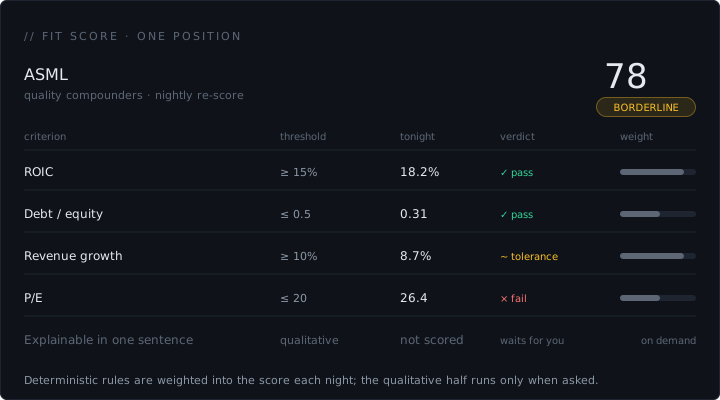
The arithmetic is deterministic. Metric rules run over reported figures, weighted the way you weighted them, with tolerance bands where you want partial credit and hard lines where you do not. That half needs nothing from a model and never asks one.
The criteria a number cannot settle are the other half, and those you hand to the AI one position at a time, when you want the read. It scores the qualitative rules and shows its reasoning beside them. Until you ask, the score is the quantitative half and the screen says so, rather than quietly averaging in a judgement nobody made. Nothing here is an opaque number you have to take on faith: you can open any score and see which criterion moved it and by how much.
Each night the fundamentals, prices and FX refresh, and every book is re-scored on the deterministic rules. A company reports, its numbers land, and that night the stock is measured against your thresholds again. The next time you open the terminal you already know whether it still clears them, or whether it quietly stopped being the thing you bought.
The judgement calls still wait for you to ask for them. The arithmetic no longer does, and the arithmetic is what actually slipped.
The screen where it clicked for me
The view I use most is a dense grid. Columns are the strategies you run, rows are the stocks you track, and every cell is a fit score and a verdict.
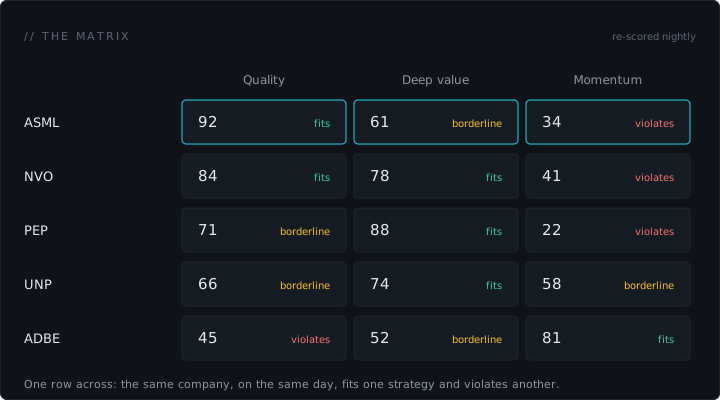
Read one row across and you get something a single rating never gives you: the same company, on the same day, fitting one strategy and violating another. Both verdicts are correct, and holding them next to each other is the whole point. A fit score is not a rating of the company, it is the distance between that company and the rules you wrote, which is why the columns are yours to define. Move a threshold and the number moves with it, exactly as it should.
Somewhere past a dozen positions my own checking had quietly stopped. That gap is where a book and its thesis come apart.
What it deliberately does not do
Monsa does not tell you what to buy or sell. It holds no opinion on whether your strategy is any good, and it will hold you to a poor one as faithfully as to a sound one. It cannot place an order: where it reads an Interactive Brokers statement, so you do not type your positions in twice, that connection is read-only and it writes nothing to your book until you accept the changes it proposes. It makes no claim about returns, mine or anyone else's.
What it tells you is whether what you already own still matches the investor you claim to be. What you do with that is yours.
The constraint is deliberate. The moment a tool starts recommending, it is not a mirror any more, and you stop being the person running the strategy.
Who this is for
Solo operators: retail and self-directed investors who run a strategy on purpose and want to be held to it. One person, their own book, their own rules.
If you invest on instinct and enjoy it, this will read as homework, and it is. If you have never written your rules down, that is the normal starting point rather than a disqualification. Write the sentence, and the criteria get drafted from it for you to edit.
But if you have ever gone back through your positions and found one you could no longer justify, you already know the problem. A thesis you don't check is just a feeling.
Monsa is at monsa.ai. It is paid from the first day, with no free tier, no queue and nobody approving accounts. I built it for my own book, and the nightly scoring runs against my positions too.
Related reading: Strategy Writing Template: A Practical Guide walks through turning a sentence like mine into checkable rules, and the founding annual pricing is still open to the first 100 annual subscriptions.
Monsa is a portfolio-analysis tool, not a broker or investment adviser. Nothing here is investment advice.
// related reading
7 Strategy Evaluation Examples to Study in 2026
See 7 real-world strategy evaluation examples from Buffett to quant funds. Learn to apply disciplined, rule-based analysis to your own stock portfolio today.
Value Investing Screener: What to Filter For and How to Build One
The metrics a value investing screener actually filters by, how to set thresholds that catch cheap stocks without catching value traps, and what changes once you own the name.
10 Best Portfolio Monitoring Tools for 2026, Ranked
What a portfolio monitoring tool actually needs to track, and a ranked look at 10 tools, from net-worth trackers to a rules-based scoring terminal.
7 / 100 founding seats claimed - $100/yr locked, then $190/yr
Monsa is a portfolio-analysis tool, not a broker or investment adviser. It never recommends what to buy or sell - it checks what you hold against rules you wrote. Nothing here is investment advice.