// blog
All Weather Portfolio Strategy: Rules, Allocations

Title: All Weather Portfolio Strategy: Rules, Allocations
The most popular description of the all weather portfolio strategy is also the least useful: copy the allocation and assume diversification has been achieved. Counting asset classes tells you almost nothing about the risk your portfolio is carrying. A book with equities, bonds, gold, and commodities can still make one hidden macro bet, especially when long-duration bonds and inflation hedges respond poorly to the same shock.
A disciplined operator starts elsewhere. The relevant question isn't “How many assets do I own?” It's “Which economic outcomes can damage this book, and which holdings are assigned to absorb each one?” Bridgewater developed the strategy in the mid-1990s and formally launched it in 1996 for Ray Dalio's trust assets. Its lasting contribution was to shift portfolio construction away from forecasting the next return and toward diversifying across economic regimes, as described in Bridgewater's account of the All Weather approach and Dalio's history of the strategy's concept and mechanics.
Table of Contents
- Rethinking Diversification Beyond Asset Counts
- Four outcomes instead of one forecast
- The Four Macro Regimes and Their Asset Matches
- Growth-sensitive exposure
- Inflation-sensitive exposure
- Classic Allocation Sleeves and Risk Parity Mechanics
- How to audit the construction
- Stress Tests and Where the Classic Model Struggles
- The hedge can become the concentration
- Rebalancing after the shock
- Converting Philosophy into Checkable Rules and Constraints
- Six rules for an operator's monitoring sheet
- From written thesis to nightly evidence
- Comparing All Weather to Traditional Stock-Heavy Portfolios
- Different sources of portfolio movement
- Maintaining Discipline Through Nightly Monitoring
- What the score should explain
Rethinking Diversification Beyond Asset Counts
Diversification is often treated as a shopping list. Add domestic equities, international equities, bonds, real estate, gold, and commodities, then call the portfolio balanced. That approach confuses capital allocation with risk allocation. Risk-parity construction instead seeks to equalize each sleeve's contribution to total portfolio volatility, rather than matching market-value weights, as explained in this risk-parity discussion.
The distinction matters because assets don't arrive with equal volatility. Equities usually fluctuate more than high-quality government bonds, so a capital allocation that appears evenly distributed can still leave equities responsible for most of the book's movement. The classic all weather design responds by assigning larger capital weights to lower-volatility bonds and smaller weights to assets such as gold and commodities. The objective is not to make every holding the same size. It's to prevent one sleeve from consuming the risk budget.
Four outcomes instead of one forecast
The framework organizes uncertainty around two variables, economic growth and inflation. Each can rise or fall, producing four broad environments:
- Rising growth: Equity exposure represents the primary growth-sensitive sleeve.
- Falling growth: Nominal government bonds are intended to provide a recession or deflation hedge.
- Rising inflation: Gold, commodities, and inflation-linked bonds address inflation sensitivity.
- Falling inflation: Nominal bonds are positioned for disinflationary or deflationary pressure, while equities retain exposure to productive businesses.
Bridgewater describes the construction as four portfolios with the same risk, each designed for one environment. This is more rigorous than saying that different assets “probably won't move together.” It asks an operator to identify the economic driver behind each holding and to test whether the holding still serves that role.
The strategy became influential after the 1990s because it offered institutions a way to diversify without pretending that macroeconomic forecasts were reliable. Its resilience, when it appears, comes from having multiple conditional responses built into the portfolio before the shock arrives. That doesn't eliminate losses. It changes the source of the losses from a single equity-market bet to a set of regime exposures that must be monitored.
The Four Macro Regimes and Their Asset Matches
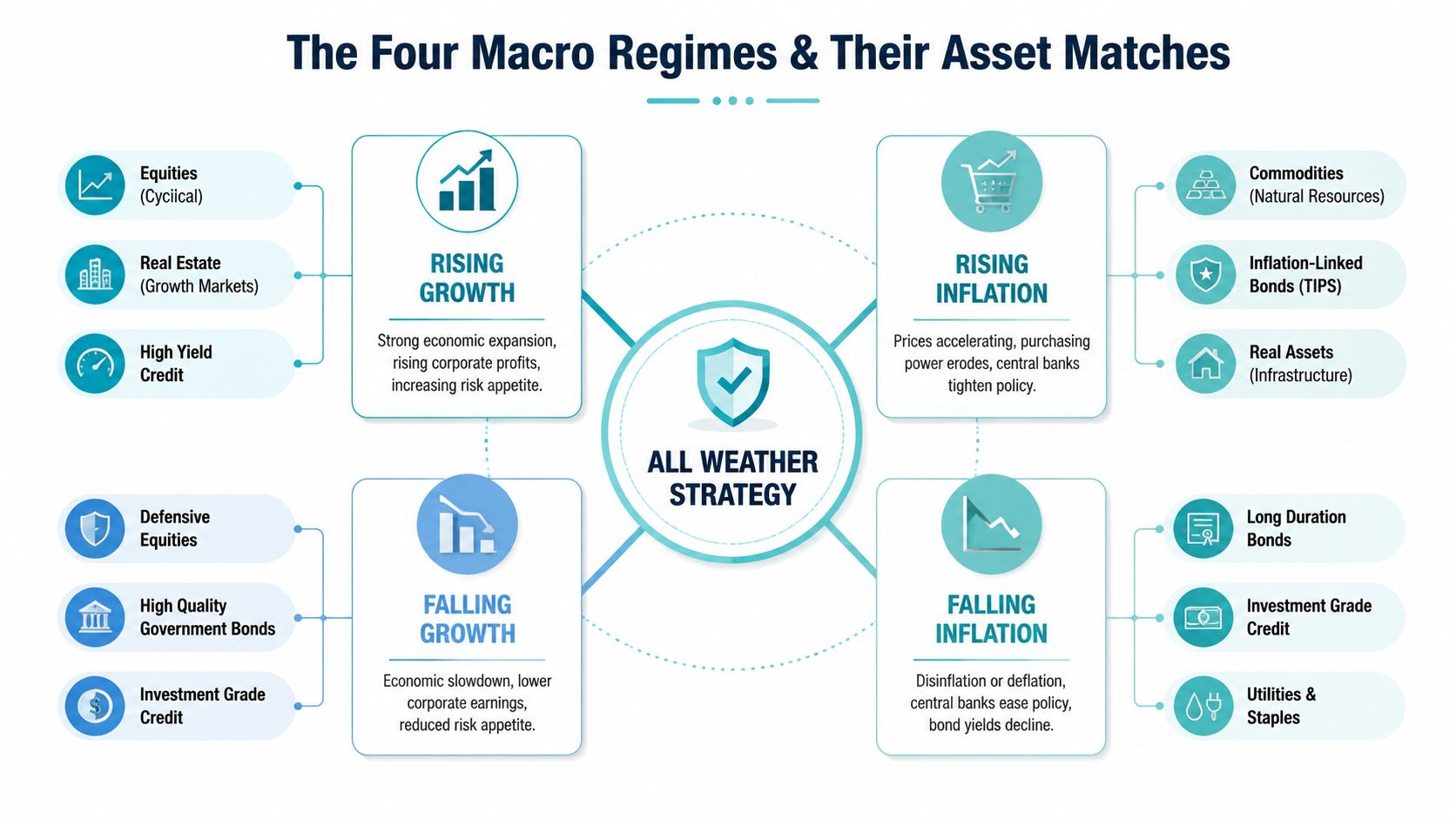
The four-regime model is simple enough to draw and demanding enough to audit. Growth and inflation don't need to follow the same direction, which is why a portfolio designed only for expansion or recession leaves a material blind spot. An all weather structure assigns assets according to how their cash flows, discount rates, or physical exposure tend to respond to each environment.
Growth-sensitive exposure
In a rising-growth regime, equities are the clearest growth sleeve. Improving economic activity can support company revenues, earnings expectations, and investor willingness to accept risk. That doesn't mean every equity holding is a valid all weather exposure. A narrow sector position may add company-specific or industry-specific risk without providing broad participation in the growth driver.
Falling growth presents the opposite problem. Nominal government bonds are designed to respond to declining yields and recessionary pressure, conditions that can support their prices while equities face weaker expectations. Their role is therefore not merely “stability.” It's a specific hedge against a growth shock and, particularly, falling inflation.
Inflation-sensitive exposure
Rising inflation creates a different failure mode. Higher prices can erode the purchasing power of fixed nominal payments, while faster rate increases can pressure both bonds and equity valuations. Inflation-linked bonds address the contractual inflation component, while commodities and gold provide exposure to different inflation-sensitive mechanisms. The State Street Bridgewater All Weather ETF overview describes a framework spanning global equities, nominal bonds, inflation-linked bonds, commodities, and gold.
Falling inflation completes the map. Nominal bonds are intended to cushion disinflation and deflation, while equities can still contribute when lower inflation supports real purchasing power or reduces pressure on monetary policy. The key is not to assign one asset to one permanent label. Each sleeve can react to several drivers, and those drivers can conflict.
Operator test: For every holding, write the macro variable it is meant to hedge. If the explanation only says “diversification,” the rule isn't specific enough to monitor.
The resulting return pattern is driven more by macro exposures than by equity beta alone. That's why all weather implementations are typically less correlated with global equities and traditional stock-heavy portfolios. The relationship is conditional, not automatic. A regime shock can still hit several sleeves together, especially when inflation and interest rates move sharply.
The visual model is useful only if it leads to an operational question: does the current book still contain a credible response to each quadrant, or has drift turned it into a disguised growth portfolio?
<iframe width="100%" style="aspect-ratio: 16 / 9;" src="https://www.youtube.com/embed/hc7THdsTS_I" frameborder="0" allow="autoplay; encrypted-media" allowfullscreen></iframe>
Classic Allocation Sleeves and Risk Parity Mechanics
The commonly cited retail formulation uses five sleeves: 30% equities, 40% long-term Treasuries, 15% intermediate Treasuries, 7.5% gold, and 7.5% commodities, as shown in this summary of the classic allocation. These figures are capital weights, not equal risk weights. Their purpose is to approximate balanced regime exposure by giving more dollars to assets that generally contribute less volatility per dollar.
Long-term Treasuries receive the largest sleeve because their lower volatility would otherwise leave them with too little influence on the total portfolio. Intermediate Treasuries add nominal bond exposure with a different maturity profile. Equities carry the main growth role, while gold and commodities provide smaller allocations to inflation-sensitive outcomes.
| Asset Sleeve | Capital Weight | Risk Contribution Role |
|---|---|---|
| Equities | 30% | Primary rising-growth exposure |
| Long-term Treasuries | 40% | Falling-growth and deflationary hedge |
| Intermediate Treasuries | 15% | Additional nominal-rate and recession exposure |
| Gold | 7.5% | Inflation and monetary-stress sensitivity |
| Commodities | 7.5% | Inflation-shock and physical-economy sensitivity |
How to audit the construction
Start with capital weights, but don't stop there. An operator can review each sleeve through four questions:
1. What regime does this sleeve address? 2. What risk makes the sleeve fail? 3. How much of total portfolio volatility does it contribute? 4. Has correlation with another sleeve changed the intended hedge?
The third question is the decisive one. A 40% bond allocation can still dominate duration risk, while a smaller commodity sleeve can generate substantial volatility during a supply shock. Equal capital weights would obscure both facts.
Risk parity also requires an explicit rebalance process. A portfolio that begins with balanced risk can become concentrated after a large move in equities, rates, currencies, or commodities. The rebalancing framework associated with the original approach describes annual rebalancing or threshold-based action when a component drifts 5% or more from its target.
That rule is mechanical, but the diagnosis around it still matters. A sleeve may drift because its price moved, because its volatility changed, or because its macro relationship weakened. Restoring a percentage target without checking the underlying exposure can repair the appearance of balance while leaving the risk architecture unresolved.
Stress Tests and Where the Classic Model Struggles
The classic model can fail precisely when diversification appears most necessary. Its conditional pairing is familiar: nominal bonds may cushion falling growth, while gold and commodities may respond to inflation shocks. The harder regime combines rapidly rising inflation, higher yields, and weakening risk assets. Nominal bonds can then lose value as the inflation-sensitive sleeves fail to offset the move.
The vulnerability is clearest in a rate shock. As discussed in coverage of risk parity in a fragmented macroeconomic landscape, a bond-heavy implementation can struggle when duration and inflation risk rise together. The problem is not the credit status of nominal government bonds. Their duration exposes the portfolio to a repricing of discount rates, so the sleeve intended to diversify equity risk can become a common source of losses.
The hedge can become the concentration
An operator reviewing the classic allocation should ask whether bond duration has become the portfolio's dominant risk, not merely whether bonds remain present. Long-duration exposure can support a deflationary hedge, yet it can also create a concentrated rate position when inflation expectations, policy, and term premiums move in the same direction.
Potential adaptations include:
- Inflation-linked bonds: TIPS can make the inflation hedge more contractual than a pure commodity exposure.
- Shorter duration: A shorter maturity profile can reduce sensitivity to abrupt yield changes, although it changes the behavior of the growth hedge.
- Global exposure: Global nominal and inflation-linked bonds can reduce dependence on one sovereign curve, while introducing currency and market-depth considerations.
- Re-hedging rules: A written process can specify when macro exposures require review instead of treating the original recipe as permanent.
Every adjustment exchanges one exposure for another. Shorter duration may weaken the response to recessionary yield declines. Foreign assets add FX exposure. More inflation-linked exposure can create a different concentration. The operational question is therefore which failure the portfolio accepts in reducing duration risk.
An external comparison tool such as Portfolio Visualizer can help operators examine alternative constructions, but its historical output still requires a regime-based interpretation. A historical comparison cannot establish that a hedge will work in the next shock.
Rebalancing after the shock
The rebalancing process described in the classic allocation section should restore target structure, while the operator separately verifies whether the regime shift has changed the portfolio's correlation and volatility assumptions.
A regime move changes more than prices. It can alter relative volatility, duration sensitivity, and the relationship between nominal bonds, inflation hedges, and equities. A sleeve that previously offset another may begin moving with it, so familiar capital weights can conceal a new concentration of risk. Nightly review should therefore compare current realized relationships with the documented macro role of each sleeve, rather than treating the original hedge map as permanent.
All weather does not promise favorable conditions in every season. It provides a process for identifying which regime the current book is implicitly positioned for, then deciding whether that exposure remains intentional.
Converting Philosophy into Checkable Rules and Constraints
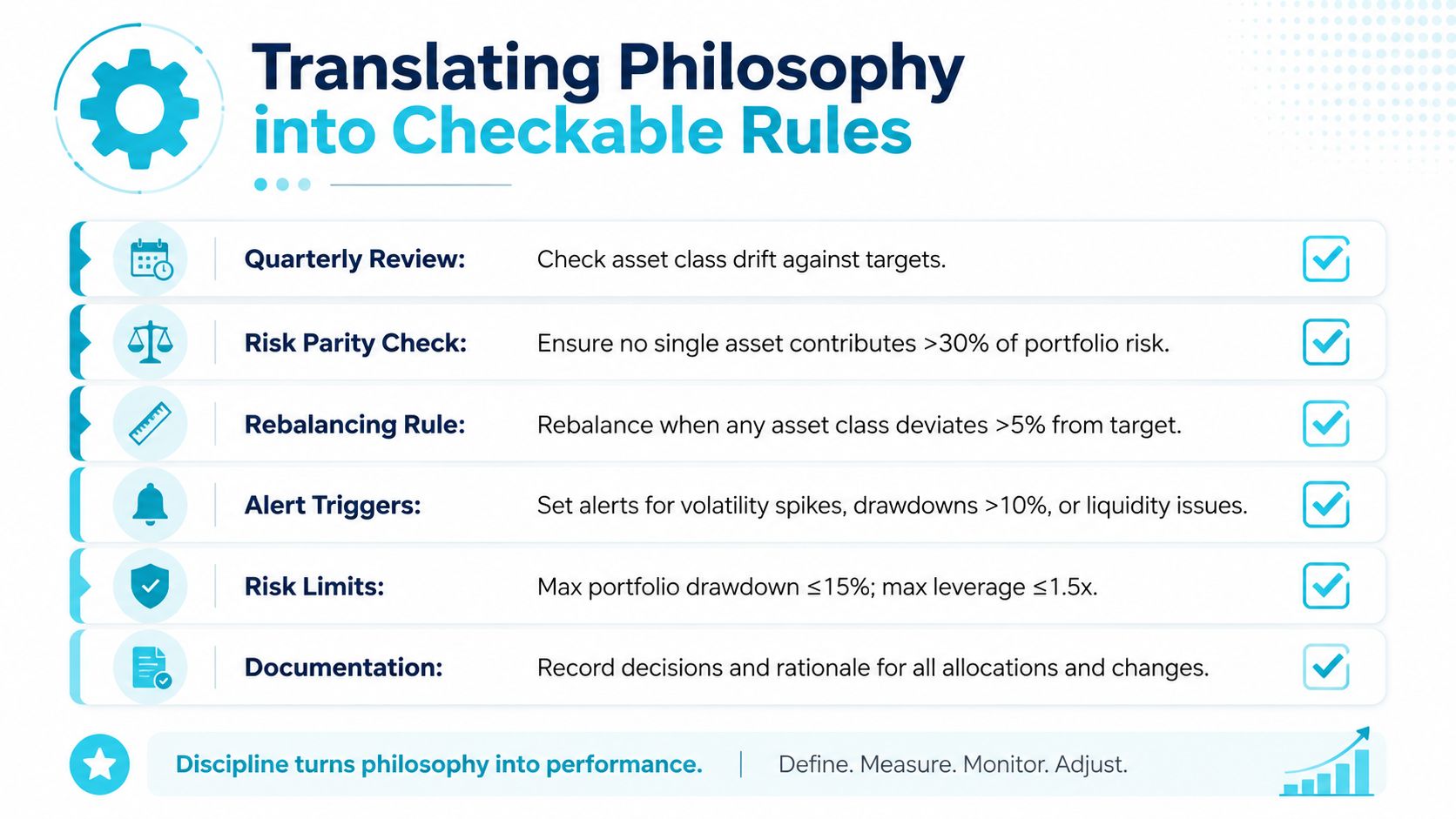
A portfolio philosophy becomes useful only after it can produce the same answer when reviewed by two different operators on two different nights. “Diversify across regimes” is a principle. “No single sleeve may contribute more than the defined risk threshold, and each sleeve must retain a documented macro role” is a rule.
The first task is to separate capital targets from risk constraints. The classic allocation provides a reference for capital weights, but the monitoring layer should track volatility contribution, duration exposure, inflation sensitivity, equity beta, currency exposure, and drift. These measurements don't need to predict the future. They need to reveal when the portfolio no longer resembles the structure that was written down.
Six rules for an operator's monitoring sheet
- Regime mapping: Assign every holding to its primary macro role and record secondary exposures.
- Sleeve boundaries: Set target capital weights with tolerance bands, rather than treating the opening allocation as permanent.
- Risk concentration: Define a maximum contribution from any one sleeve, then flag breaches before reviewing trades or substitutions.
- Duration control: Track the bond sleeve's maturity sensitivity separately from its capital weight.
- Inflation coverage: Check whether inflation protection comes from inflation-linked bonds, commodities, gold, or a combination, and document the intended reason.
- Currency treatment: State whether foreign exposure is hedged, unhedged, or deliberately left open relative to the operator's home currency.
The hard constraints belong at the book level. Maximum position size, sector caps, minimum and maximum position counts, and limits on unclassified exposure prevent a portfolio from satisfying a regime story while violating basic construction rules. Monsa's guide to portfolio optimization constraints provides a useful framework for turning those limits into explicit checks.
From written thesis to nightly evidence
Natural-language strategy capture can convert a written thesis into criteria that an operator confirms and tunes. For an all weather book, that might mean describing the desired regime sleeves, acceptable drift, and the conditions that trigger review. The system should distinguish deterministic metrics, derived values, missing data, and qualitative judgments. That separation matters because an absent data point isn't the same as a failed rule.
A nightly review should answer three questions:
1. What changed in the underlying data? 2. Which rule changed status? 3. Did the portfolio's macro balance move, or did only one holding move?
This creates a feedback loop without pretending that monitoring can forecast regimes. It catches thesis drift, exposes unplanned concentration, and makes the operator's own constraints visible before a stressful market session turns interpretation into improvisation.
Comparing All Weather to Traditional Stock-Heavy Portfolios
A traditional stock-heavy portfolio makes a clear choice: accept substantial equity-market exposure in exchange for participation in economic growth. An all weather portfolio makes a different choice: spread the risk budget across growth, falling growth, inflation, and falling inflation. The difference is structural, not cosmetic.
Different sources of portfolio movement
| Dimension | Traditional stock-heavy portfolio | All weather portfolio |
|---|---|---|
| Primary driver | Equity-market beta | Macro-regime exposures |
| Capital emphasis | Equities | Larger nominal bond sleeves, plus diversifiers |
| Main vulnerability | Growth and equity valuation shock | Joint failure of hedges, especially duration and inflation exposure |
| Rebalancing need | Often determined by equity drift | Required to restore cross-sleeve risk balance |
| Monitoring question | How much equity exposure is present? | Which regime risks dominate the book? |
The table hides an important operational distinction. Two portfolios can have the same equity percentage and very different risk profiles if one holds volatile equities, long-duration bonds, commodities, and currency exposure while the other holds shorter-duration instruments and broad global assets. Capital weight is a starting coordinate, not a complete risk description.
All weather implementations are typically less correlated with global equities and balanced portfolios than stock-heavy allocations because their behavior depends on more than equity beta. That can change the experience across some cycles, but it also means the portfolio may lag during a narrow equity-led expansion. The relevant evaluation is whether the operator deliberately chose the trade-off and can remain consistent when the favored sleeve is not leading.
Rebalancing is therefore central. A stock-heavy portfolio often tolerates drift toward equities because equity exposure is the intended engine. An all weather portfolio must question that drift because it can erase the regime diversification that justified the structure in the first place.

Maintaining Discipline Through Nightly Monitoring
Consider an operator who wrote an all weather thesis, assigned holdings to growth, deflation, inflation, and liquidity roles, and then stopped reviewing the relationships. The portfolio may still display the intended capital labels, but a large equity move can change the book's risk contribution, while a rate shock can alter the role of the nominal bond sleeve. The written strategy remains unchanged, yet the actual portfolio has moved away from it.
A nightly monitoring process treats that divergence as a data problem first. It refreshes prices, fundamentals, and FX, checks holdings against portfolio-level constraints, and presents fit status in a matrix. A watch-only ticker can be carried at zero value so the operator can inspect alignment before adding it to the book. The point isn't to produce an action signal. It's to make the relationship between the holding and the written rule visible.
What the score should explain
A fit score is useful only when its components are inspectable. Deterministic rules should do the arithmetic, such as weight limits, sector caps, sleeve assignment, or a defined drift band. AI should judge only the criteria that require interpretation, such as whether a company's business exposure supports the stated macro role, and it should show the reasoning behind that judgment.
The score is therefore not a black box. An operator should be able to see which criteria passed, which failed, which were derived, and which lacked sufficient coverage. A verdict such as fits, borderline, or violates is a summary of the rule set, not an oracle about the future.
Portfolio monitoring tools can support this workflow when they preserve the operator's own definitions instead of replacing them with generic rankings. Monsa stores an operator's rules, scores tracked stocks against those rules, and refreshes the verdict nightly using fundamentals, prices, and FX. Its leaderboard ranks by discipline, meaning how closely a book tracks its own strategy, not by performance.
The practical close is a review queue. Start with holdings whose sleeve assignment changed, whose constraints breached tolerance, or whose qualitative rationale now conflicts with the written thesis. Then inspect the reasoning and decide whether the rule, the holding, or the data needs clarification. That sequence keeps the operator in control and prevents a volatile session from rewriting the process by accident.
The all weather portfolio strategy works best as a monitoring discipline, not as a static allocation card. Define each regime role, separate capital from risk, state the constraints, and review the evidence consistently. Monsa gives operators a strategy-versus-portfolio terminal that stores those rules, provides per-criterion fit scoring, and refreshes holdings nightly. Visit Monsa to translate your written portfolio process into checkable oversight.
Monsa is a portfolio-analysis tool, not a broker or investment adviser. Nothing here is investment advice.
// related reading
What Is Portfolio Turnover and Why It Matters
What is portfolio turnover? Learn the SEC formula, worked examples, costs, taxes and benchmarks to judge if trading fits your strategy.
Watchlist Management: A Step-by-Step Guide for Traders
Master watchlist management with actionable steps to create, score, and prioritize your stock list. Learn thesis alignment and alerts setup for better
Florida Unemployment Amount: What You Will Actually Receive
Learn how the Florida unemployment amount is calculated, the $275 weekly cap, duration rules, and how partial earnings change your payment in 2026.
7 / 100 founding seats claimed - $100/yr locked, then $190/yr
Monsa is a portfolio-analysis tool, not a broker or investment adviser. It never recommends what to buy or sell - it checks what you hold against rules you wrote. Nothing here is investment advice.