// blog
Watchlist Management: A Step-by-Step Guide for Traders
You open your portfolio platform before breakfast and find the same familiar mess: dozens of tickers, half-finished notes, old catalyst dates, and no clear distinction between a stock that nearly fits your strategy and one that caught your attention. A name may still sit on the list long after its original thesis has weakened, while a relevant development gets buried among stale ideas.
That's the practical problem watchlist management has to solve. A useful watchlist isn't a storage bucket. It's a decision workflow that records why a stock matters, what would change the thesis, and when the evidence deserves another review. The process becomes more reliable when research notes, entry and exit triggers, portfolio constraints, and scheduled rechecks work together.
Table of Contents
- Introduction to disciplined watchlist management
- Initial setup process
- Create the watch-only record
- Keep the active list reviewable
- Defining scoring criteria and thesis alignment
- Turn prose into rules
- Add portfolio fit to the score
- Organising and prioritising your watchlist
- Use categories that reflect intent
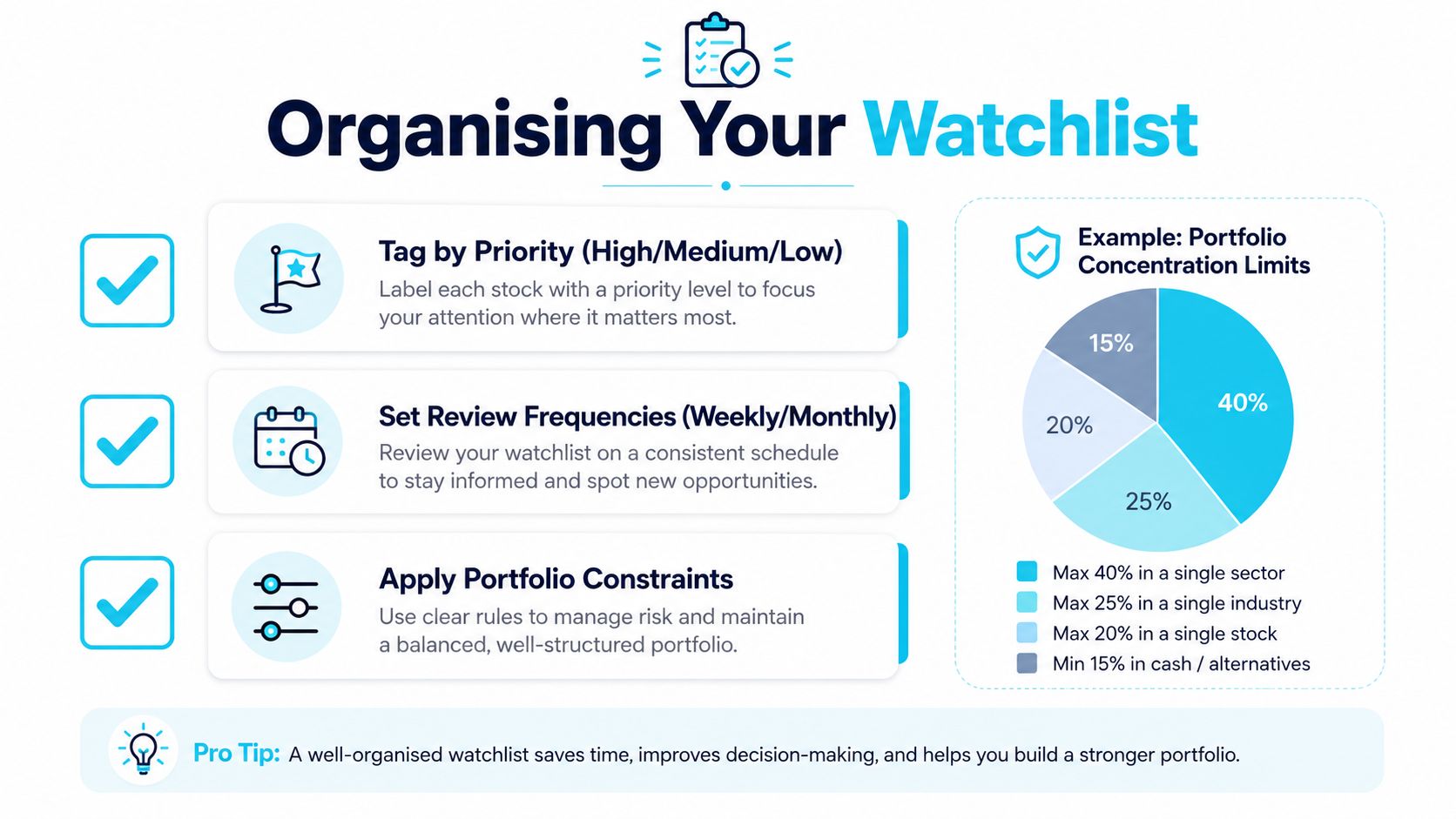
- Apply portfolio constraints before attention turns into exposure
- Prune with explicit triggers
- Automating alerts and nightly rechecks
- Make the morning review finite
- Pair automated checks with scheduled reviews
- Advanced discipline tips and avoiding watchlist bloat
- Separate research from execution
- Write the deletion rule first
- Keep constraints visible
- Conclusion and next steps
Introduction to disciplined watchlist management
Most watchlists start with good intentions. An investor reads a filing, hears a management presentation, or notices a valuation condition, then adds the ticker for later. The trouble begins when “later” has no definition. Notes remain scattered across browser tabs and spreadsheets, while the list grows beyond the investor's ability to review every name with equal care.
A disciplined process turns each ticker into a small research file. It records the thesis, the catalyst or valuation condition being monitored, the evidence that would confirm the idea, and the evidence that would invalidate it. Investor-oriented guidance also stresses the importance of a concise list, written triggers, and a fixed review rhythm, because names that accumulate without re-evaluation create watchlist bloat and slow follow-up work. See this practical overview of how investors build watchlists.
The distinction matters for operators managing a portfolio as well as a research queue. A stock can remain interesting while no longer fitting the rules governing the broader book. That's why the strongest workflow combines traditional watchlist techniques with portfolio-fit scoring and nightly rechecks. The list doesn't merely ask, “Is this company worth watching?” It asks, “Does this name still match the strategy I wrote down, and what specific evidence would change that answer?”
Initial setup process
Start with the thesis, not the ticker. Before adding a stock, write a short research note that explains the company's role in the strategy, the conditions that would make it relevant, and the facts that would make the idea stale. A note such as “quality compounder with durable margins” is too vague to guide monitoring. A more useful note identifies the business characteristics being tested, the financial measures that matter, and the event or valuation condition that would prompt deeper work.
Create the watch-only record
Add the ticker as a watch-only name, with no portfolio value assigned. This separates research interest from an existing position and prevents a watchlist entry from being mistaken for a capital allocation decision. In Monsa, operators can carry watch-only tickers at zero value and evaluate them against the same written rules used for holdings.
Attach the research note directly to the record. Include:
- Thesis: What makes the company relevant to the strategy?
- Evidence: Which financial or business facts support the thesis?
- Entry trigger: What measurable condition would justify a closer decision review?
- Invalidation trigger: What fact would make the original thesis no longer applicable?
- Catalyst: Which earnings release, filing, product milestone, or valuation condition deserves attention?
- Review date: When will the note be checked again?
A catalyst date shouldn't replace a thesis review. Earnings may arrive on schedule while the underlying question changes, so the note needs both a calendar event and a rule for interpreting the evidence.
Keep the active list reviewable
The practical ceiling for most active watchlists is 10 to 30 names, according to watchlist management guidance on list size and refresh cadence. The point isn't to impose an arbitrary limit. It's to keep the active list small enough that an operator can review every name mechanically rather than browsing selectively.
Set the cadence according to the expected holding period. A short-horizon setup may need frequent checks, while a long-term research idea can use a slower documented rhythm. A weekly review of entry criteria and a quarterly review of continued relevance provide a useful operating structure for many fundamental investors, provided the cadence matches the thesis rather than becoming a ritual.
For a practical reference on translating an investment philosophy into a repeatable checklist, see this guide to building an investment checklist. The setup is complete when every name has a reason to be present and a documented condition for review or removal.
Defining scoring criteria and thesis alignment
A written thesis becomes useful only after it has been translated into criteria that can be checked consistently. Start by separating deterministic rules from qualitative judgments. A deterministic rule might assess whether a reported metric sits above a chosen threshold. A qualitative rule might ask whether the company's competitive position remains credible based on the available evidence.
Turn prose into rules
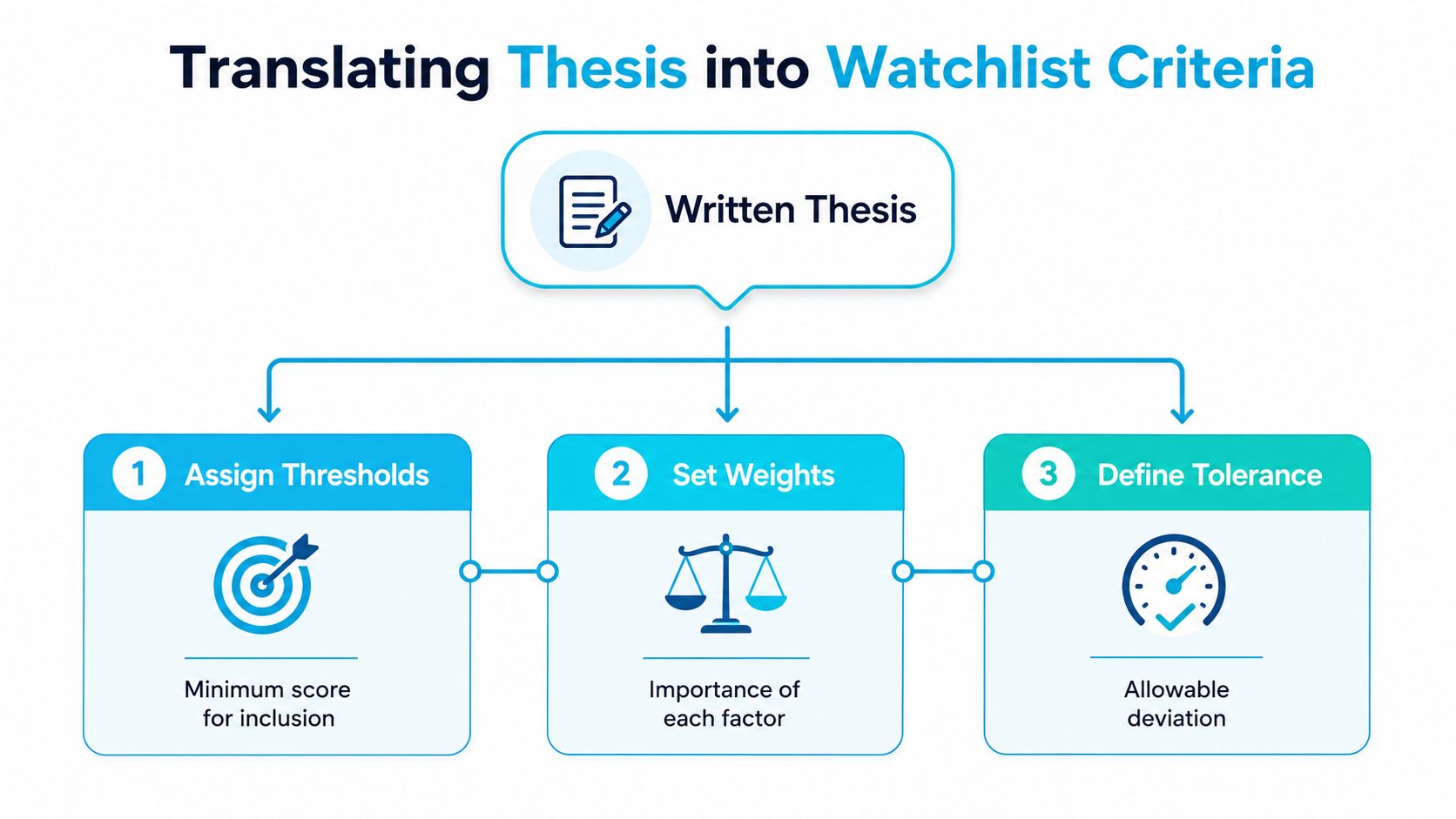
Natural-language strategy capture can help operators draft an initial rule set, but every rule still needs confirmation. Review the wording, adjust thresholds, assign relative importance, and define tolerance bands. The operator remains responsible for deciding whether a criterion reflects the original research note.
A workable rule record contains four parts:
1. Metric or question: What is being assessed? 2. Threshold: What level qualifies as acceptable? 3. Weight: How important is this criterion relative to the others? 4. Tolerance: How much deviation is acceptable before the result becomes borderline?
For example, a quality-focused thesis might include profitability, balance-sheet resilience, and evidence of durable demand. The rules don't need to pretend that every investment question is numerical. They need to make clear which parts can be measured and which require judgment.
Practical rule: If an operator can't explain what would move a criterion from fits to borderline, the criterion isn't defined tightly enough.
Monsa presents a 0–100 fit score with verdicts of fits, borderline, or violates, alongside a per-criterion breakdown. Deterministic measures handle the arithmetic. AI judgment is reserved for questions that require interpretation, and the reasoning is shown rather than hidden behind an unexplained output. Operators can inspect whether a result came from a reported figure, a derived measure, a qualitative assessment, or missing coverage.
Add portfolio fit to the score
Generic watchlists often treat each stock as an isolated research item. A less commonly addressed issue is whether the name fits the broader portfolio, including overlap, sector exposure, and strategic role. This gap is described in portfolio-context watchlisting guidance.
A company can satisfy the written stock thesis and still conflict with book-level constraints. Record the intended role, related holdings, sector exposure, and any concentration rule beside the stock-level criteria. This creates a second question for every watch-only name: does the thesis fit, and does the portfolio have room for that type of exposure?
For a deeper explanation of explicit thresholds and strategy rules, review rules-based investing. The value of scoring isn't the number by itself. It's the disciplined connection between the original thesis, current evidence, and a clearly explained verdict.
A short demonstration can make the distinction between rule arithmetic and qualitative judgment easier to follow:
<iframe width="100%" style="aspect-ratio: 16 / 9;" src="https://www.youtube.com/embed/zaE0VdPTdas" frameborder="0" allow="autoplay; encrypted-media" allowfullscreen></iframe>
Organising and prioritising your watchlist
A watchlist becomes actionable when an operator can answer three questions quickly: which names need attention, why they need it, and what evidence would change their status. Sorting alphabetically or by recent price movement rarely answers any of them. Organise the list around the workflow that governs decisions.
Use categories that reflect intent
Separate trade-ready setups from long-term research ideas and from names being monitored for a specific catalyst. Mixing those categories creates false urgency. A company awaiting a filing shouldn't occupy the same queue as a name that already meets the research criteria but needs portfolio-fit review.
Useful fields include:
- Priority: High, medium, or low, based on the next decision point.
- Role: Existing holding, watch-only candidate, hedge, compounder, or another defined portfolio function.
- Catalyst date: The event that could change the evidence.
- Fit status: Current score and verdict against the written strategy.
- Removal rule: The condition that retires the name.
- Overlap flag: Existing exposure that could make the addition strategically unsuitable.
A catalyst date should increase attention temporarily, not keep a name permanently active. After the event, update the research note and either define the next question or remove the ticker.
Apply portfolio constraints before attention turns into exposure
Portfolio oversight often uses box constraints for individual positions, group constraints for sectors or factors, and turnover constraints for how much the book can change during a rebalance. One neutral portfolio-constraints reference gives the sector-cap form as ∑ᵢ∈Sector wᵢ ≤ 25%, where the weights in a sector must remain within the defined limit. See the explanation of weight bounds and turnover limits.
The watchlist should surface these conflicts before a name reaches the execution queue. If a candidate overlaps heavily with current holdings, tag the overlap and require a portfolio-fit review. The correct outcome isn't predetermined. The important point is that the constraint becomes visible before the stock's narrative takes over the process.
Prune with explicit triggers
A name belongs on the list only while its monitoring question remains live. Remove it when the thesis is invalidated, when the catalyst has passed without a new question, when the valuation condition is no longer relevant, or when the portfolio role cannot be justified under the current constraints.
Published watchlist guidance also emphasises a written research note, explicit triggers, and a fixed cadence as safeguards against stale names. Read this practical discussion of reducing ambiguity in watchlist workflows. A lean list isn't less thorough. It's easier to inspect, rank, and update without allowing old ideas to dilute attention.
Automating alerts and nightly rechecks
Manual monitoring fails at the handoff between research and routine. An operator may write excellent criteria, then stop checking the list consistently because every review requires reopening multiple data sources and reconstructing the original thesis. Automation works best when it removes repetitive checking without replacing the judgment that determines whether the thesis still makes sense.
Configure alerts around the conditions that matter. A price alert can flag movement toward a research threshold, while a metric alert can highlight a change in a fundamental measure. Catalyst alerts should point to earnings releases, filings, or other events named in the research note. Each alert needs an interpretation rule, otherwise it creates information without a decision path.
Make the morning review finite
A nightly recheck should produce a short queue for the next review, not a stream of undifferentiated notifications. Refresh the inputs, compare each ticker with its criteria, and display what changed since the prior assessment. The morning workflow can then focus on:
- New fits: Names that now satisfy the defined criteria.
- Borderlines: Names where a threshold or qualitative condition deserves investigation.
- Violations: Names that no longer match a stated rule.
- Unchanged names: Tickers that require no immediate research beyond the scheduled cadence.
- Missing data: Records where the verdict needs verification before interpretation.
Monsa scores the stocks an operator holds against the strategy they wrote down, every night. Its role is to show whether the current evidence still matches those rules, not to issue a trading instruction. A nightly verdict is useful because it makes thesis drift visible while the original reasoning remains available for comparison.
Pair automated checks with scheduled reviews
Monitoring shouldn't happen only when a headline appears. Guidance on watchlist monitoring cadence describes a regular weekly or monthly routine built around cadence, criteria, context, and cleanup, with catalyst checks after earnings releases.
Use price alerts for conditions that require prompt visibility, then reserve the deeper review for the documented cadence. When a score changes, read the per-criterion explanation and the what-would-change note before editing the thesis. The purpose of automation is not to accelerate conclusions. It's to ensure the same rules get checked even on days when attention is elsewhere.
Advanced discipline tips and avoiding watchlist bloat
The most persistent watchlist problem isn't the absence of ideas. It's the failure to retire them. A name remains because deleting it feels like admitting that the research went nowhere, even when the catalyst has passed or the original premise no longer holds. That emotional friction is why removal rules need to be written before the stock becomes familiar.
A watchlist without entry criteria, exit criteria, categories, or invalidation rules becomes a cluttered idea inbox rather than an actionable decision system, as explained in this guide to building a structured stock watchlist.
Separate research from execution
Keep distinct lists for different jobs. A long-term research queue can contain incomplete work and open questions. A trade-ready setup list should contain only names with defined triggers, current evidence, and a near-term review date. An existing portfolio list needs a different lens again, because it monitors thesis alignment and portfolio constraints rather than merely searching for candidates.
This separation prevents a common error: treating attention as commitment. A stock can be intellectually interesting without deserving the same monitoring frequency as a name approaching a defined decision point.
Write the deletion rule first
An invalidation rule answers, “What exact evidence would remove this name?” Examples include a failed business assumption, a changed management objective, a broken balance-sheet condition, or a portfolio constraint that can't be reconciled with the candidate's intended role. The rule should be specific enough that another operator could apply it without reconstructing the author's mood at the time.
Review the rule after each catalyst. If the evidence weakens the thesis, retire the name. If the evidence changes the question, rewrite the note and assign a new date. If nothing material changes, keep the existing cadence rather than increasing attention by default.
Keep constraints visible
Position and sector limits are portfolio controls, not afterthoughts. Published portfolio materials show examples of explicit maximum position and industry limits, while broader portfolio-construction guidance describes position-size caps, sector exposure limits, minimum holdings, and turnover limits as common controls. See the portfolio factsheet with these constraint examples.
The practical trade-off is clear. A larger list offers broader coverage but increases review burden and overlap risk. A smaller list reduces noise but can omit useful research paths. The right answer is a list that can be checked mechanically, with every name tied to a role, a trigger, and a removal condition.

Conclusion and next steps
Disciplined watchlist management is a repeatable operating rhythm:
1. Write the research note before adding the ticker. 2. Define entry, exit, and invalidation triggers. 3. Separate watch-only research from existing holdings. 4. Add portfolio role, overlap, and constraint fields. 5. Review high-priority names on a faster cadence. 6. Run nightly rechecks so thesis drift becomes visible. 7. Use alerts for defined conditions, not general news. 8. Prune names when the original question no longer applies.
The list should make the next review easier, not preserve every idea you've ever considered. A score, alert, or verdict is only useful when the operator can trace it back to a stated rule and decide whether the research note still describes reality.
Operators can review Monsa's pricing page for current plan details, then test the workflow with watch-only names and live portfolios. Start with a small list, write one clear invalidation rule for every ticker, and set a nightly review habit that keeps the portfolio connected to the strategy.
Monsa helps operators track watch-only names and holdings against the rules they've written, with nightly fit scoring and transparent per-criterion reasoning. Visit Monsa to turn your watchlist into a strategy-aware review workflow rather than a passive collection of tickers.
Monsa is a portfolio-analysis tool, not a broker or investment adviser. Nothing here is investment advice.
// related reading
What Is Portfolio Turnover and Why It Matters
What is portfolio turnover? Learn the SEC formula, worked examples, costs, taxes and benchmarks to judge if trading fits your strategy.
Florida Unemployment Amount: What You Will Actually Receive
Learn how the Florida unemployment amount is calculated, the $275 weekly cap, duration rules, and how partial earnings change your payment in 2026.
XLU Ex Dividend Date 2026 and How to Read It
Find the latest XLU ex dividend date for 2026, learn how quarterly payouts work, and see how T+1 settlement changes who actually receives the distribution.
7 / 100 founding seats claimed - $100/yr locked, then $190/yr
Monsa is a portfolio-analysis tool, not a broker or investment adviser. It never recommends what to buy or sell - it checks what you hold against rules you wrote. Nothing here is investment advice.