// blog
Rules Based Investing: A Practical Guide for Operators
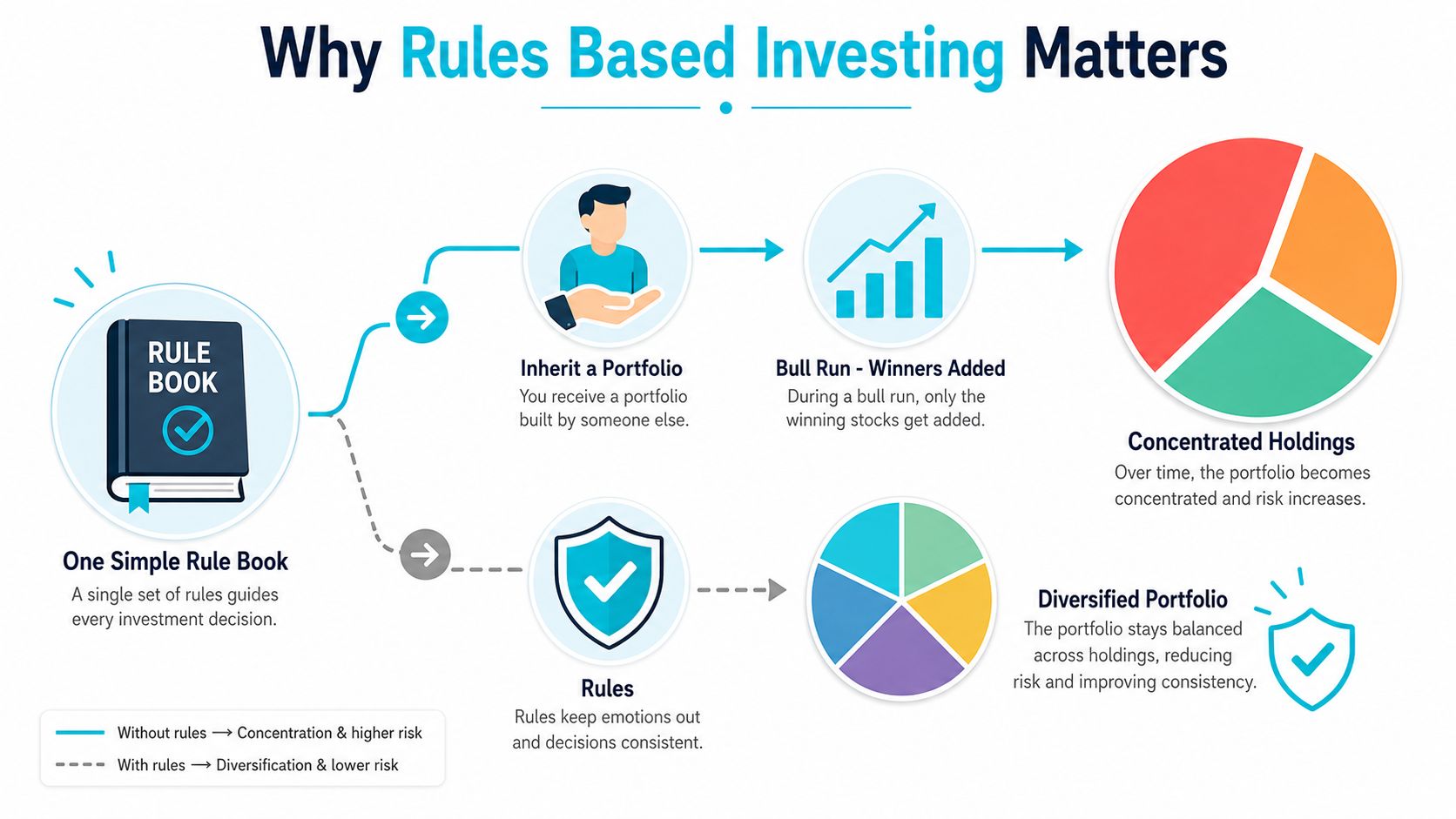
The portfolio looked healthy at first glance. An operator had inherited a book built around a clear thesis, then added familiar winners during a long bull run. Months later, three names dominated the holdings, several original constraints had disappeared, and the investment policy statement no longer described the portfolio on the screen.
That situation is common because drift rarely arrives as one dramatic decision. It accumulates through exceptions, delayed reviews, changing narratives, and the comforting belief that a successful holding has earned special treatment. Rules based investing treats the portfolio as an operating system: the thesis becomes written criteria, each position is checked against those criteria, and every exception leaves a record.
Table of Contents
- Why Rules Based Investing Matters
- The operating benefit
- The Origins of Systematic Portfolio Construction
- From market representation to factor selection
- How Rules Based Investing Actually Works
- A small example of executable logic
- Turning a Written Thesis Into Testable Rules
- Sample thresholds for a quality-value thesis
- Choosing the Right Rule Structure for Your Book
- Rule structures compared across market conditions
- Designing a Nightly Monitoring Workflow
- Separate automatic checks from human review
- An Operator Checklist for Long Run Discipline
- Common Misconceptions About Rules Based Investing
Why Rules Based Investing Matters
A rules based process starts with a simple premise: every position, position size, and exit condition follows criteria written in advance. The operator doesn't invent a new standard for each company after seeing its price move. The same tests apply to every eligible holding, and the portfolio can be reviewed against a documented process rather than against memory.
That matters most when pressure rises. A profitable position can feel like proof that the thesis is working, even when its weight has become inconsistent with the stated risk limits. A disappointing position can attract an elaborate explanation that wasn't available when the original rule was written. Without a stable reference point, the operator can confuse a changing story with a changing thesis.
Rules don't remove uncertainty. They create an audit trail. An operator can ask which rule triggered, what data was available, whether an exception was granted, who granted it, and when the decision should be revisited. That makes a review more useful than a narrative such as “the company still feels right.”
The operating benefit
The practical benefit is consistency under stress. A written rule can limit concentration, identify a broken condition, or require a review before an exception becomes permanent. It also gives an operator a common language for discussing the book with partners, clients, or an investment committee.
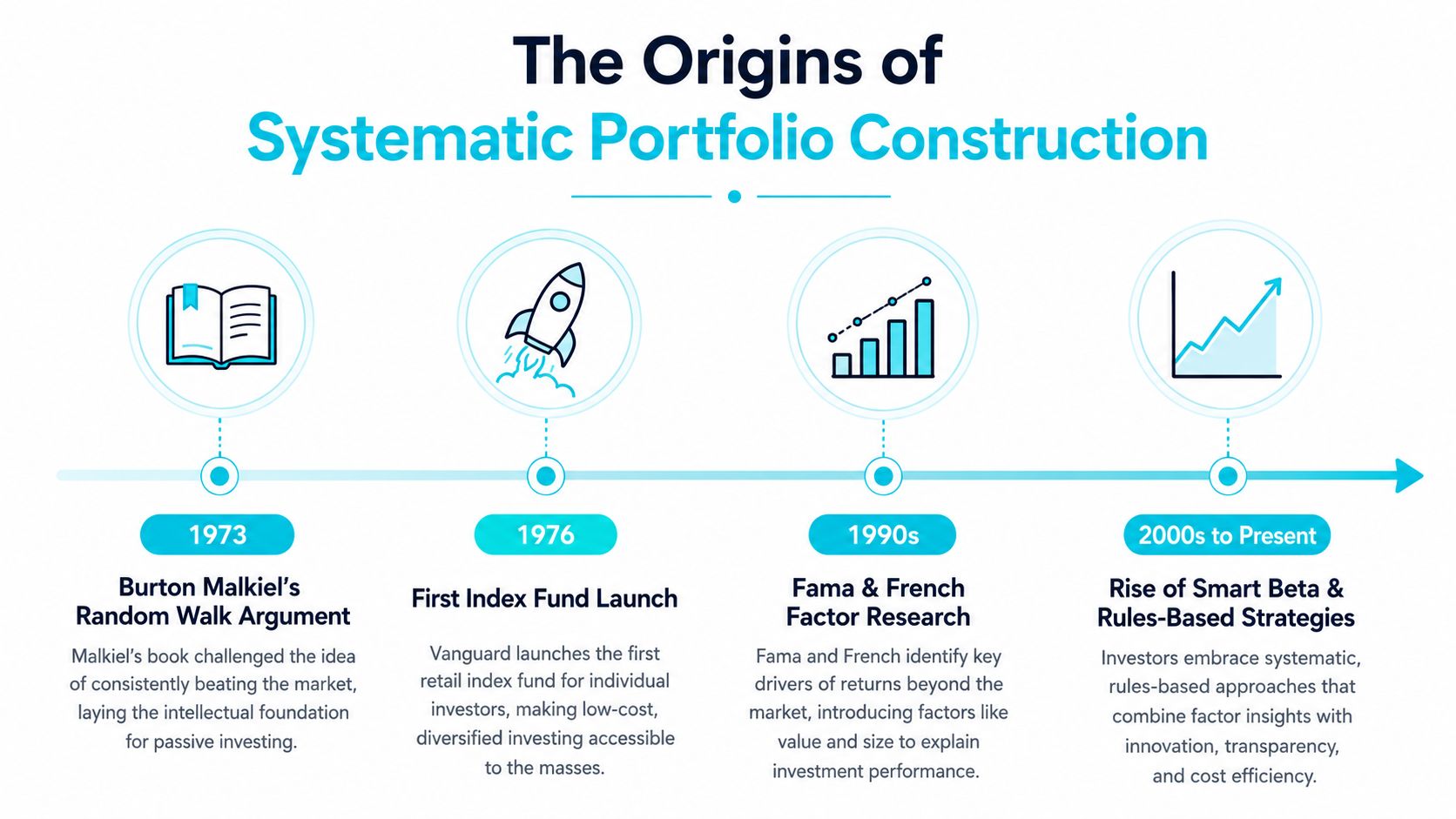
The academic foundation supports the same idea. Vanguard defines an index fund as a portfolio that holds the securities in its benchmark, targets the benchmark weights, and rebalances when the index does. The explicit design makes the process more predictable because the method is stated in advance, as described in Vanguard's history of indexing.
The rest of this guide treats rules based investing as a working system. It covers the intellectual roots, the conversion of a thesis into tests, the choice of rule structure, nightly monitoring, and the habits that stop a written philosophy from becoming another forgotten document.
The Origins of Systematic Portfolio Construction
A portfolio manager faces a familiar choice after a sharp headline: change the holdings immediately or follow a method written before the news arrived. Rules based investing grew from the second option. In the early 1970s, Burton Malkiel, a Princeton professor, argued publicly for a no-load, minimum-fee fund that would buy market averages and avoid trading. His proposal helped shape the intellectual foundation for index-tracking portfolios and later systematic strategies, as described in Vanguard's historical summary.
The underlying idea is straightforward. If a portfolio aims to represent a market, its construction can be specified in advance. Early institutional index-tracking portfolios, followed by retail offerings, turned that idea into an operating process. Benchmark weights, eligibility rules, and scheduled rebalancing replaced a succession of discretionary stock-by-stock decisions.
From market representation to factor selection
Systematic construction later moved beyond broad-market tracking. Academic work on factors, including research associated with Eugene Fama and Kenneth French, gave investors a vocabulary for recurring characteristics such as value, size, and profitability. Quantitative managers converted those characteristics into ranking models, eligibility screens, position limits, and rebalance schedules.
The historical record also shows how the method expanded. A Harvard paper reports that index-fund assets under management increased from $511 million in 1985 to $55 billion in 1995, then to more than $4.0 trillion by the paper's publication. The figures appear in Harvard's paper on index investing.
The line between passive and active is therefore less precise than the labels suggest. A portfolio may actively select securities while applying explicit eligibility tests, scoring, constraints, and review schedules. Human judgment still has a place. The defining question is whether the operator can state the process before seeing the outcome, then monitor whether the portfolio continues to follow it.
How Rules Based Investing Actually Works
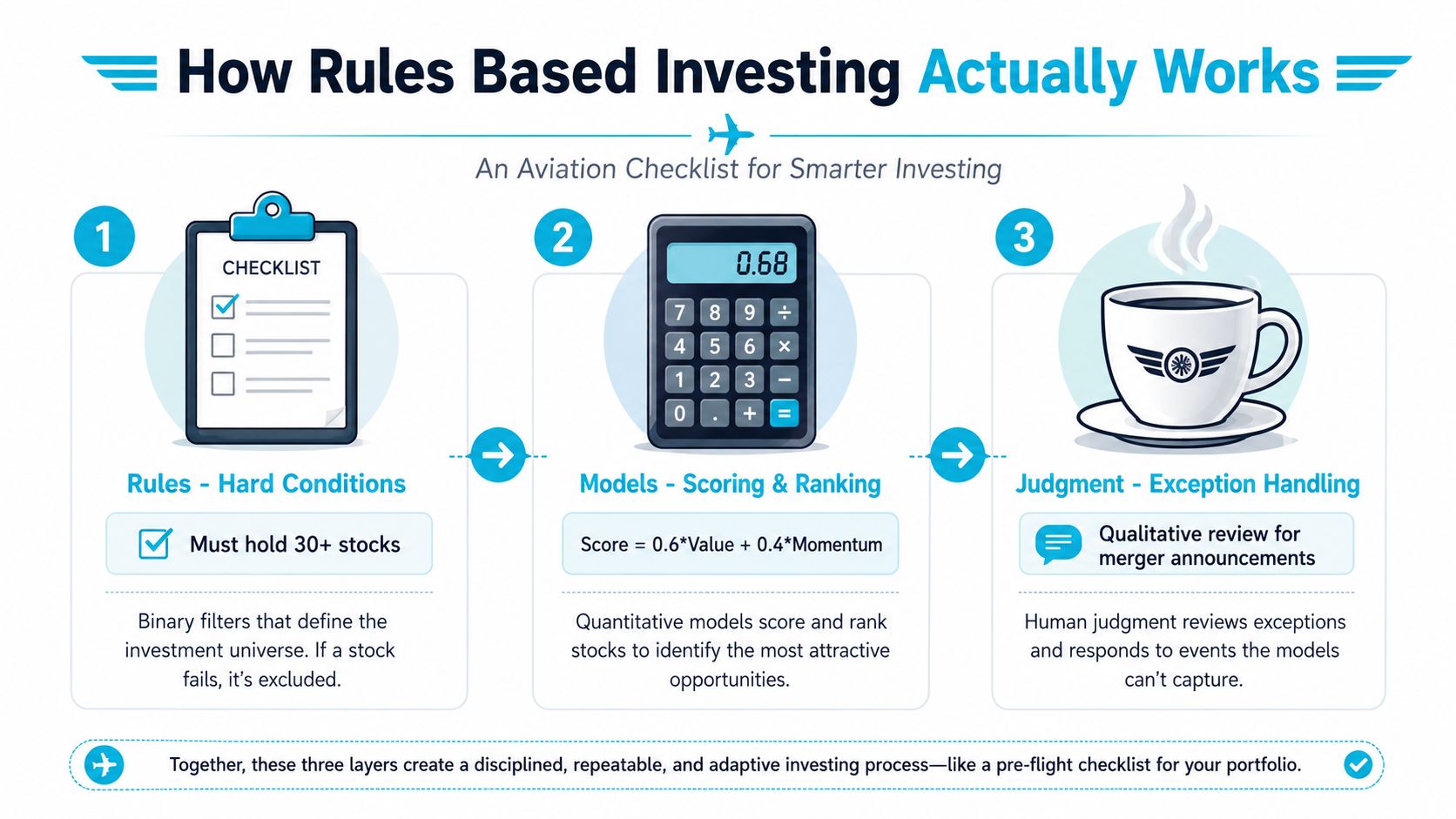
A useful analogy is an aviation preflight checklist. The checklist doesn't fly the aircraft, but it ensures that critical conditions are checked in a repeatable order. A rules based portfolio works similarly, with three layers that operators often confuse.
Rules are hard conditions. They define what must be true for a position to qualify or remain eligible. Examples include a minimum number of holdings, a sector cap, a required financial metric, or a prohibition on a specific business activity.
Tolerances define acceptable movement around a target. A position may be allowed to drift within a band before action is required. Tolerances prevent the operator from turning every small price movement into a trade while still making concentration visible.
Verdicts are the outputs produced after current data is compared with the rules and tolerances. A system might label a holding as fits, borderline, or violates. The label isn't a prediction. It records the relationship between the portfolio and the written method.
A small example of executable logic
Suppose an operator writes a rule that any position exceeding 8 percent of the book must be brought back to 6 percent within three trading days. Those figures are only an illustration of how a rule can be expressed. The key is that the condition, target, and timing are all explicit.
A vague instruction such as “keep concentration under control” leaves several questions unanswered. Does the rule apply at the close or intraday? Does a temporary breach require action? Is the position reduced to the cap or to a lower target? What happens if trading is restricted?
The rebalancing study on conditional rules makes the implementation point clearly. Conditional rebalancing triggers trades when the gap between current and target weights exceeds a threshold, directly controlling turnover. In daily momentum-factor tests, priority-based rebalancing generally preserved more alpha while reducing turnover than simpler rules, showing that the algorithm can materially alter realized outcomes even when the factor exposure is similar. See the study on smart rebalancing.
Practical rule: Write the condition, the response, the deadline, and the exception path. If one is missing, the operator still has to improvise.
Rules based investing doesn't eliminate judgment. It moves most judgment upstream, into the design of the rule set, and reserves downstream judgment for cases the rules can't settle.
<iframe width="100%" style="aspect-ratio: 16 / 9;" src="https://www.youtube.com/embed/GcYsGEKPJOY" frameborder="0" allow="autoplay; encrypted-media" allowfullscreen></iframe>
Turning a Written Thesis Into Testable Rules
A thesis becomes operational when another person can apply it without asking what the author meant. Start with a one-page investment policy statement, or IPS, that names the philosophy, eligible universe, position-sizing method, constraints, review cadence, and exit triggers. The IPS should describe the process in language that can be tested against current holdings.
Take the phrase “quality at a reasonable valuation.” It sounds useful but leaves room for almost any conclusion. An operator can translate it into gates such as return on invested capital above 15 percent, debt-to-EBITDA below 2.5x, and a price-to-earnings ratio inside a defined band relative to the company's five-year average. Those thresholds are an example of rule design, not a universal standard.
A second pass should identify what happens when data is missing, stale, or incomparable. “Good management” might become a qualitative review of capital allocation, governance, and incentive structure. That criterion needs a defined evidence source and a written review note, rather than an undocumented impression.
Sample thresholds for a quality-value thesis
| Trigger Type | Metric | Threshold | Action on Breach |
|---|---|---|---|
| Entry | Return on invested capital | Above 15% | Fails initial eligibility review |
| Entry | Debt-to-EBITDA | Below 2.5x | Fails initial eligibility review |
| Entry | Price-to-earnings ratio | Inside the chosen band versus the five-year average | Escalate for valuation review |
| Sizing | Position weight | Within the IPS limit | Flag drift when the limit is crossed |
| Exit | Core quality metric | Below the documented floor | Place in exception review |
| Exit | Thesis evidence | Material deterioration under the written criteria | Record the verdict and review action |
The table exposes two common failure points. Loose thresholds never trigger, so the rulebook becomes decorative. Tight thresholds produce an empty or unstable book, leaving the operator to override the system before it has a chance to operate.
Use version control for the rule document. Record the prior wording, the revised wording, the reason for the change, and the effective date. A rule changed after a difficult outcome may be sensible, but it shouldn't be rewritten retroactively to make the earlier decision look consistent. A practical guide to the analytical side of this work is how to evaluate stocks.
Choosing the Right Rule Structure for Your Book
There isn't one correct scheduling model. The right structure depends on the thesis, the liquidity of the holdings, the tolerance for turnover, and the operator's capacity to review exceptions.
Calendar-based rebalancing reviews the book on a fixed schedule, such as quarterly or annually. It is easy to administer and predictable, but a large drift can remain untouched until the next review.
Threshold-based rebalancing acts when an allocation moves outside a defined band. It responds to the portfolio's condition rather than the date, although volatile holdings can create more alerts.
Event-driven rules respond to a specified event, such as an earnings release, index reconstitution, or rating change. They can align closely with a thesis, but the event definitions and data handling must be precise.
An IPS template commonly uses a plus or minus 5 percentage point boundary and at least quarterly review, with cash flows used before trades when possible, as described in this investment policy statement template. A Vanguard sample IPS instead reviews semiannually, on June 30 and December 31, and uses incoming cash or outgoing disbursements before trading when moving holdings toward target weights, as shown in the sample IPS.
Rule structures compared across market conditions
| Rule Structure | Quiet Drift | Sharp Rally | Sudden Drawdown |
|---|---|---|---|
| Calendar-based | Waits for the scheduled review | May leave weights unchanged until the date | Uses the next scheduled review unless a separate emergency rule exists |
| Threshold-based | Acts only after a band is crossed | Flags concentration as the position expands | Flags a weight decline or allocation gap when the band is crossed |
| Event-driven | Does nothing without a defined event | Responds to the specified event, not the headline | Requires an event definition that distinguishes thesis damage from price movement |
Position sizing introduces another design choice. Equal-weighting spreads capital mechanically, volatility targeting changes exposure according to measured movement, and conviction tiers assign different limits to different levels of confidence. Each creates a different pattern of concentration and turnover.
Hard constraints cannot be overridden without changing the policy. Soft constraints allow an exception, but require documentation. CFA Institute materials stress that acceptable boundaries and variations outside them belong in the IPS, making the written document the reference point for deciding whether a holding still fits the policy, as explained in CFA Institute's IPS guidance.
Designing a Nightly Monitoring Workflow
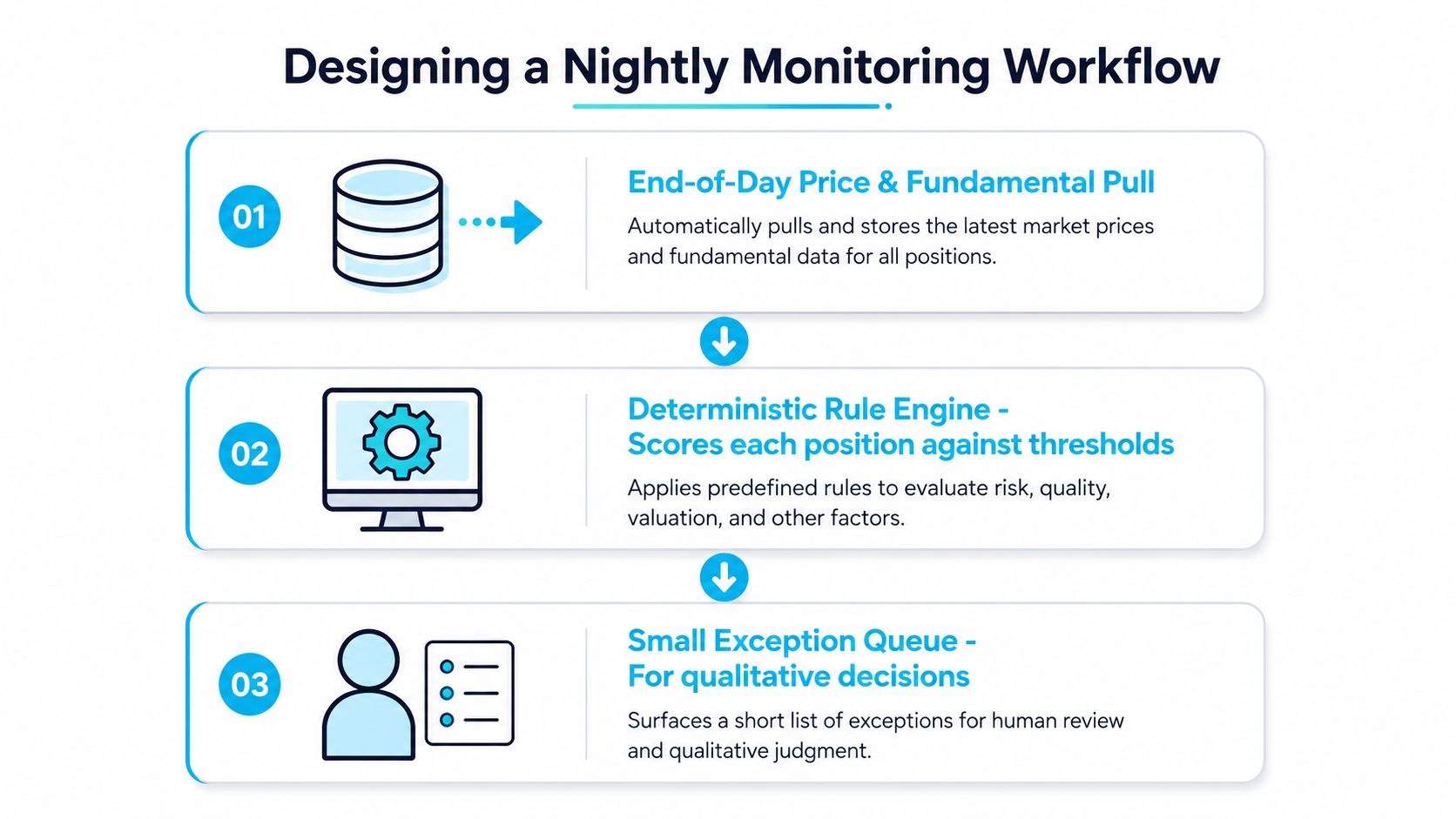
A nightly workflow should answer one operational question: which holdings no longer match the written strategy, and why? The process starts after the market closes with a pull of prices, fundamentals, foreign-exchange data where relevant, and portfolio weights.
A deterministic rule engine then checks each position against the defined thresholds. It should calculate the same metric the same way every time, flag missing inputs, and separate a hard violation from a soft drift. The output should be a short list that an operator can review, not a wall of unprioritized notifications.
Separate automatic checks from human review
Hard checks deserve immediate attention. A position-size cap violation, a missing required filing, or a stop condition defined in the IPS can page the operator. A soft drift, such as a position moving from 4 percent to 6 percent of the book, can appear in the daily dashboard when the policy treats it as a review signal rather than an emergency.
The exception queue should contain the holding, the breached criterion, the relevant data timestamp, and the available evidence. The operator then records the decision, including the rationale for action or inaction, the person responsible, and the next review date.
Automation should calculate what the rule can settle. Human judgment should handle ambiguity, not overwrite a clear calculation because the result is uncomfortable.
Weekly review meetings add a different layer. The nightly process catches individual changes, while the weekly review looks for patterns such as repeated overrides, recurring data gaps, or a constraint that is constantly too tight for the strategy. A portfolio monitoring workflow can be designed around this separation, as outlined in portfolio monitoring tool guidance.
Transaction costs belong in the workflow design, not as an afterthought. CFA Institute research finds that high turnover and related costs can erode much of a factor strategy's gross advantage, while weight constraints and explicit cost penalties can reduce turnover and leave little material value net of costs. Independent analysis cited in the same verified data estimates roughly 30 basis points of market impact for every 10 percent of average daily volume traded in aggregate, which is why liquidity-aware sizing and rebalance frequency matter. The evidence is discussed in CFA Institute's research on factor timing and tilting.
An Operator Checklist for Long Run Discipline
A rules based book stays honest through routine, not enthusiasm. The operator needs a cadence that checks the strategy before a decision, reconciles the book after decisions, and revisits the rule set when market conditions expose a design weakness.
- Weekly thesis review: Read the original thesis before reviewing a proposed change. This helps identify the moment when a company-specific story starts replacing the stated criteria.
- Monthly IPS reconciliation: Compare every holding, weight, sector exposure, and exception with the policy. A recurring breach may indicate that the rule is poorly designed or that the operator is ignoring it.
- Quarterly trigger attribution: Record which rules produced each portfolio change and which changes happened outside the rule set. The second category deserves scrutiny because undocumented discretion is how drift becomes normal.
- Annual model refresh: Recheck assumptions and backtests against new regimes, data definitions, and implementation costs. A refresh isn't permission to rewrite history. It is a review of whether the process still represents the philosophy.
The failure modes are predictable. After a favorable period, an operator may loosen position limits, dismiss a tolerance breach, or accumulate so many qualitative exceptions that the rulebook no longer governs the book.
Use a checklist that makes those failures visible. This investment checklist can serve as a starting point for organizing the review cycle, provided the operator adapts it to the actual IPS rather than treating a template as a substitute for one.
Common Misconceptions About Rules Based Investing
Myth one, backtesting is proof. A historical test can fit the past without describing the next environment. Survival bias can remove failed securities from the sample, while curve-fitting can turn accidental historical patterns into apparently precise rules. A backtest is evidence for inspection, not certainty.
Myth two, rules eliminate factor exposure. They don't. A written process can concentrate in momentum, value, size, quality, or another characteristic, especially when several screens point toward the same companies. The operator needs to measure exposures and understand how the criteria interact.
Myth three, a rulebook prevents behavioral drift. It doesn't. An operator can grant one exception for a persuasive narrative, then another for a familiar name, until the exceptions become the actual strategy. Version control and exception logs matter because they show whether the written policy still governs actual decisions.
What rules provide is narrower and more useful: consistency under pressure. They make the process inspectable, expose deviations, and force the operator to decide whether a change belongs in the portfolio or in the rulebook. They don't provide certainty, and they don't replace judgment.
Monsa stores an operator's written strategy, scores each tracked stock against its criteria, and refreshes the verdict nightly using fundamentals, prices, and FX. Visit Monsa to see how a strategy-versus-portfolio workflow can make thesis drift and rule exceptions visible.
Monsa is a portfolio-analysis tool, not a broker or investment adviser. Nothing here is investment advice.
// related reading
What Is Portfolio Turnover and Why It Matters
What is portfolio turnover? Learn the SEC formula, worked examples, costs, taxes and benchmarks to judge if trading fits your strategy.
Watchlist Management: A Step-by-Step Guide for Traders
Master watchlist management with actionable steps to create, score, and prioritize your stock list. Learn thesis alignment and alerts setup for better
Florida Unemployment Amount: What You Will Actually Receive
Learn how the Florida unemployment amount is calculated, the $275 weekly cap, duration rules, and how partial earnings change your payment in 2026.
7 / 100 founding seats claimed - $100/yr locked, then $190/yr
Monsa is a portfolio-analysis tool, not a broker or investment adviser. It never recommends what to buy or sell - it checks what you hold against rules you wrote. Nothing here is investment advice.