// blog
10 Stock Research Platforms Worth Using in 2026
The strongest stock research platform in this set is Monsa, because it turns a written thesis into nightly pass or fail checks across every tracked holding. The broader market for stock trading and investing apps is still projected to reach USD 140.07 billion by 2030 from USD 37.27 billion in 2022, which helps explain why the category keeps expanding into fuller workflows instead of simple quote lookup alone (Grand View Research).
Most investors still pick a stock research platform for surface appeal, then wonder why their process drifts. The better test is stricter, does the tool help you write a thesis, codify it into rules, and recheck those rules automatically as new facts arrive? That's the discipline lens behind this list, and it changes the ranking. Coverage matters, freshness matters, analytics depth matters, but rule-based workflow matters most if you want your portfolio to stay aligned with the strategy you said you had.
That's also why modern research tools have moved beyond simple charts. AlphaSense's overview points out that its platform covers over 100,000 stocks globally, while Fidelity's research pages show how a single stock snapshot can combine price, volume, yield, growth, dividend data, analyst research, and competitor comparisons in one place (AlphaSense). Columbia's guide also reflects the deeper shift, since it pushes investors to review years of operating history, margins, returns, free cash flow, and debt before acting (Columbia University). In other words, the best platform is no longer the one that shows you the most tickers, it's the one that makes your process repeatable.
Table of Contents
- 1. Monsa
- Why it wins for discipline-first investors
- 2. Morningstar Investor
- Best use case and limitation
- 3. Seeking Alpha Premium
- Where it fits in a thesis workflow
- 4. Koyfin
- Why visual analysts like it
- 5. TIKR
- How it serves bottoms-up researchers
- 6. Stock Rover
- Why it's good for systematic investors
- 7. Simply Wall St
- What its visuals do well
- 8. FINVIZ Elite
- Best for quick discovery, not thesis enforcement
- 9. GuruFocus
- Why value investors keep it in the mix
- 10. Zacks Premium
- Where it helps, and where it doesn't
- Top 10 Stock Research Platforms, Feature Comparison
- Choosing the Right Stock Research Platform for Your Process
1. Monsa
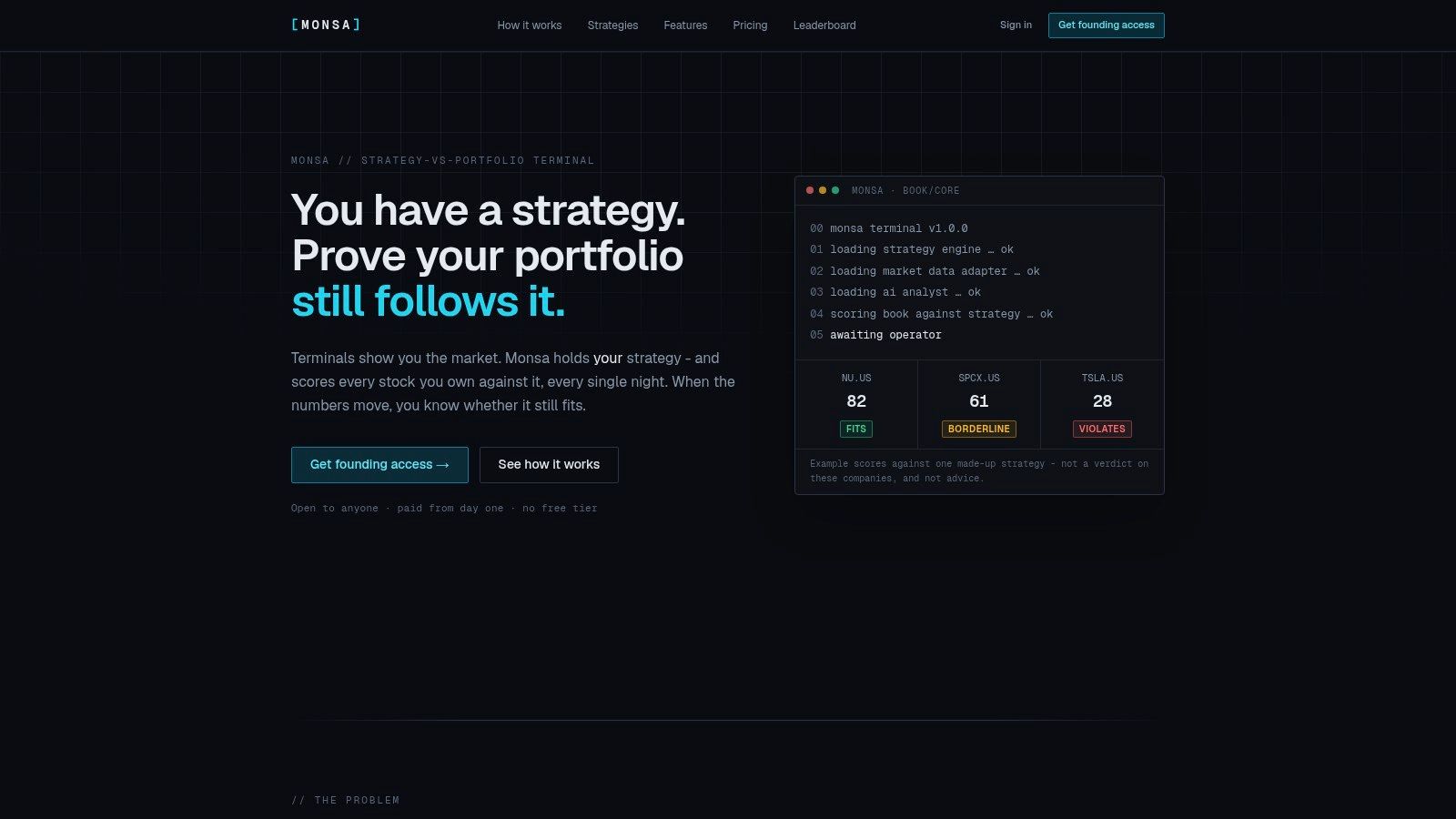
Monsa stands out because it's built around the question most general terminals ignore, does this holding still fit the thesis I wrote down? It scores each tracked stock from 0 to 100, then labels it fits, borderline, or violates, with a per-criterion breakdown that separates deterministic metrics from qualitative judgment. That's a very different job from simple screening, and it's exactly why thesis drift gets surfaced before it becomes portfolio baggage.
The platform's real strength is its rule engine. Monsa gives you 10 editable strategy templates and also lets you draft a strategy in plain English, then turn it into checkable criteria with published thresholds, weights, and tolerance bands. It refreshes end-of-day fundamentals, prices, and FX every night for US and major European exchanges, so each time you open the terminal you're seeing a fresh verdict rather than a stale one.
Why it wins for discipline-first investors
Practical rule: if your investment memo can't be turned into a nightly check, it's too loose to protect a live portfolio.
Monsa is especially useful when you manage multiple rules at once, because the matrix view shows every stock against every strategy in one grid. Portfolio-level constraints, such as position size, sector caps, and minimum or maximum positions, make it easier to check the whole book instead of only individual names. It also includes drift tracking, book value and P&L visibility, plus price alerts, which makes the platform feel like an oversight layer instead of a discovery feed.
The tradeoff is scale and scope. Monsa doesn't try to be a backtesting engine, an execution platform, or a real-time intraday terminal, and it's paid from day one. For self-directed investors, independent PMs, and small RIAs who care about repeatable discipline, that's not a weakness, it's the point.
Pros
- Nightly thesis enforcement, with automatic re-scoring instead of manual review
- Transparent rules, with published templates and no black-box scoring
- Mixed numeric and qualitative analysis, with AI handling the judgment calls numbers can't settle
- Book-level oversight, including portfolio constraints, drift, and P&L
- Simple pricing, with a monthly plan and limited founding annual seats
Cons
- Limited capacity, with a deliberately small cap on tracked tickers and parallel portfolios
- No backtests or trade execution, so it's not a research-to-brokerage bridge
- End-of-day only, which makes it less suitable for intraday traders
Website: Monsa
2. Morningstar Investor
Morningstar Investor is the most natural fit for investors who want fundamentals, analyst work, and portfolio diagnostics in one familiar place. Its equity and fund coverage makes it broader than a single-stock screener, and the platform's Portfolio X-Ray gives you a second layer of analysis that's closer to exposure review than idea generation.
That matters because a lot of investors don't need another place to find stocks. They need a way to check whether their portfolio still matches the risk and factor mix they think they own. Morningstar's research stack is strong on analyst reports, proprietary ratings, watchlists, and screening, so it works well when your process starts with research but ends with portfolio-level reflection.
Best use case and limitation
Morningstar is strongest when you want a respected methodology and a single pane for stocks, funds, and ETFs. It's less compelling if you want to define your own rulebook and score holdings against it nightly, because that discipline layer isn't its core design. The platform is better at helping you understand what you own than at enforcing a written investment memo after purchase.
It's also a cleaner fit for investors who like a more traditional research workflow. You get a balanced view of fundamentals and diagnostics without having to stitch together multiple tools, and the platform's plan structure can be easier to approach than enterprise-style terminals. Still, the key differentiator is coverage breadth, not a thesis-tracking engine.
Pros
- Balanced equity and fund coverage
- Respected analyst methodology
- Useful portfolio diagnostics
- Watchlists and alerts
- Good single-pane research flow
Cons
- Less explicit rule enforcement
- Can feel fragmented across access tiers
- Not built around nightly thesis checks
Website: Morningstar Investor
3. Seeking Alpha Premium
Seeking Alpha Premium is strongest when you want a crowded, high-volume research feed plus quantitative overlays. Its Quant Ratings and factor grades give you a systematic signal, while its premium article library and transcripts help you see how other investors are framing the same names.
That mix can be powerful, but it also creates noise. The platform rewards active curation because the volume of opinion and analysis can outrun the signal if you don't already know what you're looking for. For investors who want to challenge a thesis rather than merely discover ideas, that can be useful, but only if they're disciplined about separating crowd commentary from their own criteria.
Where it fits in a thesis workflow
Seeking Alpha is useful as a second opinion engine. You can use screeners, earnings call transcripts, and AI-assisted research tools to pressure-test a name, then compare that output against your own thesis rules. The platform's biggest edge is breadth across equity analysis, not a single consistent enforcement framework.
That's why it works best when paired with an external discipline process. If you already have a written investment thesis, Seeking Alpha helps you examine it from multiple angles. If you're still looking for the framework itself, the platform can feel like a lot of motion without a governing rule set.
Internal comparison note, how Monsa differs from Seeking Alpha.
Pros
- Quant Ratings for a structured signal
- Transcripts and article breadth
- Useful for thesis debate
- Screeners plus AI-assisted research
- Good companion to fundamentals work
Cons
- Noisy unless you curate aggressively
- Crowd input can blur decision discipline
- Not designed to enforce written rules over time
Website: Seeking Alpha Premium
4. Koyfin
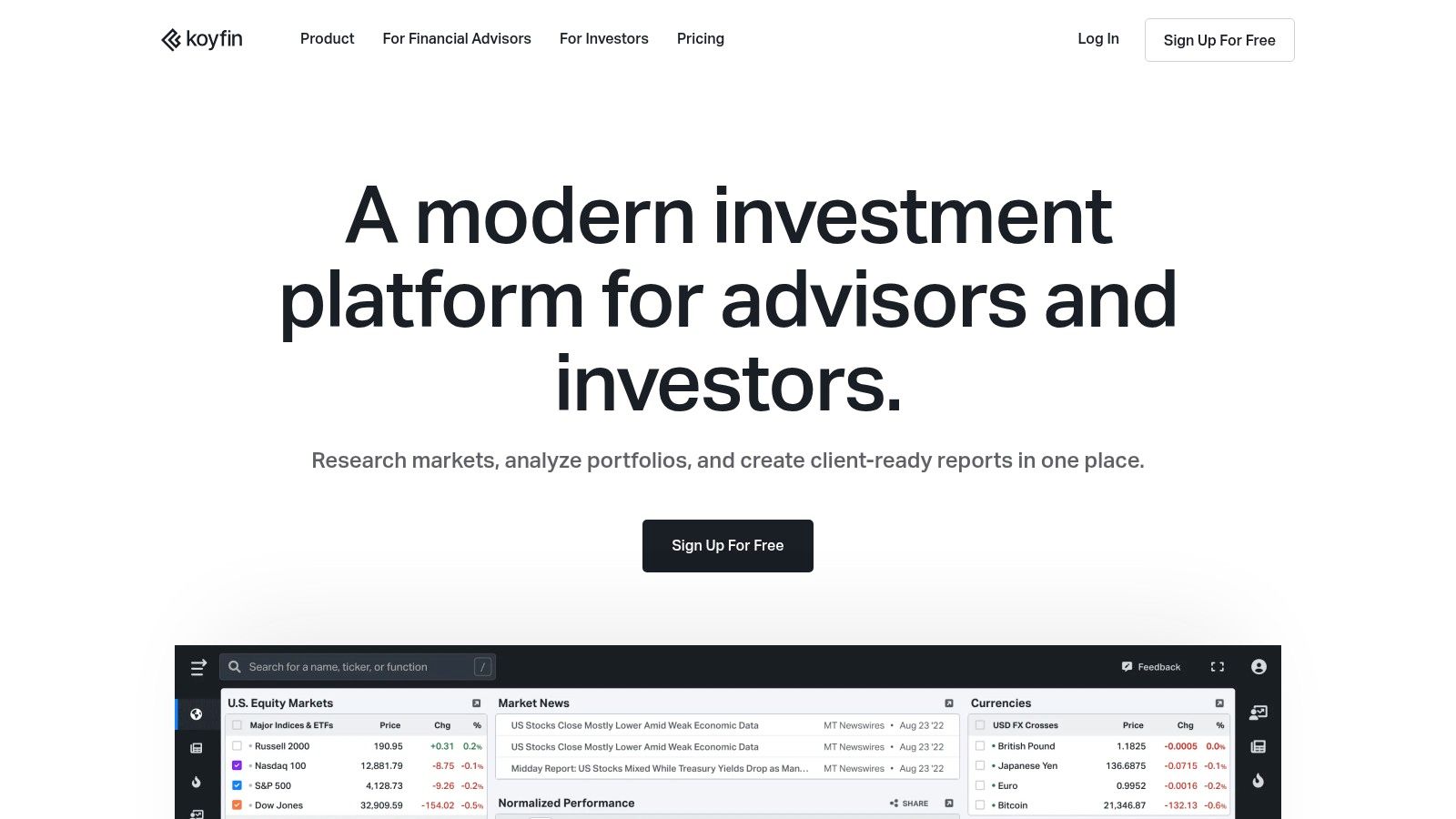
Koyfin is the most flexible visual research platform in this group. It brings together dashboards, charting, screeners, portfolio analytics, and company snapshots, so it's easy to build a workspace around the way you personally think about markets. That makes it especially appealing if you like to move between macro, sector, and company views without switching products.
Its strength is organization. Koyfin gives you a clean way to mix charts, fundamentals, estimates, filings, transcripts, and market data inside a customizable interface, which is helpful when you want context rather than a single signal. The experience feels fast and modern, and the free tier gives investors a way in before they commit.
Why visual analysts like it
Koyfin shines when the research process is exploratory. If you're comparing multiple names, building market dashboards, or watching how a sector behaves against macro data, the platform gives you enough flexibility to move quickly. For thesis enforcement, though, it's more of a workspace than a compliance layer.
Internal comparison note, how Monsa compares with Koyfin.
That distinction matters. A dashboard can show you what's changing, but it won't tell you whether the change violates the rule you wrote six months ago. Koyfin is strong on breadth and presentation. Monsa is built to turn that presentation into a yes or no decision.
Pros
- Flexible dashboards
- Strong charting and screening
- Good company snapshot workflow
- Useful macro and cross-asset context
- Transparent pricing and a capable free tier
Cons
- Not built around thesis enforcement
- Limited qualitative depth compared with enterprise systems
- Basic collaboration for larger teams
Website: Koyfin
5. TIKR
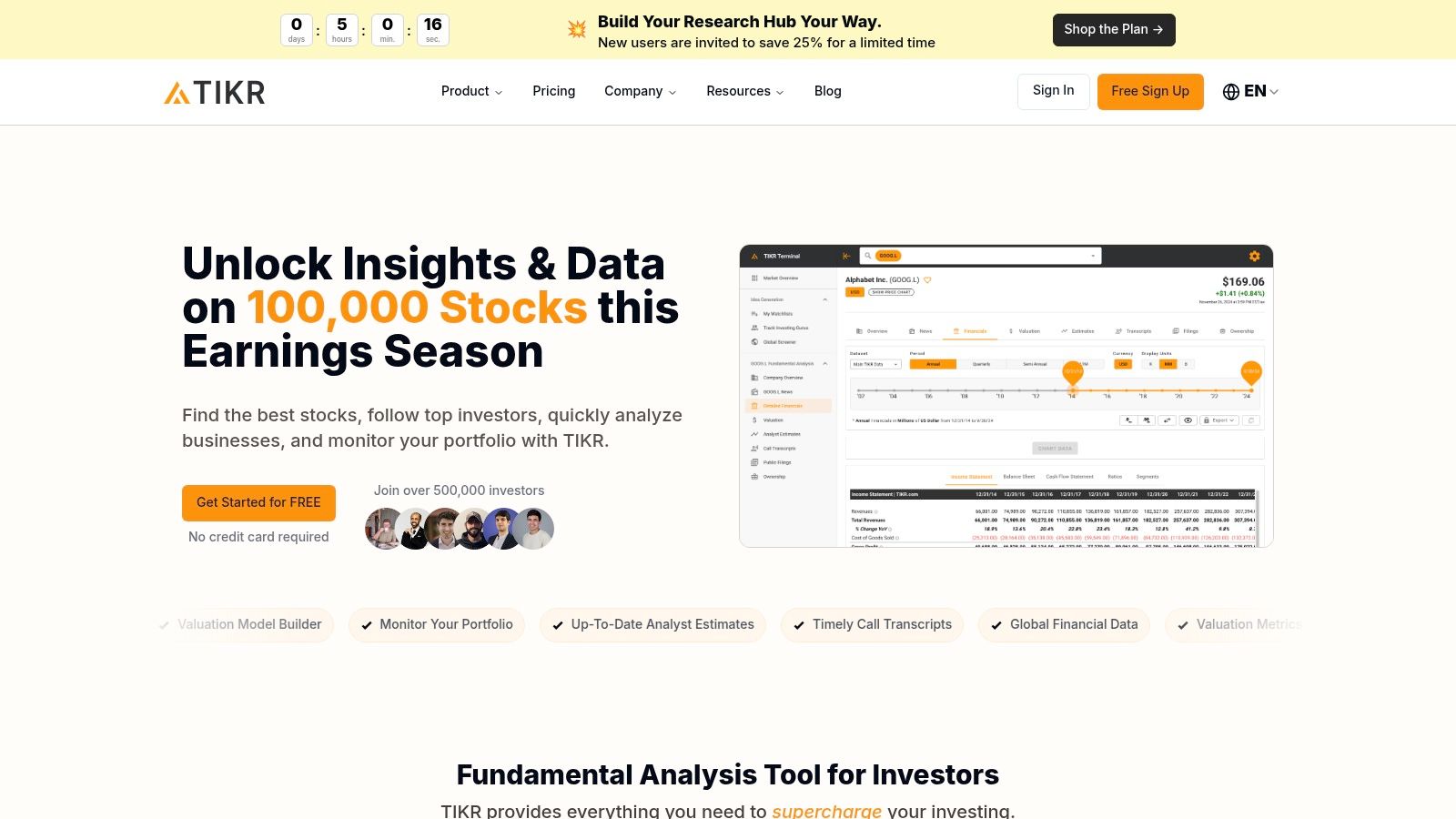
TIKR is one of the best choices for investors who care about deep company histories and a lean interface. Its appeal is straightforward, you get broad international coverage, long financial histories, filings, transcripts, estimates, and ownership data without the clutter that can slow down a bottoms-up workflow.
That makes it a strong fit for long-form stock analysis. If you're building a valuation case or checking how a company's financial history evolved across several reporting cycles, TIKR gives you a clean path through the data. It is less about flashy interaction and more about structured company work.
How it serves bottoms-up researchers
TIKR works best when your process begins with the company itself. The platform is particularly useful if you want to compare years of financial data, read transcripts, and inspect filings without bouncing between too many tabs. It's also easy to understand where the plan differences are, which helps when you care about feature clarity as much as the data itself.
The main limitation is that it isn't trying to be a technical or trading-first tool. If you want heavier charting or rapid market scanning, other platforms in this list are more direct. TIKR is for investors who think in terms of balance sheets, transcripts, and long histories.
Pros
- Deep fundamental and transcript coverage
- Long financial histories
- Lean interface
- Good international reach
- Clear tier structure
Cons
- Less technical depth
- Advanced exports can sit behind higher tiers
- Not a thesis-monitoring engine
Website: TIKR
6. Stock Rover
Stock Rover is the deepest pure screening and fundamental analytics tool here for North American investors. It's built for people who want lots of metrics, long historical context, and serious portfolio analysis without needing a broad market intelligence stack.
That design shows up in how the platform handles data density. Stock Rover is comfortable serving heavy fundamental researchers who want to slice and rank companies by dozens or even hundreds of variables, then track the resulting portfolio with alerts and brokerage integrations. If your process is built around ranking and comparison, it's hard to beat on raw structure.
Why it's good for systematic investors
Stock Rover is especially appealing for long-term investors who screen repeatedly and want to preserve the same logic over time. It gives you the inputs to create consistent filters, then lets you monitor portfolios after the screen is done. That makes it practical for rule-based investing, even if it doesn't enforce a written thesis the way Monsa does.
Its weakness is geography and scope. The platform is strongest in the US and Canada, so it's not the best answer if you need global coverage. For North American fundamental work, though, it's a serious option.
Pros
- Very deep fundamental metrics
- Strong screening and ranking
- Portfolio tracking and brokerage connections
- Heavy historical context
- Built for disciplined investors
Cons
- North America focused
- Can feel dense for casual users
- Not a thesis-drift monitoring layer
Website: Stock Rover
7. Simply Wall St
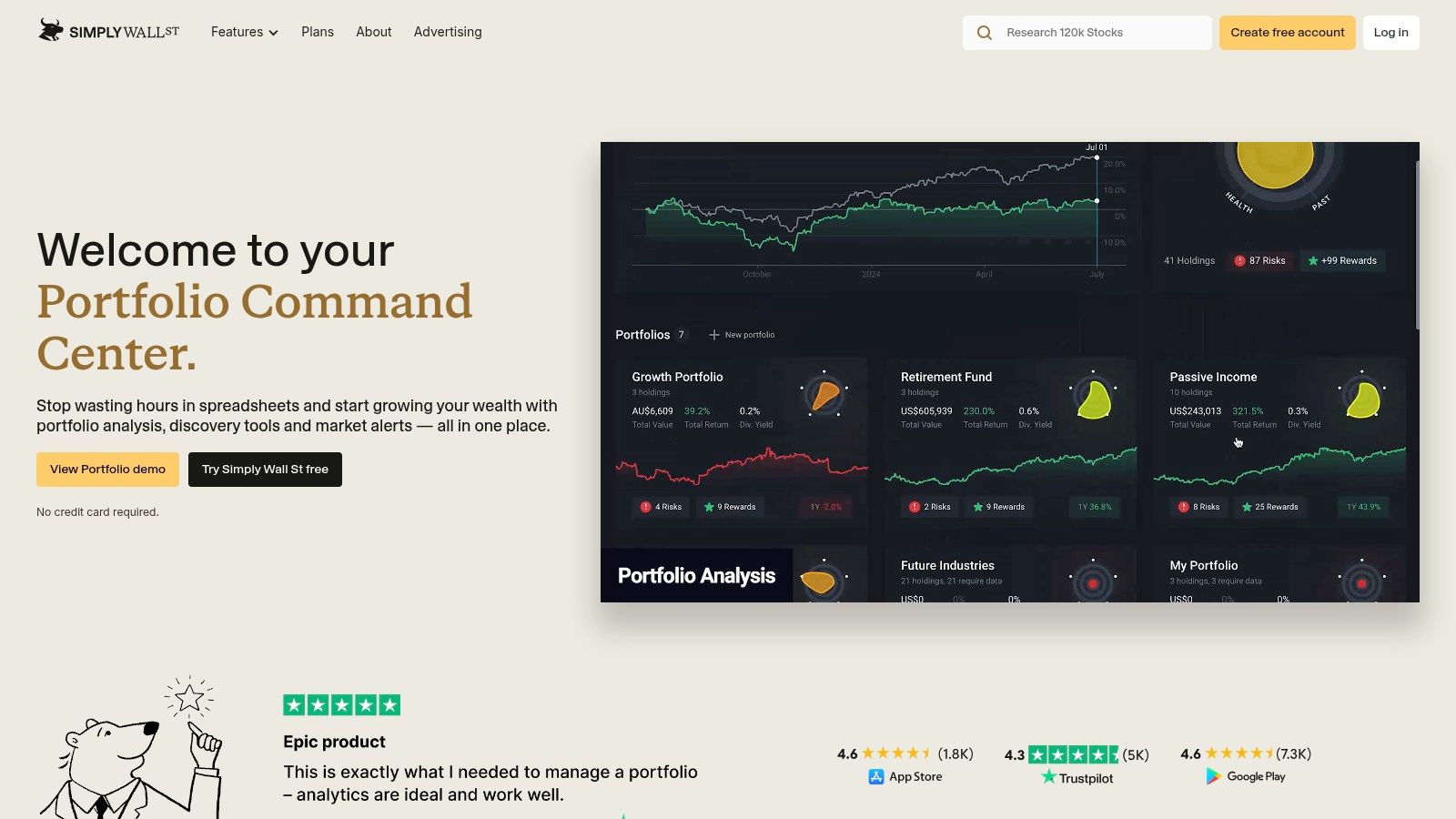
Simply Wall St is the most approachable visual research platform in the group. Its snowflake summaries and fair-value dashboards make it easy to get a quick read on a company or portfolio, especially if you don't want to start with a blank model.
The benefit is speed of interpretation. Investors can scan a lot of names quickly, which is useful when a watchlist is getting too large to inspect one company at a time. The platform is strong for triage, not for deep rule enforcement, so it's a better discovery aid than a thesis guardrail.
What its visuals do well
Simply Wall St translates financial data into visuals that are easy to digest. That lowers the barrier to review, especially on mobile, and it helps investors surface names that deserve a second look. The tradeoff is that lower-tier plans come with view caps, and the annual-only billing model reduces flexibility for some users.
If your process is visual-first, this platform can save time. If your goal is to encode a written strategy and catch drift automatically, you'll need a separate discipline layer.
Pros
- Very approachable visuals
- Quick health checks for portfolios
- Useful for idea discovery
- Active mobile experience
- Global coverage
Cons
- Monthly view caps on lower tiers
- Annual-only billing
- Not built for rule-based oversight
Website: Simply Wall St
8. FINVIZ Elite
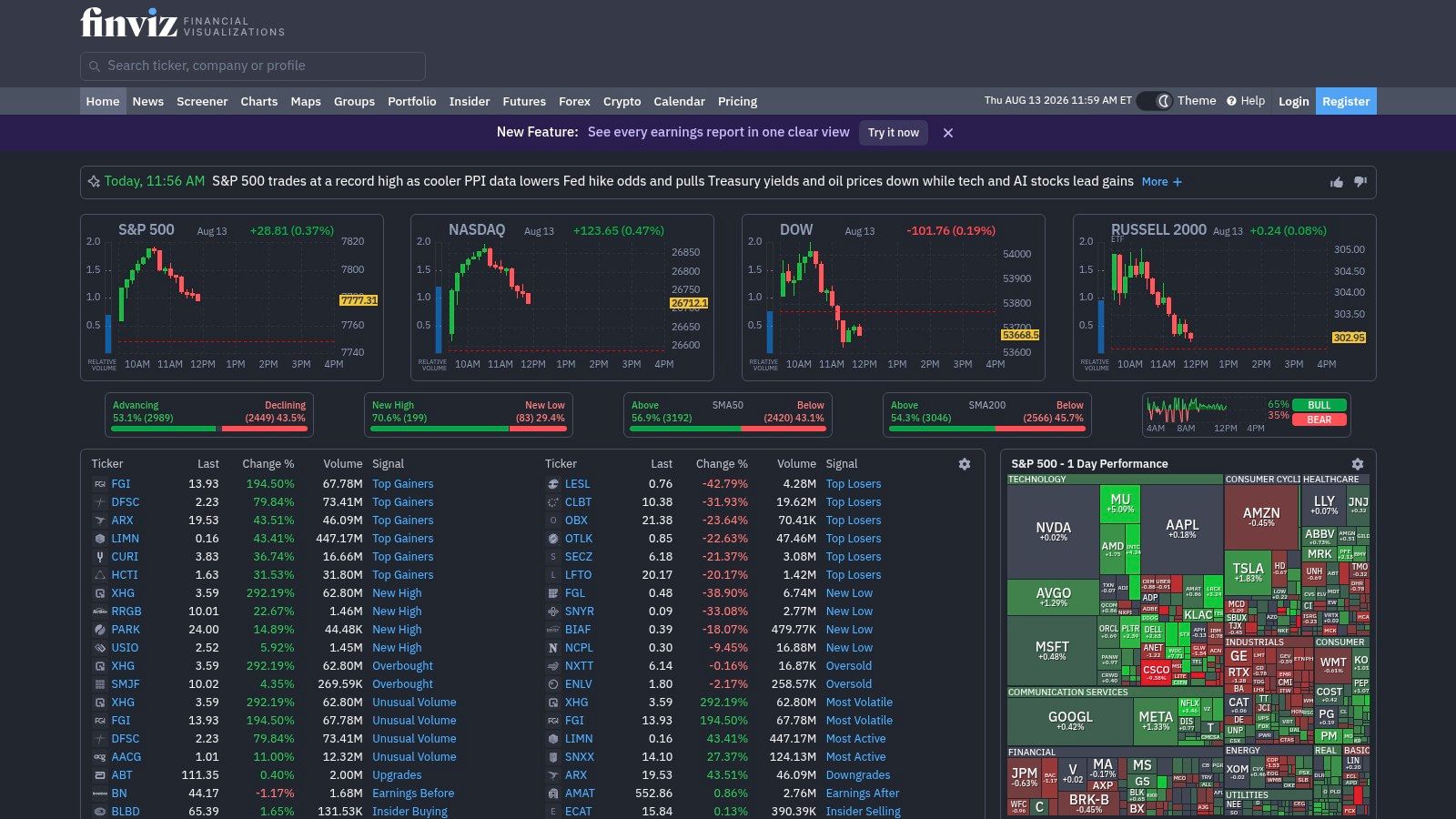
FINVIZ Elite is the fastest idea-surfacing tool in this list. Its screener, heatmaps, real-time quotes, and CSV exports are built for speed, which is why traders and visual screeners keep coming back to it for quick triage.
The platform's strength is workflow efficiency. You can move from screen to heatmap to chart quickly, and that makes it a strong first stop when you want to find names worth deeper review. It's less suited to long-form fundamental diligence, because filings, transcripts, and company histories aren't the center of the product.
Best for quick discovery, not thesis enforcement
FINVIZ is the kind of platform you open when you want to answer, “What's moving?” or “What meets my filter right now?” It's a discovery layer, not a strategy validator. That distinction matters because screening is only the first half of a disciplined process.
Internal comparison note, how Monsa compares with FINVIZ.
If you already have a thesis, FINVIZ can surface candidates quickly. Monsa can then check whether those candidates still obey the rules you wrote. That pairing is more complete than relying on screening alone.
Pros
- Very fast screening
- Useful heatmaps
- Real-time data in Elite
- Easy exports
- Familiar interface
Cons
- Limited depth on filings and transcripts
- More screening-focused than thesis-focused
- Weak as a long-horizon discipline tool
Website: FINVIZ Elite
9. GuruFocus
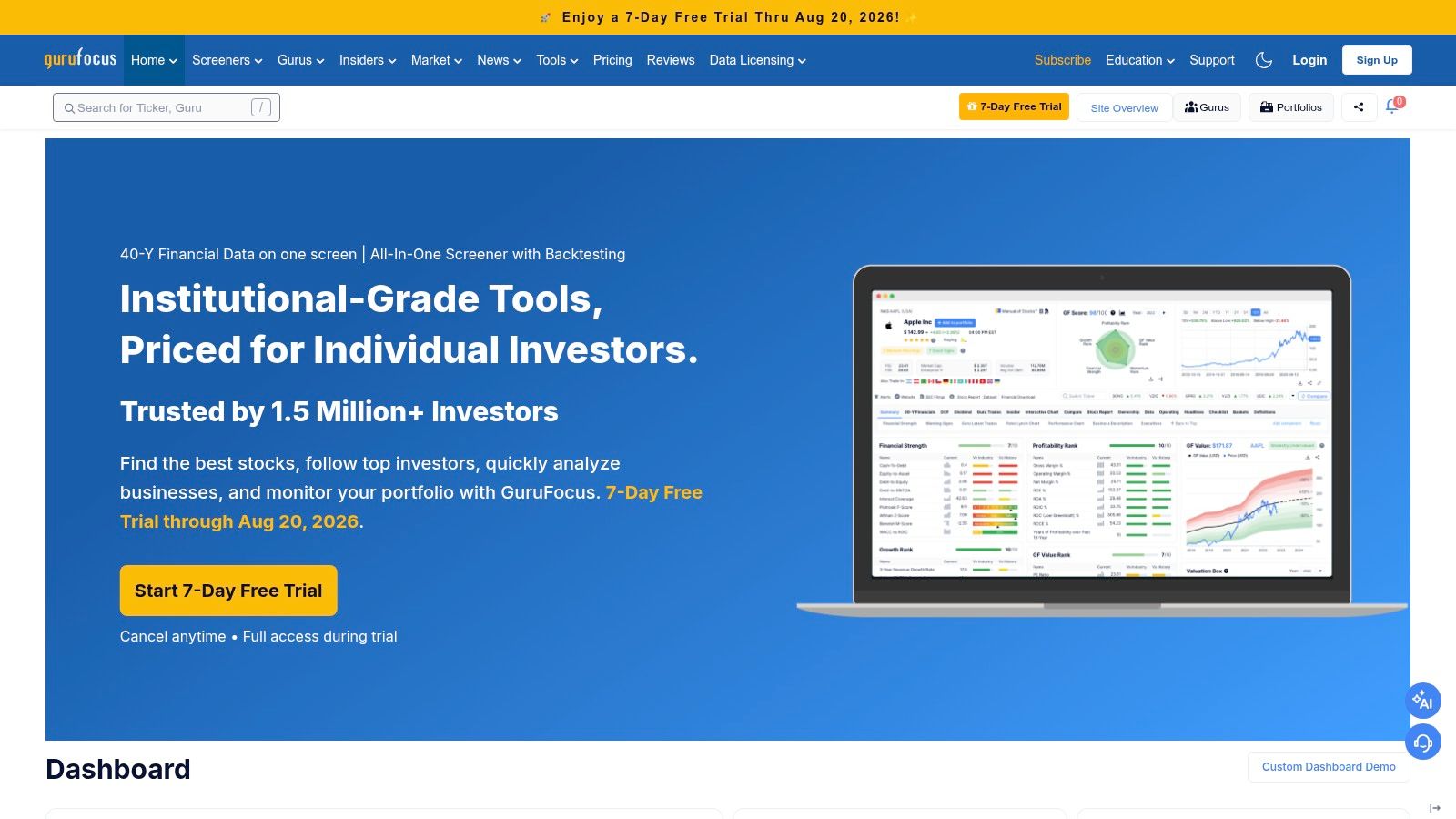
GuruFocus is built for value investors who want proprietary signals, guru tracking, and a deep valuation workflow. Its GF Score and GF Value tools make it easy to standardize a view of quality and valuation, which is useful if your process depends on repeatable comparisons.
The platform is also strong on ownership and insider context. That makes it valuable when you want to see how notable investors are positioned and how the company's fundamentals stack up against your own valuation logic. It's less about broad market intelligence and more about a value-centric analytical toolkit.
Why value investors keep it in the mix
GuruFocus is a strong companion tool for investors who already know their style. It gives you screening, alerts, backtesting, and data export options, so the platform can sit inside a research process rather than floating outside it. The question is whether you want a value toolkit or a thesis monitor.
For many investors, the answer is both. GuruFocus helps you find and assess value opportunities. Monsa can then tell you if those positions still satisfy the rules you said mattered after the buy.
Pros
- Proprietary value signals
- Guru portfolio tracking
- Insider and ownership data
- Useful screening and alerts
- Good fit for value investors
Cons
- More value-centric than broad research
- Advanced features sit in higher tiers
- Not built for nightly thesis checks
Website: GuruFocus
10. Zacks Premium
Zacks Premium is best understood as a rules-driven signal platform built around earnings estimate revisions. The Zacks Rank updates daily, and that cadence makes the product feel more like a factor engine than a general research terminal.
That structure can be useful as a complementary lens. If your own process already includes fundamentals, Zacks can add a separate earnings-momentum view that may catch changes before they show up elsewhere in your workflow. The limitation is that its signal framework is narrower than what long-horizon thesis investors usually want.
Where it helps, and where it doesn't
Zacks works well when you want a systematic overlay on top of another research process. It can sharpen attention around revisions, target upside, and other factor-based signals, but that doesn't replace a written thesis and a rule set of your own. In practice, it's a useful input, not a complete discipline system.
If you need a platform that tells you whether your portfolio still fits your strategy, Zacks doesn't go that far. If you want a structured earnings-revision lens, it does the job cleanly.
Pros
- Daily rank updates
- Clear factor-based logic
- Useful complement to fundamentals
- Good for rule-oriented signal work
- Often offers promotional pricing
Cons
- Shorter-term orientation
- Narrower than a full research workflow
- Not built for thesis drift oversight
Website: Zacks Premium
Top 10 Stock Research Platforms, Feature Comparison
| Product | Core focus & unique selling points (✨) | Quality / UX (★) | Target audience (👥) | Pricing & value (💰) |
|---|---|---|---|---|
| 🏆 Monsa | ✨ Strategy-vs-portfolio terminal, natural-language thesis to checkable rules, nightly 0-100 fit scores, matrix view | ★★★★☆ Clear verdicts + AI explanations | 👥 Self-directed investors, independent PMs, small RIAs | 💰 See the Monsa pricing page |
| Morningstar Investor | ✨ Analyst reports, star/moat/fair-value; Portfolio X-Ray diagnostics | ★★★★☆ Respected methodology, polished UX | 👥 Retail investors & advisors seeking fundamental research | 💰 Paid tiers; trials/discounts available |
| Seeking Alpha Premium | ✨ Crowd + in-house research, Quant grades, transcripts, AI insights | ★★★☆☆ Broad coverage; can be noisy | 👥 Idea hunters, active/quant-minded investors | 💰 Premium subscription; large article library |
| Koyfin | ✨ Fast dashboards, multi-asset charting, custom visual workflows; capable free tier | ★★★★☆ Fast, flexible dashboarding | 👥 Analysts, advisors building custom dashboards | 💰 Free tier + clear paid plans |
| TIKR | ✨ Deep global financial histories, filings & transcripts across 90+ countries | ★★★★☆ Excellent fundamentals depth | 👥 Bottoms-up stock analysts & international researchers | 💰 Tiered annual plans; retail-friendly pricing |
| Stock Rover | ✨ Very granular metrics (300-800+), advanced screening & portfolio mgmt | ★★★★☆ Data-rich for heavy fundamental research | 👥 Long-term fundamental investors & advisors | 💰 Subscription; powerful but higher tiers costlier |
| Simply Wall St | ✨ Visual 'snowflake' fair-value summaries and narrative dashboards | ★★★☆☆ Approachable, mobile-friendly visuals | 👥 Idea discovery users and casual investors | 💰 Annual-only plans; tiered company-view caps |
| FINVIZ Elite | ✨ Real-time quotes, intraday heatmaps, fast screeners & backtests | ★★★★☆ Blazing-fast scanning for screens/techniques | 👥 Traders, momentum/technical users | 💰 Elite subscription (real-time features) |
| GuruFocus | ✨ GF Score/GF Value, guru portfolio tracking, backtests & API | ★★★★☆ Robust value toolkit & data add-ons | 👥 Value investors and data power-users | 💰 Multiple tiers; add-ons increase cost |
| Zacks Premium | ✨ Zacks Rank & earnings-revision momentum screens; rules-driven signals | ★★★☆☆ Clear rules for earnings momentum | 👥 Shorter-term signal users; complements fundamentals | 💰 Premium subscription; trials/promos available |
Choosing the Right Stock Research Platform for Your Process
The right stock research platform depends less on feature count than on the part of your workflow that keeps breaking. If you're a self-directed investor who cares most about thesis discipline, Monsa is the clearest fit because it turns a written strategy into nightly checks, visible verdicts, and portfolio-level rule enforcement. That makes it especially valuable if your biggest problem isn't finding ideas, but letting positions drift after the thesis changes.
If you're a screener or visual-first analyst, the best fit is usually a discovery tool first. Koyfin, FINVIZ, and Stock Rover are the strongest options in that lane because they help you surface names, compare metrics, and organize dashboards quickly. They're efficient for idea generation and screening, but they won't automatically tell you whether a holding still matches the memo you wrote when you bought it.
If you're a fundamentals-first, long-horizon researcher, Morningstar Investor, TIKR, and Simply Wall St give you the best balance of analyst context, historical data, and readable company views. Those tools are strongest when your process starts with company-level diligence and ends with portfolio review. They're less effective when you need a system that enforces custom rules after purchase.
For most readers, the smartest setup is a two-tool stack. Use one platform for screening or discovery, such as FINVIZ, Koyfin, or Stock Rover, then add a discipline layer like Monsa to score holdings against your written thesis on a fixed cadence. That combination covers the two jobs most investors need, finding candidates and preventing drift.
A simple implementation plan helps keep the process honest. Write your strategy in one sentence. Choose a platform that lets you codify it. Set alerts for rule violations, then re-score holdings on a fixed schedule instead of relying on memory. A stock research platform is only as good as the rule it forces you to follow.
If you want a platform that treats your thesis like a living rule set instead of a static note, take a look at Monsa. It's built to score holdings against the strategy you wrote, refresh those verdicts nightly, and make thesis drift visible before it spreads through your portfolio.
Monsa is a portfolio-analysis tool, not a broker or investment adviser. Nothing here is investment advice.
// related reading
What Is Portfolio Turnover and Why It Matters
What is portfolio turnover? Learn the SEC formula, worked examples, costs, taxes and benchmarks to judge if trading fits your strategy.
Watchlist Management: A Step-by-Step Guide for Traders
Master watchlist management with actionable steps to create, score, and prioritize your stock list. Learn thesis alignment and alerts setup for better
Florida Unemployment Amount: What You Will Actually Receive
Learn how the Florida unemployment amount is calculated, the $275 weekly cap, duration rules, and how partial earnings change your payment in 2026.
7 / 100 founding seats claimed - $100/yr locked, then $190/yr
Monsa is a portfolio-analysis tool, not a broker or investment adviser. It never recommends what to buy or sell - it checks what you hold against rules you wrote. Nothing here is investment advice.