// blog
The 10 Best Value Investing Screener Tools for 2026
Searching for undervalued companies can feel like staring at a screen full of ratios that all look plausible and none of them feel decisive. A good value investing screener cuts that noise down fast, but the challenge is finding one that matches how you invest, whether you follow Graham-style balance-sheet discipline, Buffett-style quality, or a more modern fair-value workflow. Classic value screening has always been multi-factor, not a single cheapness test, starting with Graham's checklist of valuation, debt, liquidity, and growth rules as summarized by Aswath Damodaran in his lecture notes. Modern screeners expanded that logic into broader, standardized rule sets with valuation, quality, and sector-aware filters as described in contemporary screener guides.
The tools below are best understood as different answers to one question, how do you turn value philosophy into a repeatable process? Some tools are built for quick triage, others for deep research, and a few are closer to a portfolio discipline engine than a traditional screener. That distinction matters because the weakest part of most value workflows isn't finding cheap names, it's separating true mispricing from value traps. Recent coverage still shows a gap between simple ratio screens and the harder task of checking whether fundamentals are holding up or slipping across newer screener discussions.
Table of Contents
- 1. Monsa
- 2. Stock Rover
- 3. GuruFocus All-In-One Screener
- 4. Morningstar Investor Screener
- 5. Finbox
- 6. TIKR Terminal With Screener
- 7. AlphaSpread
- 8. Simply Wall St
- 9. Value Line Digital Equity Research Center
- 10. Finviz Elite
- Top 10 Value Investing Screeners: Feature Comparison
- From Screening to Strategy: Making Your Choice
1. Monsa
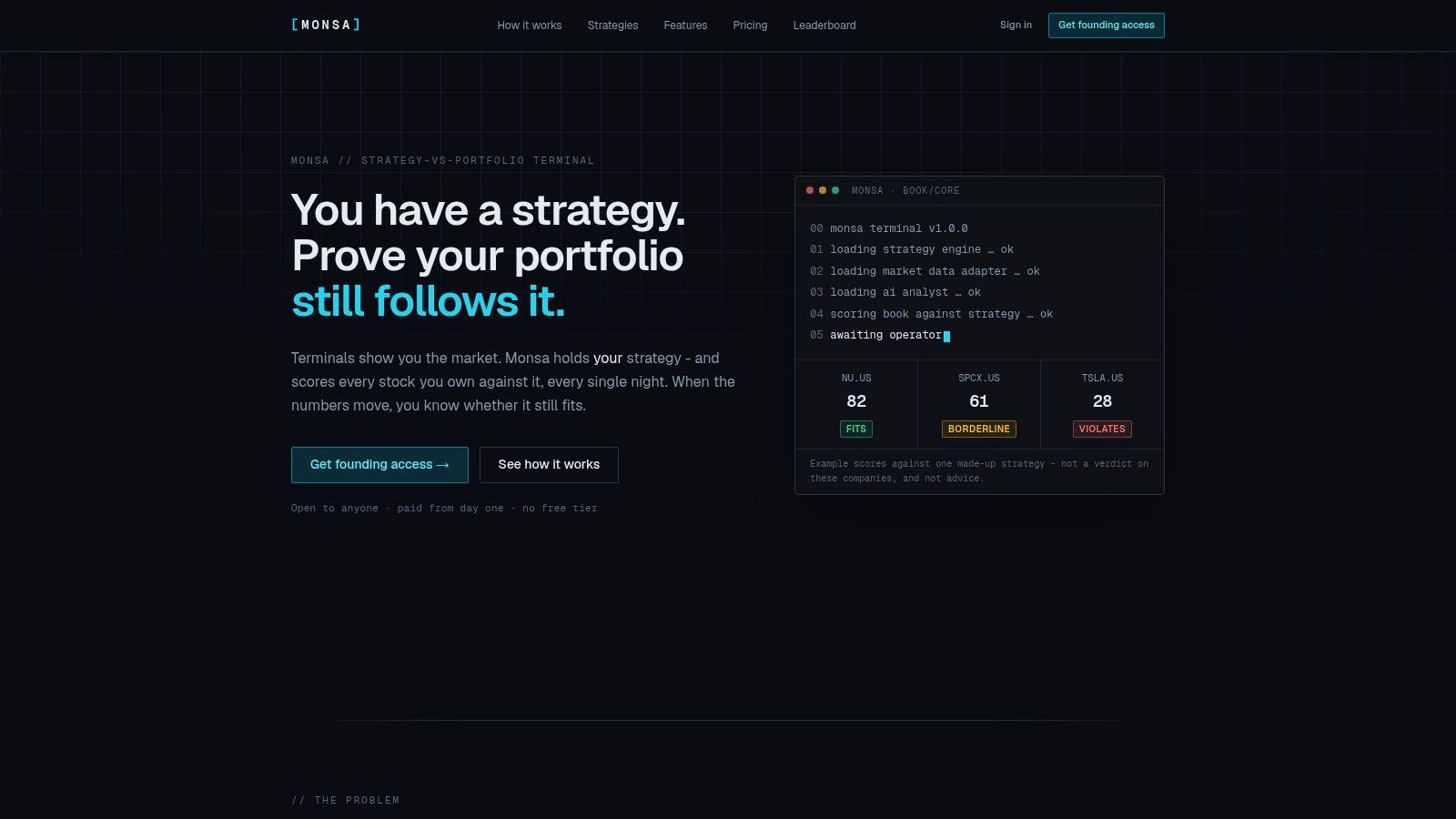
Monsa stands out because it treats value screening as a rules-enforcement problem, not just a search problem. It stores your written thesis, turns it into checkable criteria, and then re-scores each holding nightly against those rules using fresh fundamentals, prices, and FX for US and major European exchanges. That makes it unusually useful for investors who already know what they want a value position to look like, but want a system that keeps enforcing the thesis after the buy.
The practical edge is clarity. Monsa gives each tracked stock a fit score and a verdict that says whether it fits, is borderline, or violates the strategy, plus a per-criterion breakdown that separates deterministic metrics from qualitative judgments. It also scores watchlist names, so you can test a candidate before capital goes in. The published workflow is transparent, with metrics flagged as reported, derived, or missing, and the product explicitly says it does not publish backtests or performance claims.
Practical rule: use Monsa when your value process is written down and you want the portfolio to be checked against it every night, not every quarter.
Its template set is broad enough to map onto several value styles, including Classic Value, Deep Value, Quality Compounders, and Dividend Growth. That makes it a better fit for thesis-driven investors than for traders who just want a low P/E list. The current limits also define its use case clearly, with a capped number of portfolios, tracked tickers, and AI-assisted analyses depending on plan level. For current details, see Monsa. Those constraints matter because they show Monsa is designed for focused oversight, not sprawling institutional coverage.
You can review the platform directly at Monsa, and if you want to compare how it handles screening versus traditional terminals, see the internal comparison with Stock Rover.
2. Stock Rover
Stock Rover is a strong choice if you want a deep, build-anything value screener without writing code. Its database spans a very broad metric library, and its screening engine supports equation-based, historical, and ranked filters, which is exactly what a serious value investor needs when one ratio isn't enough. That flexibility makes it easy to combine valuation, balance-sheet strength, profitability, and growth persistence in a single workflow.
A practical way to use Stock Rover is to build a Graham-plus-quality screen. A practical setup would start with low valuation, then add debt and liquidity checks, then finish with quality and growth persistence so you do not end up with a pile of distressed names. That is where Stock Rover's built-in Fair Value and Margin of Safety models help, because they move the workflow away from raw cheapness and toward estimated price gaps versus business quality. The platform also includes ready-made Value, GARP, and Magic Formula-style screens, which is useful if you want to test multiple value philosophies side by side.
Its weakness is the learning curve. Stock Rover feels built for users who enjoy tweaking filters and rankings until the screen mirrors their mental model. That's a feature for power users, but it can slow down investors who want a cleaner, more opinionated answer.
For a value investor, the key advantage is not just the filter depth, it's the ability to combine hard constraints with weighted scoring. That is how you move from “cheap stocks” to a more defensible shortlist of candidates worth research time. You can also link portfolios and set alerts, which helps the screen stay connected to the actual portfolio rather than living as a one-off idea generator. The service details and plan access are listed on Stock Rover's pricing page.
3. GuruFocus All-In-One Screener
GuruFocus is built for investors who want fair value, quality, and long-term fundamentals in one place. Its screener is strongly anchored in proprietary valuation and quality signals, especially GF Value, GF Score, and Business Predictability, which makes it feel closer to a value research desk than a simple filter tool. That matters if your process is driven by intrinsic value estimates and you want a quick read on whether the market price is above or below your own estimate of worth.
A good use case is idea triage. You can use GuruFocus to separate names that are obviously overextended from those that are more plausibly mispriced, then layer in the broader fundamental history before spending time on a full write-up. The platform also exposes a large filter set, backtesting options, long historical fundamentals, a DCF calculator, and guru or insider tracking, so it supports both screens and follow-through research. For investors who like to check what respected managers are buying, that combination is especially useful.
The limitation is usability, not depth. GuruFocus can feel dense, and the interface asks more from the user than newer, more visual tools do. It also sits at a higher price point than many retail options, so it makes most sense for investors who will use the research stack regularly.
What sets it apart in a value workflow is the combination of valuation and historical context. A screen based only on low multiples can miss deteriorating businesses, but GF Value and the deeper fundamentals make it easier to ask whether cheap really means cheap. If you want to inspect the service directly, the pricing and access details are on GuruFocus' pricing page.
4. Morningstar Investor Screener
Morningstar Investor Screener is strongest when your value process depends on analyst fair value estimates and a disciplined read on quality. The platform's best-known advantage is its price-to-fair-value lens, which is especially helpful when you want to screen for companies trading at a discount to Morningstar's own estimate instead of relying only on raw ratios. That makes it a natural fit for investors who think in terms of price versus intrinsic worth.
It also fits a quality-first value style. Morningstar's Economic Moat and stewardship research add context that classic screens usually miss, especially when a company looks cheap but deserves a deeper check on competitive durability. If you're building a Buffett-style process, that combination is more aligned with your workflow than a pure low-multiple screen. The screener itself still supports the familiar valuation fields, dividend yield, and rating filters, so you can keep the search practical rather than purely qualitative.
The tradeoff is that Morningstar is broader than it is customizable. That makes it excellent for triage, watchlist building, and portfolio review, but less suited to highly specialized screens that need dozens of custom thresholds. Some portfolio functions also require manual entry, which adds friction if you're trying to keep everything synchronized.
Morningstar works best for investors who want one independent research voice to anchor their process. That can be a strength, but it's also why advanced users sometimes treat it as a first-pass filter rather than their entire screening stack. The platform details sit on Morningstar's main site.
5. Finbox
Finbox is the right choice for value investors who think in terms of intrinsic value models rather than just cheap-versus-expensive multiples. Its screening toolkit emphasizes fair-value estimates, upside discovery, and a broad metric library, which makes it practical for investors building a model-driven value process. If you already use valuation work in spreadsheets, Finbox fits that style better than a lightweight retail screener.
Its biggest advantage is workflow compatibility. Finbox offers a very large metric library, multi-year financials, and spreadsheet add-ons, so you can move ideas from screening into modeling without constantly exporting and reformatting data. That matters because many value investors don't just want a list, they want a way to compare estimated valuation gaps against their own assumptions and update the model over time. Finbox is built for that handoff.
The limitation is that Finbox is less narrative and less opinionated than some of the platforms above. It gives you the data and the valuation frame, but not as much guided interpretation. That's fine for users who trust their own process, but less helpful if you want the software to do more of the thinking for you.
A practical value workflow on Finbox starts with undervaluation screens, then moves into model review, then ends with your own margin-of-safety judgment. That sequence is useful because it prevents a low multiple from becoming a false signal on its own. If you build your process around intrinsic value rather than signal hunting, Finbox is one of the more natural fits. Platform details are available at Finbox.
In value investing, the screen should shorten research time, not replace the model.
6. TIKR Terminal With Screener
TIKR is a strong pick for investors who care about global coverage and long historical context. The platform offers deep historical data at higher tiers, along with valuation metrics, filings, transcripts, and estimate revisions, so it supports a business-first style of value analysis rather than a single-ratio hunt. That makes it especially useful when you want to see how the company behaved through multiple cycles, not just how cheap it looks today.
The screener itself is only part of the appeal. TIKR's transcripts and filings help you judge whether the story behind the numbers is improving or deteriorating. For value investors, that matters because a screen can tell you what looks cheap, but transcripts can tell you whether management is explaining a temporary setback or a structural problem. The platform's saved screens also vary by plan, so it works best when you know how much customization you'll use.
One limitation is that some of the strongest datasets sit behind higher tiers, and the free tier is more restricted, including narrower coverage and shorter history. That does not make TIKR weak, it just means the value of the platform depends on whether you need the broader data stack or just occasional screening.
For investors who split time between valuation work and qualitative research, TIKR can act like a bridge. It is less rigid than a pure value screener and more research-oriented than a simple market filter, which is exactly why it works for users who read transcripts before they buy. You can review its package structure on TIKR's pricing page.
7. AlphaSpread
AlphaSpread narrows its focus to price-versus-value calculation, offering Intrinsic Value and DCF tools without the broader research depth found on institutional terminals. That makes it useful when a value investor wants a direct answer to a single question, how far the market price sits from estimated fair value. The platform also includes valuation backtests, a fundamental screener, alerts, and support for shareholder yield and dividend safety, so the workflow stays centered on valuation rather than on broad market browsing.
That focus suits classic value work. A Graham-style screen can stay close to balance-sheet strength and a margin-of-safety check, while a Buffett-oriented review can use the DCF tools to test whether a business still looks attractive after assumptions are adjusted. The shareholder yield and dividend safety metrics also give income-oriented investors a way to screen for return of capital, not just earnings multiples. For investors who want repeatable filters instead of a large research surface, AlphaSpread keeps the process disciplined.
The tradeoff is scope. AlphaSpread does not try to match a full institutional terminal, so it will not substitute for deeper datasets when you need long historical series, richer ownership data, or more qualitative context around a business. That is a design choice, and it matters because some value workflows depend on those extra layers, especially when you are checking how a company behaved across different cycles or comparing management commentary against the numbers. For many individual investors, the practical question is whether the platform delivers a clear valuation answer with less friction.
Its free tier gives it a lower-friction entry point than some research-heavy tools, which makes it easier to test a valuation process before paying for more access. The pricing structure is listed on AlphaSpread's pricing page. The value proposition is strongest if you already know the filters you want and prefer software that keeps the math visible while you work through the screen.
8. Simply Wall St
Wall St is the most approachable tool on this list for visual, retail-friendly value screening. Its reports combine fair-value estimates, narrative analysis, and global coverage in a format that makes idea triage much faster for investors who don't want to live inside a dense terminal. If a company looks cheap, you can usually see the valuation gap and the quality context quickly.
That visual layer matters. Value investors often need a fast way to decide whether a stock deserves deeper research, and Wall St does that job well because it shows valuation and business quality in a format that is easier to scan than many institutional tools. It also includes screeners, alerts, broker linking, and portfolio analytics on paid tiers, so it can serve as a broader portfolio review layer too.
The limitation is customization. Simply Wall St is less flexible than the deeper pro platforms, which means it's better for broad discovery than for highly specific Graham or Greenblatt-style filter combinations. Pricing also varies by region and promotions, which can make comparison harder than it should be.
That said, it's a strong fit for investors who want a clean first pass across a global watchlist. It is also one of the few tools in this group that feels immediately usable for newer investors without sacrificing the core value lens. For a direct comparison of how Monsa approaches this style of workflow, see Monsa's comparison with Simply Wall St. The platform itself is available at Simply Wall St.
9. Value Line Digital Equity Research Center
Value Line remains relevant because it compresses a lot of judgment into a few proprietary ranks. Its Timeliness, Safety, and Financial Strength ratings give conservative investors a shorthand for quality-oriented screening, and that's useful when you want a simple but disciplined filter set. The Digital Equity Research Center packages those ranks with screening functions, which keeps the workflow centered on quality and relative attractiveness.
This is not a tool for users who want endless customization. It works better as a structured research system where the ranking language does some of the work for you. For investors who care about quality at a reasonable price, that can be enough, especially when paired with a deliberate manual review of the underlying business.
The limitation is presentation. Value Line's interface can feel dated compared with newer tools, and the service structure is not always as transparent as modern retail SaaS pricing. That can slow down users who expect an app-like experience with obvious paths from screen to report.
Still, the appeal is durable. Value Line has always been strongest for conservative investors who want a clear, old-school signal set instead of a sprawling data warehouse. It sits somewhere between a research publication and a screener, which is exactly why some long-term investors still keep it in their workflow. Service details are listed on Value Line's digital equities page.
10. Finviz Elite
A value investor using Finviz Elite is usually trying to do one thing fast, screen a large U.S. universe for obvious cheapness, then sort the results by price action, liquidity, or dividend traits. The platform fits that workflow well because the screener is fast, the interface is chart-oriented, and the Elite tier removes most of the friction that gets in the way of repeated scanning. Real-time quotes, ad-free access, alerts, and CSV or API export make it easier to move from a screen to a watchlist or spreadsheet without extra cleanup.
That speed matters more than it first appears. For a Graham-style first pass, Finviz can filter on basic valuation ratios such as P/E and P/B, plus cash flow and dividend yield, which is enough to surface names that look statistically cheap. For a Buffett-style workflow, the tool is less complete because it does not push hard into business quality, moat analysis, or long historical context. In practice, that means it works best as a discovery layer, not as the final research layer.
Finviz also handles ongoing monitoring well. Custom watchlists and alerts make it practical to keep a list of candidates under review, while the heatmap view helps investors see where value pockets are forming across sectors and industries. That is useful for comparative screening, especially if you want to compare cheap names within a group instead of judging each stock in isolation. The visual layout can also help spot concentration risk, since clusters of weakness or strength show up quickly.
A sample value filter set in Finviz might start with low P/E, low P/B, positive cash flow, reasonable dividend yield, and liquidity thresholds that keep the results tradable. That kind of screen is useful for rapid triage, but it does not tell you whether earnings quality is stable or whether the balance sheet is strong enough for a full margin-of-safety check. Greenblatt-style screening is possible in a limited way if you combine valuation filters with return-focused metrics, yet the platform still gives less depth than tools built around intrinsic value modeling.
The main tradeoff is coverage. Finviz Elite stays focused on the U.S. market, so investors who need global comparison sets, long-run financial history, or richer narrative research will run into limits quickly. It is stronger as a front end for idea generation than as a full research terminal. For a practical comparison with a more thesis-driven workflow, see Monsa's Finviz comparison. The Elite offering is described on Finviz's Elite page.
Top 10 Value Investing Screeners: Feature Comparison
| Product | Core focus ✨ | Key features | Quality ★ | Target audience 👥 | Pricing 💰 |
|---|---|---|---|---|---|
| 🏆 Monsa | Strategy-first rule enforcement; nightly re-scoring ✨ | NLP strategy capture, fit scores, matrix view, Claude AI analyses | ★★★★ | 👥 Rule-driven equity investors, portfolio managers | 💰 Tiered plans, see site |
| Stock Rover | Deep fundamental screener & multi-factor scoring ✨ | Broad metric library, fair-value models, ranked screens | ★★★★ | 👥 Value investors to advisors | 💰 Tiered plans |
| GuruFocus All-In-One Screener | Value methodology + guru/13F data ✨ | GF Score, predictability rank, long-run fundamentals, backtesting | ★★★★ | 👥 Long-term/value investors | 💰 Premium pricing |
| Morningstar Investor Screener | Analyst fair-value & moat research ✨ | P/FV filters, Moat & stewardship research, watchlists/alerts | ★★★★ | 👥 Retail investors seeking analyst insight | 💰 Investor subscription |
| Finbox | Valuation & model-driven workflows ✨ | Broad metric library, fair-value gap screens, spreadsheet add-ons | ★★★ | 👥 Modelers & valuation builders | 💰 Subscription pricing |
| TIKR Terminal | Global terminal-style with transcripts ✨ | Deep historical data, filings/transcripts, saved screens by plan | ★★★★ | 👥 Global analysts & value investors | 💰 Tiered plans, limited free access |
| AlphaSpread | Intrinsic-value + backtest workflows ✨ | DCF/backtests, screener, AI Q&A & journaling | ★★★ | 👥 DIY value investors | 💰 Freemium and paid plans |
| Simply Wall St | Visual fair-value reports & portfolio triage ✨ | Narrative reports, global coverage, alerts | ★★★★ | 👥 Retail investors wanting visuals | 💰 Regional plan tiers |
| Value Line (Digital ERC) | Proprietary ranks (Timeliness/Safety) ✨ | Timeliness/Safety/Financial Strength ranks, screeners | ★★★ | 👥 Conservative, rank-oriented investors | 💰 Service packages |
| Finviz Elite | Fast U.S. screener & export workflow ✨ | Real-time filters, alerts, CSV/API export, ad-free | ★★★★ | 👥 U.S. traders & quick screeners | 💰 Elite subscription |
From Screening to Strategy: Making Your Choice
The best value investing screener is the one that matches your actual process, not the one with the longest feature list. If you want broad fundamental flexibility and custom rankings, Stock Rover is hard to beat. If you want a research-heavy intrinsic-value workflow, Finbox and GuruFocus bring more depth than a simple low-multiple list. If you want quick triage and visual clarity, Simply Wall St and Finviz are easier to live with day to day.
Monsa sits in a different category because it is not just looking for cheap stocks, it is checking whether your portfolio still matches your own written thesis. That matters for value investors because the hardest part of the job is often not initial screening, it's avoiding thesis drift after fundamentals change. Graham-style discipline, as Damodaran summarizes it, has always been about combining valuation with balance-sheet strength and growth persistence in a repeatable checklist. Modern screeners add more metrics and broader market coverage, but the underlying goal is the same, reduce false positives and keep your process repeatable.
If you are building a value process from scratch, start with a screen that can express your rules cleanly. If you already have a process, choose the tool that enforces it with the least manual drift. And if you invest across more than one style, use a platform that can separate the styles instead of blending everything into one noisy list, because style purity usually makes decision-making cleaner than a single composite bucket.
For many investors, the right answer is not one tool forever. It is one tool for discovery, another for research, and a third for portfolio discipline. That stack gives you a practical way to identify businesses that look cheap, then pressure-test whether the case still holds.
If you want a value screener that goes beyond simple cheap-stock filters and keeps checking whether each holding still fits your thesis, Monsa is built for that job. It scores stocks against your own rules, refreshes the verdict nightly, and makes portfolio drift visible before it turns into a bigger mistake.
Monsa is a portfolio-analysis tool, not a broker or investment adviser. Nothing here is investment advice.
// related reading
What Is Portfolio Turnover and Why It Matters
What is portfolio turnover? Learn the SEC formula, worked examples, costs, taxes and benchmarks to judge if trading fits your strategy.
Watchlist Management: A Step-by-Step Guide for Traders
Master watchlist management with actionable steps to create, score, and prioritize your stock list. Learn thesis alignment and alerts setup for better
Florida Unemployment Amount: What You Will Actually Receive
Learn how the Florida unemployment amount is calculated, the $275 weekly cap, duration rules, and how partial earnings change your payment in 2026.
7 / 100 founding seats claimed - $100/yr locked, then $190/yr
Monsa is a portfolio-analysis tool, not a broker or investment adviser. It never recommends what to buy or sell - it checks what you hold against rules you wrote. Nothing here is investment advice.