// blog
GARP Investing Strategy: Rules, Metrics, and Tradeoffs
Most investors still hear GARP investing strategy and jump straight to PEG under 1. That shortcut is tidy, but it's too small for how practitioners screen stocks, and it breaks down fastest where earnings estimates are unstable, missing, or noisy. The better frame is a quality-growth-value composite, not a single ratio test, and that changes how you judge both the upside and the failure modes of the style.
Table of Contents
- Why GARP Is More Than a PEG Ratio
- What the shorthand misses
- The Three Building Blocks of a GARP Stock
- Growth has to be real, not just fast
- Quality decides whether the growth lasts
- Price keeps the process from drifting into growth chasing
- Key Metrics and Typical Thresholds
- What each metric is trying to avoid
- A Worked Example of a GARP Screen
- How the verdict changes
- GARP vs Value vs Pure Growth
- The same stock looks different under each lens
- When GARP Quietly Lags
- Where the edge fades
- Putting the Rules on Autopilot
Why GARP Is More Than a PEG Ratio
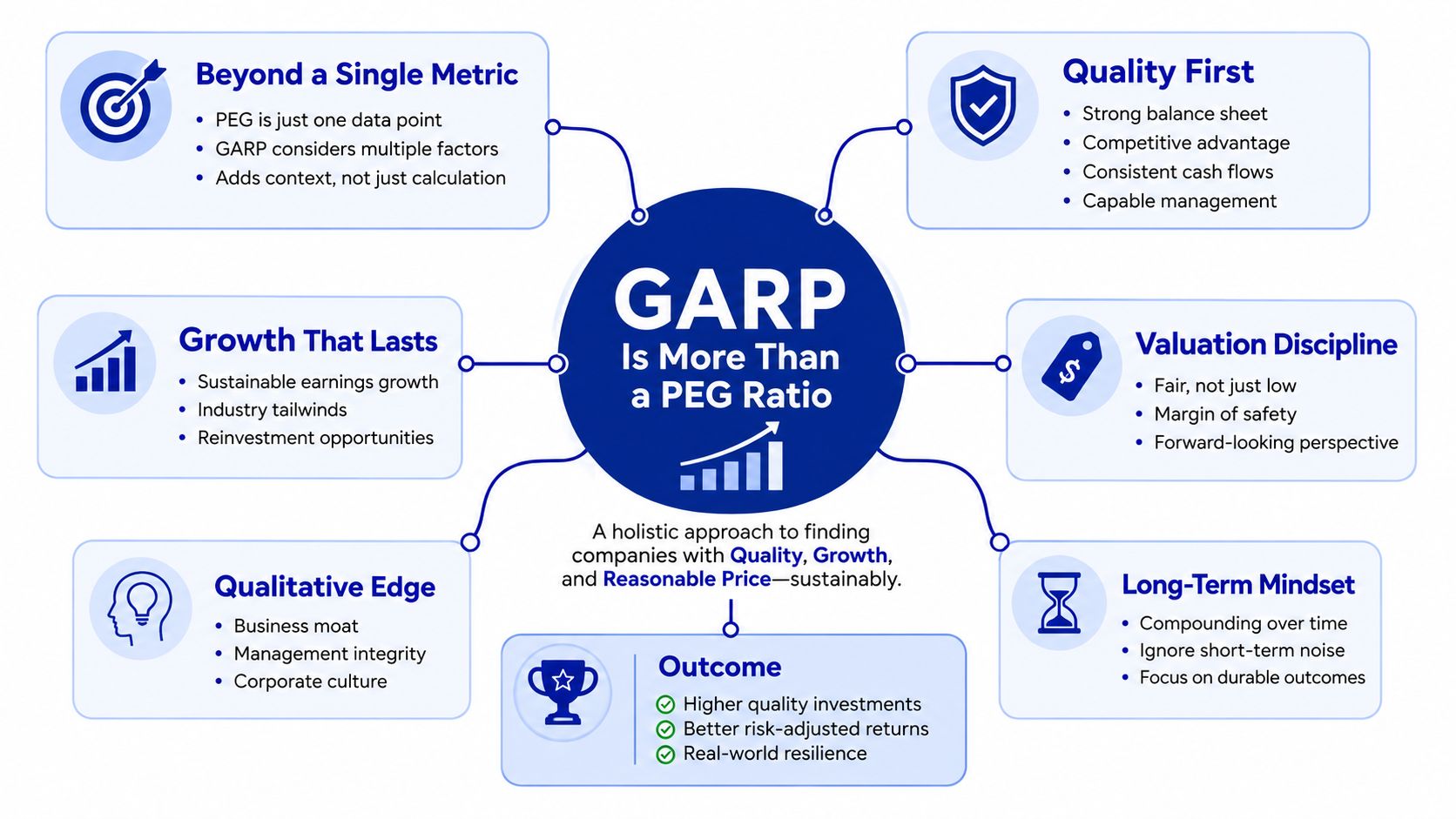
The popular version of GARP is easy to memorize and hard to trust. A single PEG ratio can look precise, but it leans on forward earnings estimates, which can be unstable or unavailable for cyclical firms, banks, and many non-U.S. names, exactly the areas where investors most want a dependable screen. The practical problem is simple, if the estimate is shaky, the ratio can be misleading.
That's why institutional screens tend to use a broader mix of inputs. Practitioner guidance points to three-year EPS growth, three-year sales-per-share growth, debt levels, ROE, and earnings-to-price as part of the GARP toolkit, with PEG only one piece of the puzzle. Investopedia's overview of GARP also points out that sales growth and balance-sheet strength can stand in when earnings growth is noisy, which is the right instinct for global and sector-diverse portfolios. Investopedia's GARP overview frames the same gap between the beginner shorthand and the institutional version.
What the shorthand misses
A PEG-first definition treats growth as the main event and valuation as the only restraint. In practice, that leaves out the thing that makes the style survivable, quality. A company can grow fast and still be a poor GARP candidate if debt levels are high, returns on capital are weak, or the growth is being bought at an unhelpful multiple.
The deeper point is that GARP is closer to a screening philosophy than a formula. It asks whether a business combines enough growth, enough quality, and enough valuation discipline to deserve capital, especially when analysts' earnings estimates are uneven across regions and sectors. Once you see it that way, the question stops being “What's the right PEG?” and becomes “Which mix of growth, quality, and price survives the widest set of markets?”
Practical rule: if you can't defend the earnings estimate, don't pretend the PEG is the answer.
That's the cleanest way to think about the strategy. The ratio can help, but it can't carry the whole process.
The Three Building Blocks of a GARP Stock
A usable GARP stock usually has three traits at once: durable growth, financial quality, and a fair price. This is like buying a rental property in a stable neighborhood where rents are rising and the asking price is reasonable. You want rent growth, but you also want a building that doesn't swallow cash in repairs, and you don't want to overpay for the privilege.
Growth has to be real, not just fast
Growth is the first filter because without it, GARP turns into a value screen with a growth label. In practice, that usually means looking at three-year EPS growth and three-year sales-per-share growth together, since earnings alone can be distorted by accounting and buybacks. Sales growth helps show whether the business is expanding, while EPS growth tells you whether that expansion is showing up in per-share economics.
Quality decides whether the growth lasts
Quality is the part beginner screens often miss. ROE and debt metrics tell you whether management is compounding capital efficiently or using the balance sheet to manufacture the appearance of growth. A stock that grows but burns capital, leans too hard on borrowed money, or converts revenue poorly into earnings is not a GARP candidate, it's a future disappointment with a good slide deck.
Price keeps the process from drifting into growth chasing
The third leg is valuation, usually framed with earnings-to-price and sometimes PEG as a cross-check. Earnings-to-price helps you see whether the stock still offers an acceptable earnings yield relative to what you're paying. PEG can still help, but only after you've checked that the growth is durable and the capital structure isn't fragile.
A weak result on any one leg changes the verdict. Good growth without quality is speculation, quality without growth can be a trap, and a fair price without the first two is just cheap.
For readers who want to compare that logic with a dedicated quality framework, the structure lines up closely with quality compounders, even if the weighting is different. The overlap matters because many investors use the same inputs under different labels.
Key Metrics and Typical Thresholds
A real GARP investing strategy screen is less about a single number and more about a checklist that blocks obvious errors. The exact thresholds vary by market, sector, and index universe, but the working logic is consistent, each metric filters a different kind of mistake. If you treat them as guardrails rather than magic numbers, the screen becomes much more useful.
What each metric is trying to avoid
Three-year EPS growth is there to weed out the no-growth names that only look cheap. Three-year sales-per-share growth catches cases where earnings are flattered but the underlying business isn't expanding in a durable way. ROE screens for efficient compounding, while debt checks keep the portfolio away from businesses that only look attractive because they're stretched on debt.
Earnings-to-price is a useful valuation cross-check because it forces you to think in earnings yield terms rather than only in price multiples. PEG still has a role, but it works best as a sanity check, not as the core definition. The point is not to find the cheapest stock with some growth, it's to avoid paying for weak growth, weak quality, or both.
Rule of thumb: when the growth metric looks good but the quality metrics look thin, the stock is usually telling you something the headline multiple doesn't.
| Metric | Typical Threshold | What It Filters Out |
|---|---|---|
| Three-year EPS growth | Often 10% to 15% | Low-growth names that can't compound fast enough to justify a premium |
| Three-year sales-per-share growth | Positive and persistent | Earnings growth that isn't backed by business expansion |
| ROE | Frequently 15%+ | Businesses that grow but don't earn attractive returns on capital |
| Debt-to-equity or net-debt-to-EBITDA | Moderate, with no obvious stress | Balance-sheet leverage that can break the thesis in a downturn |
| Earnings-to-price | Attractive relative to peers and history | Expensive growth stories with little earnings yield |
| PEG | Around 1 or below in common retail framing | Paying too much for growth, especially when estimates are thin |
A screen built this way is intentionally conservative. It doesn't try to catch every good stock, it tries to avoid the most common ways investors fool themselves, slow growers that look cheap, fast growers that don't compound well, and expensive names that only earn the right to be expensive after the fact.
A Worked Example of a GARP Screen
A screen becomes clearer when you run two names through it and let one fail on valuation. Take two hypothetical mid-cap industrials, Apex Manufacturing and Pioneer Industrial, and compare them on the same checklist. The point isn't to declare a winner by narrative. It's to show how one failing criterion changes the verdict.
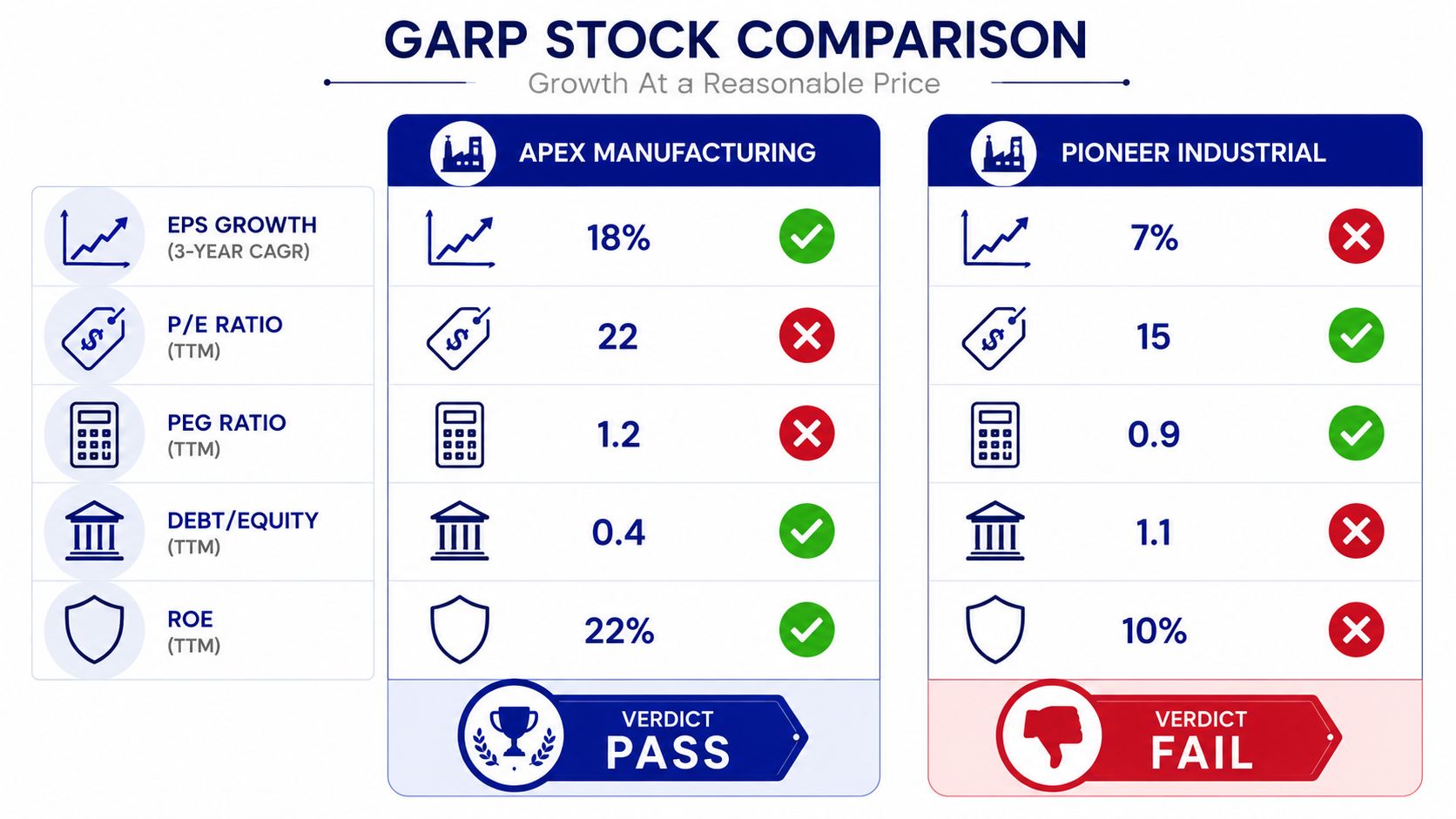
Apex has stronger growth, cleaner operations, and a better earnings yield profile. It clears the growth hurdle, the quality hurdle, and the valuation hurdle, so the screen calls it a fit. Pioneer, by contrast, still looks respectable on growth and quality, but it screens expensive on earnings-to-price, which is exactly the kind of borderline case a rules-based process should flag instead of automatically approving.
How the verdict changes
That distinction matters because GARP isn't supposed to reward every decent business. It's supposed to identify businesses where the market hasn't overcharged for the growth and quality already visible in the fundamentals. When valuation slips too far, the strategy should stop there rather than keep approving the company just because the business looks good.
| Stock | Growth Check | Quality Check | Valuation Check | Screen Verdict |
|---|---|---|---|---|
| Apex Manufacturing | Pass | Pass | Pass | Fits |
| Pioneer Industrial | Pass | Pass | Borderline on price | Review, not automatic approval |
The logic is useful because it shows where discipline lives. A good screen doesn't need to be dramatic, it needs to be consistent. If the valuation rule says no, then the process should say no, or at least say “not yet.”
The same discipline is easier to maintain when the rules are explicit and repeatable, which is why many investors compare their checklist against a framework like classic value before deciding whether a name belongs in the middle ground. The contrast makes the tradeoff obvious.
<iframe width="100%" style="aspect-ratio: 16 / 9;" src="https://www.youtube.com/embed/i3X7MFUvm_w" frameborder="0" allow="autoplay; encrypted-media" allowfullscreen></iframe>
GARP vs Value vs Pure Growth
GARP sits in a narrow but useful lane between classic value and pure growth. That middle position is exactly why it attracts investors who want compounding without paying any price, and also why it often disappoints people who want the deepest discount or the fastest top-line expansion. The style is a compromise, and the compromise is the strategy.
The same stock looks different under each lens
A profitable mid-teens grower with a moderate multiple can look cheap enough for one investor and too expensive for another. Classic value likes the price but may dislike the growth quality. Deep value wants a bigger margin of safety and can reject the name outright if the multiple isn't distressed. High growth may love the expansion profile but still engage only if the growth rate is explosive enough to justify the premium.
GARP is the only one of the four that explicitly asks all three questions at once, is the business growing, is it healthy, and is the price still reasonable. That makes it less tolerant of low-quality balance sheets than value, and less tolerant of stretched multiples than growth.
| Style | What It Rewards | What It Rejects |
|---|---|---|
| Classic Value | Cheapness and mean reversion | Paying up for growth |
| Deep Value | Severe discount and large margin of safety | Moderate multiples, even on good businesses |
| GARP | Quality growth at a fair price | Weak quality or clearly rich valuation |
| High Growth | Rapid expansion and future optionality | Slower compounders with modest multiples |
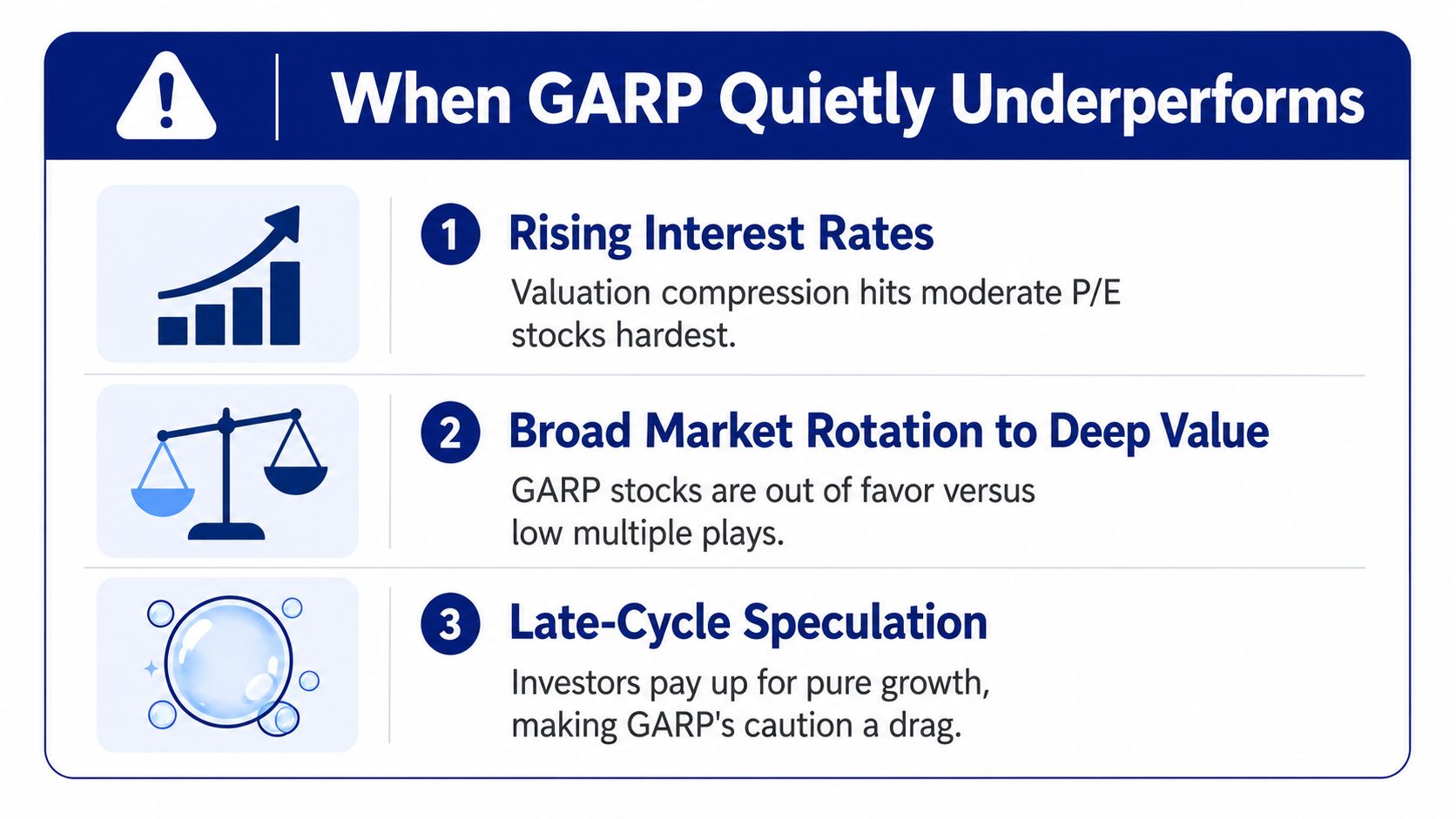
The useful takeaway is not that GARP is superior. It's that GARP is selective in a different way. If the market is rewarding unprofitable growth, GARP will look cautious. If the market is rewarding the cheapest stocks regardless of business quality, GARP will look expensive. Those are not flaws in the definition, they're signals that another style may fit the regime better.
GARP works best when the market still pays attention to both earnings quality and price discipline.
That's why investors should think in terms of style allocation, not style loyalty. A stock can be a good business and still be the wrong fit for a GARP process at that moment.
When GARP Quietly Lags
GARP tends to struggle when valuation compression overwhelms decent operating performance. Rising-rate environments are the obvious pressure point, because moderate-multiple names can lose support even when their fundamentals remain intact. In those periods, the market often cares less about “reasonable” growth and more about either the cheapest value or the most aggressive growth.
Where the edge fades
The style can also lag when expensive mega-cap quality compounders dominate returns. In that setup, investors pay up for the best balance sheets, the strongest moats, and the cleanest growth stories, which can leave GARP looking too cautious. The stock may be sound, but the market wants a different kind of certainty and is willing to pay for it.
A second problem is that GARP gets mixed up with factor-portfolio behavior. A stock-picker can apply the rules thoughtfully, but once the style becomes a portfolio sleeve, the aggregate exposure starts behaving like a constrained factor basket. That's a different game, because the sleeve can lag even if individual names still make sense on their own.
The honest conclusion is that GARP is not a permanent edge. It is a disciplined way to avoid obvious overpayment for growth, and that discipline helps in some regimes and hurts in others. When the market is rerating expensive quality or rotating hard into value, the right move may be to tighten thresholds, lighten exposure, or sit out rather than force the screen to produce ideas.
Practical rule: treat GARP as a portfolio constraint with explicit tolerance bands, not as a permanent buy list.
That framing is more realistic than pretending the strategy should work every quarter. It also protects you from calling a good screen “broken” when the market is rewarding a different factor.
Putting the Rules on Autopilot
The cleanest workflow is blunt. Define your growth, quality, and valuation thresholds, decide where you'll tolerate borderline names, and rescore the portfolio on a regular cadence instead of reacting to headlines. If the business changes, the verdict should change too.
A rules-based terminal can help if it stores the thesis and rechecks the facts without forcing you to rebuild the screen by hand. One option is Monsa's stock research tools, which can store a GARP template, score holdings against it, and refresh the verdict nightly using fundamentals, prices, and FX. That matters more than it sounds, because the main failure in GARP isn't usually the first screen, it's thesis drift after the stock is already in the book.
A disciplined checklist is enough for most investors:
- Define Growth Inputs: Decide whether EPS growth, sales-per-share growth, or both will carry the screen.
- Set Quality Floors: Use ROE and debt levels as hard constraints, not soft suggestions.
- Fix the Valuation Rule: Pick earnings-to-price, PEG, or both, then keep the rule stable.
- Assign Borderline Tolerance: Decide what gets reviewed versus what gets rejected.
- Recheck on Schedule: Re-score names after fresh fundamentals land, not when social media gets loud.
The advantage of automation is consistency. The rules stop changing with your mood, and the portfolio becomes easier to defend when a position no longer matches the written thesis.
If you want a cleaner way to run the GARP investing strategy as an actual process, not a loose habit, visit Monsa and see how a rules-based terminal can store your thresholds, rescore holdings, and surface when a name no longer fits. It's a practical way to keep growth, quality, and price tied to the same discipline instead of letting one metric dominate the decision.
Monsa is a portfolio-analysis tool, not a broker or investment adviser. Nothing here is investment advice.
// related reading
What Is Portfolio Turnover and Why It Matters
What is portfolio turnover? Learn the SEC formula, worked examples, costs, taxes and benchmarks to judge if trading fits your strategy.
Watchlist Management: A Step-by-Step Guide for Traders
Master watchlist management with actionable steps to create, score, and prioritize your stock list. Learn thesis alignment and alerts setup for better
Florida Unemployment Amount: What You Will Actually Receive
Learn how the Florida unemployment amount is calculated, the $275 weekly cap, duration rules, and how partial earnings change your payment in 2026.
7 / 100 founding seats claimed - $100/yr locked, then $190/yr
Monsa is a portfolio-analysis tool, not a broker or investment adviser. It never recommends what to buy or sell - it checks what you hold against rules you wrote. Nothing here is investment advice.